Emperor Tarot Card Meaning - 35 Interpretations!

Fourth in the procession of the Major Arcana, the Emperor sits where the dreamer’s journey first meets the solid wall of the real world. After the lush, flowering abundance of the Empress, the landscape changes abruptly. Gone are the wheat fields and the flowing streams of Venus. Here there is stone.
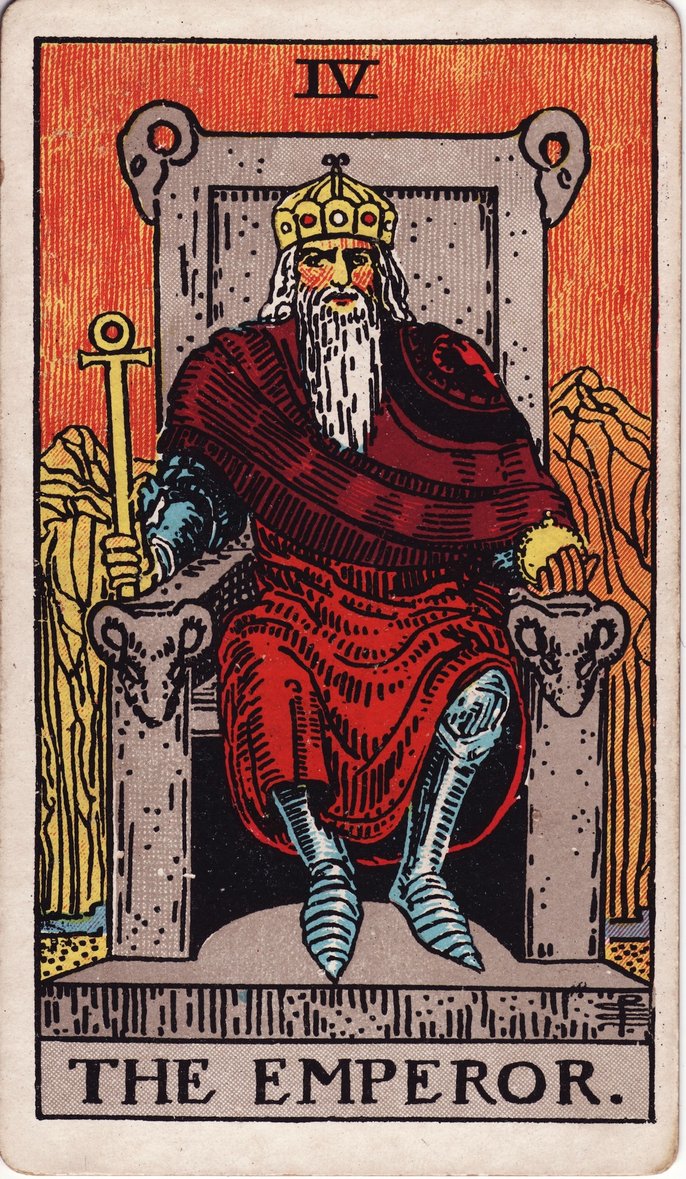
The Rider-Waite deck shows us a stern, bearded ruler seated on a massive throne of grey rock, carved at each corner with the head of a ram, the emblem of Aries, the sign this card belongs to. Mars, the planet of drive, courage, and assertion, rules Aries, and its fire burns quietly beneath every line of this image. The Emperor wears a suit of armor under his red robes. Even at rest, even enthroned in apparent peace, he is prepared. He has seen what happens to kingdoms that are not.
In his right hand he holds an ankh, the Egyptian cross of life, a reminder that his authority exists to protect and sustain the living, not to dominate them. In his left rests a golden orb, the world itself, held gently. Behind him rise barren, jagged mountains. Nothing grows there. Structure, on its own, does not bloom. Yet look closely at the base of the peaks and you will find a thin river winding through the rock. The Empress’s waters have not vanished. They have simply been channeled.
That is the whole secret of this card. The Emperor does not oppose life; he gives it banks to flow between, the way a river without banks is not a river at all, only a flood.
His number is four: the four seasons, the four directions, the four legs of a table, the four walls of a home. Four is the first number that can enclose space, and enclosed space is where civilization begins. Where the Magician wills things into being and the Empress grows them, the Emperor makes them last.
He is the archetype of the father, the builder, the lawgiver. Not the tyrant, though his shadow can become one. At his best he is the person whose presence makes everyone else feel safe enough to do their finest work, because someone competent is holding the perimeter.
The Emperor takes many forms in a reading. This guide covers them all.
What does The Emperor Tarot card mean?
Upright, the Emperor means structure, authority, and the confidence to lead. When he appears, the reading is telling you that the situation calls for order rather than inspiration, planning rather than improvising, and steady follow-through rather than bursts of enthusiasm.
This is a card of earned power. The Emperor did not inherit his throne in this story; he built it. Every rule he enforces is one he once learned the hard way. When this card lands in your reading, it often points to a moment when your own experience is finally sufficient. You know enough. You have been through enough. It is time to stop asking for permission and start making decisions.
The Emperor also speaks of protection. His armor is not paranoia, it is care made practical. He thinks about what could go wrong precisely so the people who depend on him never have to. If you have been carrying responsibility for others, a family, a team, a project, this card honors that weight and tells you that you are strong enough for it.
There is a stabilizing quality here that other cards of power lack. The Emperor is not interested in conquest for its own sake. He wants borders that hold, harvests that repeat, agreements that get honored. His ambition serves continuity.
Practically, the card favors anything that involves systems: setting a budget, writing a plan, defining roles, putting a boundary into words, formalizing something that has been vague. What you organize now will support you for years.
One caution comes built into the image. Those mountains behind the throne are bare. Order pursued for its own sake becomes sterile. The Emperor works best when he remembers the Empress, when structure serves life rather than replacing it.
The Emperor card Keywords:
- Authority
- Structure
- Stability
- Leadership
- Discipline
- Protection
- Fatherhood
- Strategy
- Order
- Foundations
- Responsibility
- Self-control
- Ambition
- Endurance
What does The Emperor Tarot Card Mean when Reversed?
Reversed, the Emperor shows power out of balance, and the imbalance can tip in either direction.
Tipped one way, the reversal is an excess: control that has hardened into domination. Rules multiply until no one can breathe. Flexibility is treated as weakness, other opinions as threats. The armor never comes off, not even with the people he loves, and the throne room grows very quiet because nobody dares to speak freely in it anymore. If this describes someone in your life, the card is naming the dynamic plainly. If it describes you, it is doing you the favor of saying so before the people around you stop trying.
Tipped the other way, the reversal is an absence. Authority abandoned. The throne is empty. Decisions that are yours to make sit unmade, structure that would help everyone never gets built, and chaos fills the space that leadership left vacant. This side of the reversed Emperor often shows up as a person who is capable of far more responsibility than they are currently willing to accept, usually because stepping up feels risky, or because an earlier authority figure made power look ugly and they swore never to resemble them.
Both failures share one root: a broken relationship with the idea of authority itself. The tyrant believes control is the only safety. The abdicator believes control is inherently corrupt. The healthy Emperor knows that authority is simply responsibility with the power to act, nothing more and nothing less.
The reversed card may also point to struggles with a father, a boss, an institution, or any structure that is pressing on you unfairly. In those readings it asks a sober question: do you fight the structure, reform it, or build your own?
Either way, the medicine is the same. Come back to legitimate authority, the kind that listens, protects, and serves something larger than its own comfort.
The Emperor card Reversed Keywords:
- Domination
- Rigidity
- Control issues
- Stubbornness
- Tyranny
- Abdication
- Avoided responsibility
- Weak boundaries
- Micromanagement
- Insecurity
- Coldness
- Power struggles
The Emperor Tarot Card as How Someone (He/She) Sees You
When you ask the cards how another person sees you and the Emperor answers, they see you as solid. Dependable. The one who has it handled.
This person looks at you and perceives competence before anything else. You are the friend who shows up with a plan, the colleague whose work does not need checking, the partner who makes the household feel secure. Whether or not you feel that way inside is irrelevant to the question; the card describes the view from where they stand, and from where they stand you look like a fortress.
There is real admiration in this perception. People do not hand the Emperor’s image to someone lightly. They may come to you for advice, lean on you in a crisis, or quietly measure their own decisions against what they imagine you would do.
But notice what a fortress invites and what it discourages. They see strength, so they may not think to offer you comfort. They see certainty, so they may hesitate to show you their own mess. Some people who are seen as the Emperor go years without anyone asking whether they are okay, simply because it never occurs to anyone that they might not be.
If you want to be known more fully than this, you will have to open the gate yourself. Show a little of the unfinished, uncertain person behind the armor. The right people will not respect you less for it. Most will finally relax around you.
The Emperor Reversed as How Someone (He/She) Sees You
Reversed in this position, the perception has soured or shrunk, and it lands in one of two ways.
The first: they see you as controlling. Bossy, inflexible, always right, exhausting to disagree with. Perhaps this is unfair, a projection of their own history with authority onto you. Perhaps it is feedback worth hearing. A useful test is to recall your last few disagreements with this person. Did any of them end with you changing your mind? If the honest answer is never, the card may have a point.
The second: they see you as weaker than your role. Someone who holds a position of responsibility, at work, in the family, in the relationship, but does not truly occupy it. Promises drift, decisions wobble, and they have quietly begun making their own arrangements rather than relying on yours.
Neither picture is pleasant, and neither is permanent. Perceptions of authority change faster than most, because authority is demonstrated in every small interaction. Keep three commitments in a row and the abdicator’s image starts to fade. Genuinely yield one argument you could have won and the tyrant’s image begins to soften.
Do not perform the correction. People smell a performance of humility or firmness instantly. Just do the thing, repeatedly, and let the record speak.
What does The Emperor Tarot Card mean in Love?
The Emperor in a love reading is stability wearing armor, and how welcome that is depends on what your heart currently needs.
In an established relationship, this card is largely good news. It speaks of commitment that behaves like commitment: bills handled, promises kept, a partner who shows up on the bad days and not just the fun ones. Emperor love is not always verbally lavish. It says “I filled your car with gas” more often than it writes poetry. If you learn to read that dialect, you will find real devotion in it.
The card often describes one partner, frequently but not always the man in the pairing, who carries the protective and providing role. Handled well, this creates a relationship that feels like solid ground. The thing to watch is that protection stays a gift and never becomes a cage. A partner who manages everything can drift into managing you, usually with the best intentions, and intentions do not make it healthier.
For those seeking love, the Emperor points toward a partner who is established, serious, and probably older in years or in spirit. This is not the whirlwind romance card. Courtship under the Emperor moves deliberately: plans made and kept, intentions stated plainly, a slow building of trust. If you have been burned by charming and unreliable people, this energy can feel like coming in from a storm.
The card can also be advice rather than description: bring more structure to your love life. Decide what you actually want. State it. Stop treating your standards as negotiable. Romance does not die from clarity; it dies from chronic ambiguity.
If you are trying to see where the relationship’s foundations are strong and where they are cracking, a good relationship tarot spread will map that terrain far better than a single card can.
What does the Emperor Reversed mean in Love?
Reversed in love, the Emperor describes a relationship where power has stopped being shared.
The most common picture is control. One partner decides where the money goes, whose friends matter, which feelings are reasonable and which are dramatic. It rarely starts that way. It usually starts as competence, one person naturally better at logistics, and calcifies year by year into a household with a ruler and a subject. If you have to prepare a case before raising a preference in your own relationship, the card is describing your home.
The reversal can also show emotional armor that never comes off. A partner who provides everything except access to himself. You know his schedule, his opinions, his plans, and after all these years you still do not really know his fears. Living beside someone like that is lonelier than living alone, because the loneliness comes with witnesses.
Flipped the other way, the reversed Emperor is the partner who will not step into the role at all. Charming, affectionate, and allergic to responsibility. Every practical burden lands on you, and any request that he carry his share is treated as nagging.
For single readers, this card is a flare warning you about a pattern: choosing partners who feel powerful and discovering they are controlling, or choosing partners who feel easygoing and discovering they are passengers. Both are the same lesson wearing different coats. Look for someone who can hold power lightly.
None of these situations is hopeless, but every one of them requires the thing the reversed Emperor resists most: an honest conversation where both people put their armor on the floor.
What does The Emperor Tarot Card mean in Friendship?
In friendship, the Emperor is the reliable one, and this card asks you to notice how rare that actually is.
Most friendships run on affection and proximity. Emperor friendships run on demonstrated loyalty. This is the friend who answers the phone at 2 a.m., who shows up with a truck when you move, who remembers what you said in March and asks about it in June. He may not be the most emotionally fluent person in your circle. His love language is logistics.
If you are asking about a specific friend, the card affirms them: this person is a keeper, a load-bearing wall in your life. Their advice tends toward the practical, sometimes bluntly so. When they tell you a plan is bad, they are not raining on your dream; they are checking your foundations, because that is how they care.
If the card describes you in the friendship, it acknowledges that you are the organizer, the reliable center, the one who books the table and remembers the birthdays. That role is genuinely valuable and quietly tiring. Notice whether the reliability flows both directions. The Emperor’s failure mode in friendship is becoming so useful that people forget you also need things.
The card can also be advice for a friend group: bring some structure to the connection. Standing dinners, annual trips, the small institutions of friendship. Warmth is the reason friendships form; structure is often the reason they survive busy decades.
What does the Emperor Reversed mean in Friendship?
Reversed in a friendship reading, the Emperor points to a hierarchy problem between equals, and friendship dies without equality.
The classic form is the friend who has appointed himself in charge. He picks the restaurant, sets the schedule, delivers verdicts on everyone’s relationships and careers, and takes disagreement as a personal affront. What he calls honesty is often just dominance with good posture. Around such a friend you slowly stop offering your real opinions, and a friendship where you cannot speak freely is already half gone.
The reversal can also describe a friendship where support runs one way. You are their advisor, lender, planner, and crisis line, and when your own storm arrives the phone stays quiet. The card does not tell you to end such a friendship, but it does tell you to stop pretending the imbalance is not there.
Sometimes the reversed Emperor is you, and this is worth sitting with honestly. Have you been steamrolling your friends’ preferences? Correcting them in front of others? Treating your competence as a license to run their lives? Strong personalities drift into this without noticing, and friends rarely say it out loud. They just become gradually less available.
The repair, in every version, is the same small revolution: one honest conversation where the quiet party speaks and the dominant party only listens. Friendships that survive that conversation come out stronger than they were before.
What does The Emperor Tarot Card mean in Career?
The Emperor is one of the strongest career cards in the deck. This is his native territory: hierarchy, strategy, budgets, buildings, org charts, the whole architecture of working life.
At its simplest, the card points to advancement. A promotion, a leadership role, the moment your name starts being said in rooms you are not in. If you have been steadily doing excellent work and wondering whether anyone notices, the Emperor suggests the structure is about to answer.
More broadly, this card favors the disciplined path over the flashy one. In career questions it consistently blesses the same behaviors: plan long, document well, master the fundamentals, keep your commitments, and treat deadlines like promises. None of this is glamorous. All of it compounds. The Emperor’s empire was built by decades of unglamorous compounding.
For entrepreneurs and the self-employed, the message shifts slightly: it is time to become an institution rather than a hustle. Systems, contracts, real bookkeeping, prices you defend without apology. The creative fire that started your venture is Empress energy; the Emperor is what makes it survive year five.
In money matters, the card is deeply conservative in the old sense of the word. It favors saving over speculating, assets over toys, the boring fund over the thrilling gamble. Emperor wealth is a fortress built one stone at a time, and it holds precisely because no single storm can take it.
If the card comes with friction, it usually concerns authority: a difficult boss, a rigid institution, a battle over who decides. Play those situations with Emperor patience. Document, deliver, and outlast.
What does the Emperor Reversed mean in Career?
Reversed in a career reading, the Emperor usually means the structure around you is unhealthy, or your relationship to authority is costing you.
The most common picture is the bad king: a boss who micromanages, takes credit, punishes honesty, or rules by mood. Under such a ruler, talented people spend their energy managing upward instead of doing their work. If this is your situation, the card offers cold comfort and practical counsel: you will not fix a tyrant by being more excellent. Protect your reputation, keep records, build allies, and quietly prepare your exit toward a healthier kingdom.
The reversal can also point at institutional rigidity rather than a person. Process for its own sake, innovation smothered by approval chains, a company still fighting the last decade’s war. If your best ideas keep dying in committee, the card confirms it is the structure, not you.
And sometimes, honestly, the reversed Emperor is a mirror. Are you the manager whose team has gone quiet? Are you hoarding decisions, rewriting everyone’s work, mistaking control for standards? Or the opposite: have you been avoiding the promotion, the leadership, the ownership that is plainly yours to take, because responsibility feels heavy? Both are reversals. Both are correctable.
In money matters, the reversed card warns against two extremes: recklessness with what you have built, or a rigidity so total that you cannot adapt when circumstances change. Review the plan. Then be willing to amend it.
The Emperor Tarot Card as How Someone Thinks of You
When the question is what someone privately thinks of you and the Emperor appears, their inner verdict is respect.
Thoughts are not feelings, and this distinction matters with this card. The person may or may not have warm emotions toward you, but their assessment of you is high. They think of you as capable, serious, and consequential. When they imagine asking a hard question, yours is one of the opinions they consult in their head. That is a form of standing that flattery never buys.
In romantic contexts, this often means they think of you as the real thing. Not a fling, not a maybe: the kind of person one builds with. They may actually be intimidated, running quiet calculations about whether they measure up to the life you appear to have organized. If someone promising has been oddly slow to approach you, this card offers a plausible reason.
In professional contexts, they think of you as authority, whether or not your title agrees. You are the standard they check their work against, the name they would suggest for the hard job.
The one shadow in this otherwise excellent card: they may think of you as more finished than you are, a settled fact rather than a person still growing and occasionally struggling. Being respected from a distance is nourishing but incomplete. If you want closeness from this person and not just esteem, you will need to show them something unfinished.
The Emperor Reversed as How Someone Thinks of You
Reversed, the card says their private assessment has a critical edge, and it circles the theme of power.
They may think you are too much: domineering, inflexible, addicted to being right. In their mental theater you play the character who talks over people, who cannot be told anything, who must be managed rather than simply talked to. You might find this wildly unjust. Note, though, that people usually earn this reputation not through great sins but through an accumulation of small overrides, corrected sentences, seized decisions, unrequested advice.
Or they may think you are not enough: someone whose confidence outruns their follow-through, who holds a role they do not fill. If you have made promises to this person that quietly evaporated, this is likely the residue.
There is a third possibility worth naming. Some people are simply at war with authority itself, and they will cast anyone competent as a tyrant regardless of conduct. If you review your behavior honestly and find no crime, the reversal may live in their history, not your character. You cannot fix that for them.
What you can control is the record going forward. Opinions formed by patterns are changed by patterns. Be consultable rather than commanding, or reliable rather than impressive, whichever correction applies, and give it time.
What does The Emperor mean in Conflict?
In a conflict reading, the Emperor counsels the discipline of the long game. This card does not fight hot. It fortifies, prepares, and wins slowly.
If you are in an active dispute, the Emperor’s first instruction is to get off the emotional battlefield. Whoever loses their temper first usually loses more than that. Move the fight onto structured ground: facts, records, agreements, timelines. Write things down. Confirm conversations in writing. Bring the receipts, not the grievances. The Emperor wins arguments the way engineers win, by having built better foundations before the storm arrived.
The card also asks a strategic question most angry people skip: what does victory actually look like? The Emperor never fights for the satisfaction of being right; that is a peasant’s prize. He fights for outcomes, terms, borders, arrangements that will still matter in a year. Define your outcome precisely and you will find that many battles along the way can be conceded for free.
If the conflict is with an authority, a boss, an institution, a bureaucracy, the Emperor advises fighting through legitimate channels rather than open revolt. Appeal, document, escalate properly. Structures respect those who understand structures.
One more thing, and it is quietly the most important: the Emperor protects. If this conflict involves someone weaker who is depending on you, your child, your team, your elderly parent, then steadiness is not just strategy, it is duty. Be the person in the room whose calm makes everyone else braver.
What does the Emperor Reversed mean in Conflict?
Reversed in conflict, the card warns that power itself has become the problem, and the fight is no longer really about its subject.
One version: you are up against someone who cannot lose. Not will not, cannot. For this person the dispute has fused with their identity, and every concession feels like annihilation. You cannot reason such a person into yielding, because you are not arguing with their position, you are arguing with their self-image. The card’s counsel is to stop trying to win the argument and start limiting the damage: reduce your exposure, involve neutral third parties, and put everything that matters in writing.
Another version: the fight has entrenched into siege warfare. Both sides dug in, communication reduced to cold formalities, the original issue barely remembered beneath the fortifications built since. The reversed Emperor says plainly that walls are now the problem. Somebody has to be strong enough to walk out from behind theirs first, and the card suggests it may as well be you, since you are the one holding it.
And there is the version where the reversal points home: your own need for control is escalating things. If every discussion must end with your terms accepted in full, you are not resolving conflicts, you are collecting surrenders, and surrenders breed the next war.
A useful rule for any reversed Emperor conflict: prefer the fair settlement today over the total victory someday. Empires fall chasing total victories.
The Emperor Tarot Card as Feelings
As a feelings card, the Emperor describes emotion that runs deep and shows little, and reading it correctly requires respecting that style rather than resenting it.
If you are asking how someone feels about you, the Emperor says: serious. This person does not do casual attachment, and the fact that this card appeared means you are not casual to them. They feel protective of you, invested in you, and quietly proud of you. What they likely do not feel is comfortable saying any of this out loud. Emperor feelings are expressed in behavior: the problem solved before you mentioned it, the reliability that never lapses, the way they always know where you are in a crowded room. Count those, not the speeches.
There is often a note of restraint in this card, and it is worth understanding gently. People who feel like the Emperor frequently learned early that their feelings were a burden or a weakness, so they process everything behind the wall and present you with conclusions. It is not coldness. It is armor that was fitted a long time ago, usually by someone else.
If the card describes your own feelings, it may be telling you that you feel steady about the matter, calm, decided, built on rock. Or it may be asking whether you have organized your feelings so thoroughly that you have stopped actually feeling them. Composure is a virtue right up until it becomes a sealed room.
Feelings under this card are trustworthy. Slow, undemonstrative, and trustworthy.
The Emperor Reversed as Feelings
Reversed as feelings, the Emperor describes emotion that has gone wrong in its relationship with control.
Asking about another person, the most common meaning is feelings locked down so hard that even their owner has lost access to them. This person may genuinely care for you and be entirely unable to act on it. Every impulse toward openness gets reviewed, revised, and shelved by an inner security council. What reaches you is bureaucracy: correctness without warmth, presence without contact. Waiting for such a person to spontaneously open is usually a long wait.
Alternatively the reversal can mean possessive feelings, care that has curdled into ownership. They feel anxious when you are out of reach, resentful of your independence, entitled to explanations. This can look flattering at first, being wanted that intensely, but wanting to hold and wanting to control are different feelings wearing the same face. The card asks you to check which one you are dealing with.
If the card describes your own emotional state, it often catches you in one of two spots: white-knuckling composure over something that actually needs to be felt and expressed, or feeling everything through a filter of frustration because events refuse to obey you. Grief, especially, does not take orders. Neither does love.
The healing direction is the same in every case: loosen the grip slightly. Feelings are like the river at the base of the Emperor’s mountains. Channeled, they nourish. Dammed completely, they either dry up or burst.
The Emperor Tarot Card as a Situation
As a situation, the Emperor describes a moment governed by structure, and your fortunes in it depend on how you relate to that structure.
Often the card marks a situation where rules, institutions, and formal authority are the main characters: a contract negotiation, a mortgage application, a legal process, a reorganization at work, dealings with government, a family matter that has acquired official dimensions. Feelings will not move this situation. Paperwork will. The person who arrives organized, documented, and patient holds the advantage, so be that person.
Alternatively, the card can describe a situation that has stabilized. After a period of flux, things have settled into a defined shape: the new job is now just the job, the new arrangement is now the arrangement. Stability of this kind is a genuine gift with a quiet cost. What has solidified is harder to change. If the shape that things have taken is good, reinforce it now while it is still fresh. If something about it is wrong, object now, before the concrete fully cures.
Sometimes the Emperor as a situation simply means: an authority figure currently holds the outcome. A boss, an official, a landlord, a judge, a parent. Your task is not to wrest control from them, which you cannot, but to present your case in the language structures understand: clearly, correctly, and through the proper door.
Whatever the specifics, the situation rewards the Emperor’s virtues, preparation, patience, and follow-through, and punishes improvisation. Plan accordingly.
The Emperor Reversed as a Situation
Reversed as a situation, the card describes a structure that is failing, and the failure runs in one of two directions.
Direction one: too much structure. You are inside a system that has become rigid, oppressive, or absurd. Rules that no longer serve their purpose are enforced anyway. Authority is arbitrary, procedure has replaced sense, and the humans inside the machine are treated as its least important parts. Workplaces do this. Families do it too, and so do institutions of every kind. The card validates the frustration you have been trying to talk yourself out of: no, it is not just you, the structure really is the problem.
Direction two: no structure at all. The situation is chaotic because nobody is actually in charge. Responsibilities are undefined, decisions bounce endlessly, everyone assumes someone else is steering. A household, a project, an estate, a group trip, anything can fall into this state, and it generates a surprising amount of conflict, because in a vacuum of legitimate authority, small illegitimate authorities sprout everywhere.
Your move depends on the direction. In the rigid version, your options are reform, appeal, or exit, and the card gently suggests you assess honestly how reformable this structure is before spending years on it. In the chaotic version, the opportunity is real: someone competent stepping up with a plan will meet less resistance than you fear. Most people are relieved when order arrives, provided it arrives with fairness attached.
Either way, the situation will not fix itself. Broken structures never do.
The Emperor Tarot Card as Intentions / What Someone Wants
When the Emperor appears as someone’s intentions, the answer has unusual clarity: this person wants to build, and they want to build with you in the picture.
In romantic questions, this is one of the most serious intention cards in the deck. It does not mean flirtation, curiosity, or seeing where things go. It means the person is thinking in structures: commitment, exclusivity, cohabitation, marriage, the long arc. They may not have said any of this yet, Emperor types announce intentions through actions and rarely before they are certain, but the internal decision is either made or very close. Watch for the tells: they introduce you to the people who matter, they plan months ahead with you in the plans, they start solving your problems as if your problems were theirs.
The card also carries a protective intention. This person wants to be your safety, the one who handles it, whatever it turns out to be. Received well, this is a profound form of devotion. The only thing worth watching is whether their picture of the future has room for your authorship too, or whether you appear in it as a beloved but fully designed feature.
In work and business questions, the Emperor’s intention is order and legacy. They want the venture on solid footing, the roles defined, the agreement formalized. If you are waiting to find out whether they are serious, they are. Bring your terms, because they will certainly bring theirs.
In any context, one sentence summarizes it: they intend something permanent.
The Emperor Reversed as Intentions / What Someone Wants
Reversed as intentions, the card warns that what this person wants involves control, and you should look at the fine print before signing anything, literal or emotional.
The primary meaning: they want to run it. The relationship, the deal, the project, the family decision, whatever the subject of your question is, their vision of success is one where they hold the wheel and you hold the map they drew. This does not necessarily make them villainous. Many controlling intentions are sincere, even loving, in the mind that holds them: they truly believe things go best when they decide. But sincerity does not make the arrangement good for you, and the card exists to make you notice the arrangement.
A second meaning: they want the throne without the weight of the crown. Status without responsibility, the title without the duties, your commitment without offering their own. If someone is asking for guarantees they refuse to reciprocate, the reversed Emperor is naming that asymmetry.
A third, softer reading: they do not know what they want, because wanting requires deciding and deciding is the thing they avoid. Their intentions shift with whoever spoke to them last. You cannot build on this ground, however pleasant the company.
None of these readings says run. All of them say negotiate with your eyes open. Ask direct questions about roles, expectations, and decision-making, and weigh the answers less than the reaction to being asked. A healthy person welcomes that conversation. A controlling one is offended by it. The offense is your answer.
Is The Emperor a Yes or a No?
The Emperor is a yes, provided you are willing to work like one.
This card says yes the way a good banker says yes: on terms. The outcome you are asking about is achievable, the foundations are there or can be built, and the authority to make it happen is available to you. What the Emperor will not promise is a yes that arrives by luck. His yes is conditional on planning, discipline, and follow-through. Bring those, and the answer is solidly affirmative. Hope to skip them, and you are reading the wrong card.
The Emperor’s yes is especially strong for questions about career, business, property, finances, long-term commitment, and anything involving institutions or authority. These are his lands, and he is generous in them.
For questions of pure passion and spontaneity, will the whirlwind romance ignite, will the wild gamble pay, his yes cools somewhat. He can bless those things, but his nature bends toward the enduring rather than the thrilling, and his answer quietly redirects you toward the version of your wish that lasts.
Reversed, the Emperor leans no, and the no usually has one of two flavors: not while control issues are running the show, or not until someone actually takes responsibility for making it happen. A reversed Emperor no is rarely permanent. Fix the structural problem it points to and ask again.
If a single yes or no feels too thin for what you are carrying, one of the best tarot spreads for guidance will let the question breathe properly.
The Emperor Tarot Card as a Place
As a place, the Emperor points to environments of order, authority, and stone.
Literally, the card suits official and institutional spaces: government buildings, courthouses, banks, corporate headquarters, military facilities, universities with old walls and older rules. Places with security desks and protocols, where you state your business and someone decides whether you pass. If your question concerns where something will happen, expect it to happen somewhere formal.
The card also loves built landscapes of permanence: fortresses and castles, obviously, but also any city center of granite and steel, any structure raised to outlast its makers. And it holds the high, bare country shown behind the throne: mountains, rock, commanding views, terrain that is magnificent without being soft. If the Star’s place is a quiet pool under the night sky, the Emperor’s is a summit at noon, with the whole ordered world visible below.
Domestically, the Emperor is a house rather than a wanderer’s room. Specifically, it is the well-run house: the mortgage on schedule, the tools hung in their places, the pantry stocked against winter. Possibly a father’s house, or the family seat where the patriarch presides. For questions about moving or settling, the card favors ownership over renting, permanence over flexibility, the solid neighborhood over the exciting one.
As advice about place, it is simple: put yourself somewhere structured. Some seasons of life are for drifting. The Emperor says this is not one of them; claim ground and hold it.
The Emperor Reversed as a Place
Reversed as a place, the card describes territory where authority has failed, in one of its two familiar ways.
The oppressive version: a place ruled too hard. The office where everyone watches their words, the home where one person’s moods are the weather, the institution where rules exist to demonstrate power rather than to serve people. Such places have a recognizable atmosphere, a quietness that is not peace. People in them speak in low voices and relax visibly when a certain door closes. If you have been feeling inexplicably drained by a location, the card suggests the drain is structural: the place itself is organized around someone’s control.
The abandoned version: a place where stewardship stopped. The property nobody maintains, the department nobody manages, the grand building gone to dust and litigation, the family home decaying because no one will either claim it or release it. These places have their own melancholy. They are monuments to responsibility that was dropped and never picked up.
In practical questions, relocation, workplace choices, where to hold the difficult meeting, the reversed Emperor is a caution flag over the location in question. Look past the surface at how the place is actually governed. Who decides things here? Is that decision-making sane, fair, and functional? A beautiful apartment under an unhinged landlord is a bad apartment.
And if the neglected place is yours, the card is a work order. Fix the gate, claim the room, resume the stewardship. Places, like people, respond quickly to being cared for again.
The Emperor Tarot Card as an Obstacle / Challenge
When the Emperor himself stands in the crossing position, the obstacle is structure, and it is blocking you in one of three ways.
First, and most literally: an authority is in your way. A boss who will not approve it, a regulation that will not bend, a gatekeeper, a committee, a father, a system. The frustrating part of this obstacle is its impersonality; you can be entirely right and still denied, because structures do not run on rightness, they run on rules. The card counsels you to fight structure with structure: learn the rules better than their enforcers, find the legitimate exceptions, file the appeal, or locate the door you have not tried. Raging at the wall is the one strategy guaranteed to fail.
Second: the obstacle may be order itself, the very stability you built. The career that pays too well to leave, the routines that hold your days together so firmly that nothing new can enter. Foundations are wonderful servants and quiet jailers. If your life is secure and airless, the Emperor as obstacle names the trade you have been making.
Third, and hardest to see: the obstacle may be your own inner Emperor. The need to control outcomes can strangle the thing it means to protect. Plans so complete they leave no room for luck, standards so high nothing survives them, a grip so firm the reins snap. If every venture must be guaranteed before you begin it, you will begin very little.
Identify which wall is yours. Each one has a different gate.
The Emperor Reversed as an Obstacle / Challenge
Reversed as an obstacle, the card points to disordered power as the thing between you and your goal.
Often this is a specific person: a tyrant in the path. The manager who buries your work, the official who enjoys saying no, the family member who must approve everything and approves nothing, the ex who uses process as a weapon. Dealing with disordered authority is a specific skill, and the card offers its rules: never rely on their goodwill, never meet provocation with heat, keep records of everything, and route around them wherever a route exists. You are not obligated to redeem this person. You are only obligated to get past them.
Just as often, the obstacle is an absence: nobody will decide. Your project waits on an approval no one feels empowered to give. Your family drama continues because no one will lead the resolution. Progress requires an act of authority, and the throne is empty. Here the card turns to you with a raised eyebrow, because the person who names the vacuum is usually the person best positioned to fill it. The obstacle may persist only until you accept that it is yours to remove.
And sometimes the reversed Emperor blocking your path is internal: your own unresolved history with authority. If you reflexively defy every structure, sabotage every stable arrangement, or shrink before anyone with a title, then the obstacle travels with you and will be waiting at the next gate too. That one is worth clearing properly. It pays for itself for the rest of your life.
The Emperor Tarot Card as Action
As an action card, the Emperor is unambiguous: take command.
Stop waiting for permission, consensus, or perfect conditions. The situation you asked about needs a decision-maker, and the card has appointed you. Today, not eventually, do the following: decide what outcome you want, write down the steps between here and there, put dates on the steps, and execute the first one before the day ends. That is the entire Emperor method. Its power is not in its sophistication but in how few people actually do it.
The card also commands structure-building. Whatever in your life is currently informal and load-bearing, make it formal. Turn the understanding into an agreement. Turn the habit into a schedule. Turn the shoebox of receipts into a ledger, the someday into a plan, the vague boundary into a stated one. Every structure you build releases attention you were spending on holding things together by hand.
Where other people are involved, the Emperor’s action is to lead, and to lead in his particular style: calmly, visibly, and by carrying the heaviest part yourself. Announce the plan. Assign the parts, including your own. Absorb the friction that decision-makers absorb, without theatrics, because that absorption is the actual job.
One instruction hides in the card’s armor: prepare for opposition rather than resenting it. Someone will push back on your new order; someone always does. The Emperor does not take this personally. He answers questions, adjusts what deserves adjusting, and proceeds.
Act like the ruler of your own affairs. Not the tyrant of them, the ruler. There is a difference, and everyone can feel it.
The Emperor Reversed as Action
Reversed as action, the Emperor tells you to correct your relationship with control, and the correction you need is the one that feels least natural.
If you have been gripping too hard, the action is to release, deliberately and concretely. Delegate one real responsibility without hovering over it. Let a decision that is not yours be made without your input. End one argument by saying “you may be right” and meaning it enough to stop. Take the hands off the reins for one defined area and watch what happens. Usually what happens is nothing terrible, and that lesson, learned in the body rather than the mind, is worth more than any resolution to be less controlling.
If you have been gripping too little, the action is to claim, equally concretely. Pick the one responsibility you have been orbiting and land on it. Have the conversation you have been delegating to time. Make the decision that has been making itself badly in your absence. You do not need to feel ready; Emperors rarely do at first. Authority is like a language, learned only by speaking it badly in front of others until you speak it well.
In dealings with a reversed Emperor other than yourself, a controlling boss, a domineering partner, a rigid parent, the action is neither submission nor war but boundary: state plainly what you will and will not accept, in specific terms, and then hold the line without drama. Controlling people probe boundaries the way water probes a foundation. Calm consistency is the only mortar that holds.
Whichever correction is yours, start it this week. The reversed Emperor’s problems are the kind that grow while you deliberate.
The Emperor Tarot Card as Advice
As advice, the Emperor tells you to bring order to the chaos, starting with your own.
Before it says anything about the outside world, this card looks at your inner state and prescribes discipline as a kindness. Sleep at regular hours. Put your money where you can see it. Finish what is half-finished or formally abandon it. The scattered mind cannot rule anything, and most of the anxiety you are carrying is not fear of the future, it is the hum of unmade decisions and unkept systems. Order is not the opposite of freedom. Practiced rightly, order is what freedom stands on.
For the matter you asked about, the advice runs: think long, decide firmly, communicate clearly. Ask what you want the situation to look like in five years, not five days, and let the long view discipline the short one. When you have decided, say so plainly, in complete sentences, without a question mark at the end. Half the world’s confusion is people announcing decisions as suggestions and then resenting that no one follows them.
The card also advises you to accept the authority that is legitimately yours. Somewhere in your life you have been elected and are refusing to serve, at work, in the family, in your own affairs. The Emperor says: serve. Not because power is pleasant, but because the alternative to good authority is never no authority. It is bad authority, or chaos, and the people you love live in whichever one you permit.
Last, the armor note. Wear it into battle; take it off at home. Advice from the Emperor is incomplete without that second half.
The Emperor Reversed as Advice
Reversed as advice, the Emperor warns you about power, either the kind being used on you or the kind you are misusing.
If someone in your situation is ruling badly, a controller, an intimidator, a chronic override of your choices, the advice is to stop negotiating for their approval. You have likely been trying to earn fair treatment through excellence, patience, or accommodation. That works with fair rulers and never with unfair ones; to an unfair ruler, your accommodation is simply confirmation that the arrangement works. Withdraw from the game instead. Decide your terms, state them once without heat, and enforce them with your feet if necessary. This is not aggression. It is the orderly exercise of the one authority no one can take, authority over your own participation.
If the misused power is yours, and be honest here, because this card in this position often means exactly that, the advice is to loosen before something breaks. Rigidity feels like strength from the inside; from the outside it looks like fear, and structurally it behaves like fear too. The oak that cannot bend meets the storm as firewood. Ask the people closest to you one dangerous question: “Where am I hardest to deal with?” Then survive the answer without defending yourself, and change one thing.
And if the reversal shows abdication, if the advice-seeker’s real problem is a throne they keep declining, then the counsel inverts: stop hiding from your own competence. The discomfort of responsibility is temporary. The cost of watching your life be run by whoever bothered to grab the wheel is not.
The Emperor Tarot Card as an Outcome
As an outcome, the Emperor promises that your efforts consolidate into something solid.
This is one of the most reassuring outcome cards for any question about building: the business establishes itself, the career reaches real standing, the family stabilizes, the property is secured, the long uncertainty resolves into settled ground. Whatever has been provisional about your situation becomes official. Whatever has been fragile acquires foundations. The Emperor as outcome is the moment the scaffolding comes down and the structure stands on its own.
Expect the victory to be quieter than you imagined. Emperor outcomes rarely arrive with fireworks; they arrive as a normal Tuesday on which you notice that the thing you fought for has simply become true, load-bearing, and slightly taken for granted. The money is orderly. The role is yours. The household runs. People have started treating your position as a fact of the landscape. This is what winning looks like in the Emperor’s world, and those who expect confetti sometimes fail to notice they have won.
In relationship questions, the outcome is commitment with structure: the defined partnership, the shared roof, the formalized bond. In conflict questions, it is resolution through proper channels, and generally in favor of whoever kept the better records and the cooler head.
The card attaches one clause to its promise, in fine print but binding: what you build, you must then govern. The outcome is not a resting place; it is a realm, and realms require maintenance. Accept that clause gladly. It is the price of everything durable.
The Emperor Reversed as an Outcome
Reversed as an outcome, the card warns that the current course ends in a structural failure, and it names the two shapes such failures take.
Shape one: the hollow crown. You get the position, the control, the formalized arrangement, and it costs more than it pays. The promotion that devours your health, the relationship secured by management rather than love, the victory in the family dispute that leaves you presiding over silence. Everything obeys and nothing warms. If the reading shows this outcome ahead, the correction is available now, at the level of means: how you are pursuing the goal is contaminating what the goal will be worth.
Shape two: the collapse of an order. The structure you are relying on does not hold, the deal unravels, the regime at work falls, the arrangement that organized your life loses its authority. Before you despair, look honestly at the structure in question, because the reversed Emperor mostly topples what deserved toppling: orders built on control rather than consent, on one person’s grip rather than shared foundations. If that describes the thing now cracking, this outcome is a severe mercy, clearing ground you would never have cleared voluntarily.
In either shape, the card leaves you with the same counsel: do not rebuild the old design in new materials. After a hollow crown, learn what the crown was for. After a collapse, found the next order on fairness, the only base that does not require constant enforcement. People defend willingly what treats them justly. That, and not the armor, was always the Emperor’s real security.
The Emperor Tarot Card in the Future
In the future position, the Emperor announces that a season of consolidation is coming, and it invites you to be ready to take charge of it.
Concretely, the card points toward approaching structure: a role of authority being offered, a commitment formalizing, a property or foundation being secured, an unsettled chapter of life finally acquiring walls and a roof. If the recent past has been fluid, improvised, or chaotic, the Emperor ahead is genuinely good news. Ground is coming. Things will hold their shape again, plans will stay made, and effort will finally accumulate instead of washing away.
The card may also foretell the arrival of an Emperor figure in your story: a mentor with real power, a serious partner, a boss who actually leads, possibly a father figure returning to relevance. Weigh this person when they appear. The upright card suggests their influence is protective and steadying, but even good structure should be examined before you move into it.
There is an implicit assignment in this future. Consolidation is not a spectator event; the season will hand you responsibility, and its gifts are collected only by those willing to govern what they are given. Between now and then, build the small disciplines the role will require. Futures like this one reward preparation with almost embarrassing generosity.
One gentle warning attached: when stability arrives, it will try to become permanent in every direction, including the few where you might not want it. Decide in advance what should stay flexible in your life, or the settling season will settle that too.
The Emperor Reversed in the Future
Reversed in the future position, the card forecasts a confrontation with power, and forewarned is well armed.
The most common form: an overreaching authority ahead. A controlling figure entering your professional or personal life, an institution tightening its grip, a structure you depend on beginning to rule rather than serve. The value of seeing this early is enormous, because early is when defenses are cheap. Strengthen your position now: savings, records, allies, options. People are only as controllable as their alternatives are few, and you have time to grow alternatives.
The second form: a test of your own authority coming. A moment when leadership will be needed, yours specifically, and the reversal warns that your current relationship with power is not yet ready for it. If you tend toward over-control, the coming test will punish rigidity; if you tend toward avoidance, it will punish absence. The card is not predicting failure. It is scheduling the exam and handing you the syllabus.
Third form, quieter: a structure in your life is due to wobble. An arrangement, an institution, a settled understanding that has been running on inertia will demand renegotiation. Do not spend these intervening weeks pretending otherwise; spend them deciding what you want the renegotiated version to look like, so you arrive at the table as an author and not just a signatory.
None of this future is fixed. Reversed cards ahead are the most negotiable kind, because they describe pressures, not verdicts. The pressure will come. Who it finds when it arrives is still being decided, by you, now.
The Emperor Tarot Card as a Person
As a person, the Emperor is the one everybody stands a little straighter around, often without noticing they are doing it.
Classically the card describes a mature man of authority: a father, a boss, a builder of things, someone with weathered judgment and a handshake that means something. But the archetype is not owned by men or by age. The Emperor is anyone whose word is a load-bearing structure, the person of any description who, having said a thing will happen, causes it to happen, on schedule, without reminders.
Their virtues are the quiet kind. They are punctual because your time is real to them. They are prepared because the people counting on them are real to them. They remember what they owe, they defend those under their protection at actual cost to themselves, and in a crisis their voice drops instead of rising. Emotional expression is not their fluent language; provision is. They will fix your car, review your lease, and stand between you and trouble, and they will do all of it while changing the subject if you try to thank them too warmly.
Their flaw grows from the same root as their strength. Certainty can harden into inflexibility, protection into gatekeeping, high standards into a chronic disappointment with a world that keeps failing inspection. And beneath the armor there is nearly always a private loneliness, because people who are never permitted to seem weak are rarely asked how they are.
Love such a person by trusting their actions and gently insisting on their humanity. They will resist the second part. Insist anyway.
The Emperor Reversed as a Person
Reversed as a person, the card describes power that never grew up, and it comes in two recognizable characters.
The first is the petty tyrant. This person needs control the way others need air: the manager who rewrites everything, the parent whose approval has terms and conditions, the partner who audits the friendships, the neighbor of a hundred grievances. The tell is disproportion, authority exercised most fiercely where it matters least. Understand what drives this and the character becomes less frightening, though no less tiring: beneath nearly every petty tyrant lives a large fear, of chaos, of irrelevance, of some original throne room where they were once the powerless one. Compassion for that history is appropriate. Obedience to its reenactment is not.
The second character is the abdicated king. Real capability, visible to everyone, permanently unexercised. This is the brilliant one who never quite commits, the father present in the house but absent from the role, the natural leader who keeps declining the field. There is often charm here, and real sweetness, and a trail of people who waited years for potential that stayed potential. Their fear is the mirror of the tyrant’s: having seen power abused, they concluded the only clean hands are idle ones.
Dealing with either character, the counsel is identical: boundaries without cruelty, clarity without contempt. You are allowed to name the pattern. You are not able to fix it for them; reversed Emperors are only ever righted from inside.
And if either portrait stung with familiarity, that sting is the most useful sentence in this reading.

What Zodiac Sign is The Emperor?
The Emperor belongs to Aries, the first sign of the zodiac, and the fit is exact. In fact, when readers ask which tarot card is associated with Aries, the Emperor is the definitive answer. The rams carved into all four corners of his stone throne are the sign’s emblem repeated like a seal, and the card’s ruling planet is Mars, the warrior planet that governs Aries: the source of all that red in his robes and all that iron under them.
At first glance the pairing seems strange. Aries is the zodiac’s headlong child, the spark, the charge, the first shout of spring, while the Emperor sits in armored stillness on a mountain of rock. But that tension is precisely the card’s teaching. The Emperor is Aries grown up. He is what happens when the raw Mars fire, which begins life as pure impulse, the same untamed spark you see flaring in the Ace of Wands, gets disciplined by years and responsibility into something that can hold a realm together. The fire has not gone out. It has become a forge.
You can feel the Aries pulse everywhere in his meanings once you look for it: the initiative, the courage, the instinct to lead from the front, the refusal to wait for permission. Aries is the sign of the pioneer, and every empire began as a pioneer’s audacity that refused to stop at audacity.
For readers with strong Aries placements, the Emperor often arrives as a personal card, an image of their own fire asked to build rather than merely burn. For everyone else, he carries the Aries prescription in its most useful form: begin boldly, and then, and this is the part that separates emperors from mere sparks, stay.
Final Thoughts
The Emperor is the Major Arcana’s great argument that structure is a form of love. The rules kept, the promises honored, the perimeter held so that the softer things, the Empress’s whole flowering world, have somewhere safe to grow. At the Fool’s fourth step, the journey learns that freedom without foundations is just falling, slowly.
If this card has taken up residence in your readings lately, take the hint that it is your season to build: decide, formalize, lead, and wear the responsibility that fits you better than you think. And when the building is done for the day, remember the card’s quietest lesson, the one hidden under all that armor: take it off at home. To see how raw courage becomes this kind of composed strength, spend time with the Strength tarot card, and to understand what tradition and counsel add to a ruler’s power, meet his spiritual neighbor in the Hierophant, the card that follows his.
Stone lasts. Build something worth its lasting.