The Judgement Tarot Card, 35 Interpretations!

Judgement sits at number twenty in the Major Arcana, the second to last stop on the Fool’s long road, and it makes an entrance like no other card in the deck. Pluto, the planet of death, rebirth, and everything we bury and pretend we didn’t, rules this card. In the older esoteric tradition it belongs to the element of Fire, the fire that purifies rather than destroys. Both associations tell you what you’re dealing with: nothing about Judgement is small.
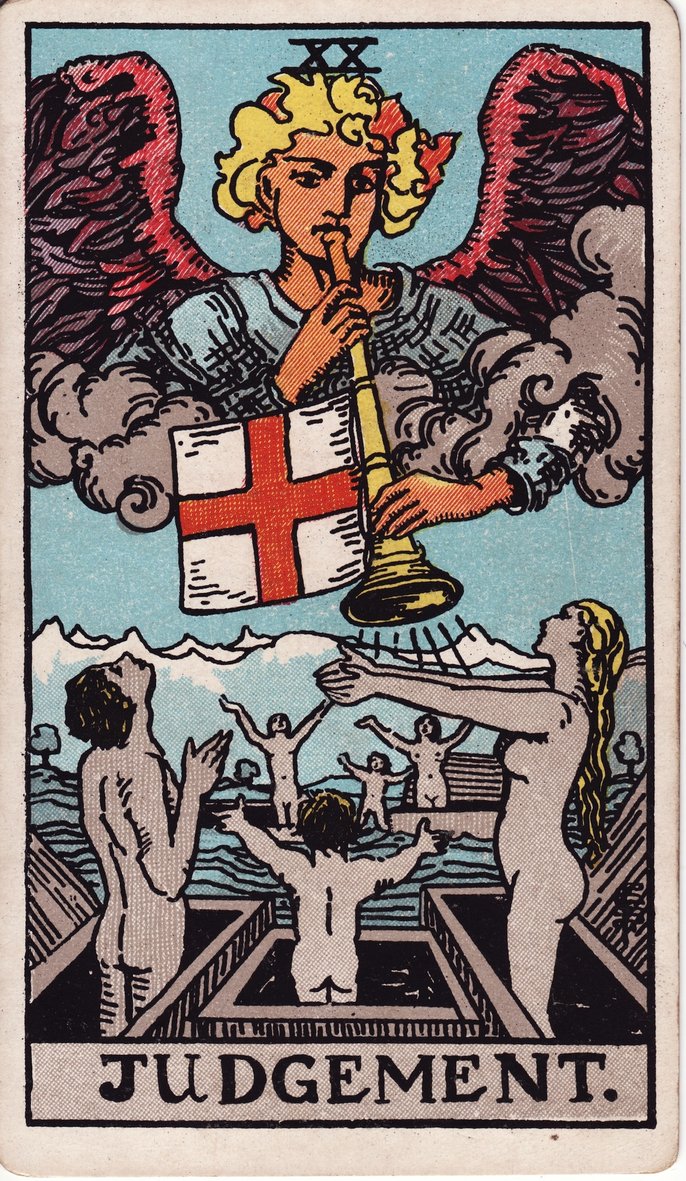
Look at the Rider-Waite image and let it be as strange as it actually is. The Archangel Gabriel erupts from a bank of clouds, wings spread across the whole sky, blowing a great golden trumpet. From the trumpet hangs a white banner with a red cross, the old symbol of resurrection and victory over the grave. Below him, gray-skinned figures rise from open coffins that float on a wide, calm sea. A man, a woman, and a child stand in the foreground with their arms flung open, and behind them more figures rise, all of them turned toward the sound. In the far distance, a range of icy mountains marks the edge of the known world.
Here is the detail almost everyone misses: nobody in this picture is being condemned. There is no scale, no sword, no ledger of sins. That’s the Justice card, and it lives sixteen cards back. Every single figure on Judgement is rising. The dead are not being judged so much as they are being woken up, and their faces show awe, not fear. New readers regularly mistake this for a death card, when it is closer to the opposite. Death already happened. This is the morning after.
The trumpet is the heart of it. A trumpet is not a suggestion. You cannot half-hear a trumpet the way you can half-hear your own conscience. Judgement arrives in a reading when something in your life is making that kind of sound: a truth you can no longer talk yourself out of, a calling that keeps ringing no matter how many times you decline it, a reckoning with your own past that has finally come due. The card does not ask whether you are ready. It asks whether you are listening.
And the sea beneath the coffins matters too. In the Tarot, water is the unconscious, and here it is perfectly still. The storm of the Tower is long past, the illusions of the Moon have burned off under the Sun. What rises now rises in clear light, with nothing left to hide behind.
Judgement is the wake-up call, not the sentence. This guide covers every way it can sound.
What does the Judgement Tarot card mean?
Upright, Judgement means an awakening you cannot sleep through, and a reckoning that sets you free rather than locks you up.
Something is calling you to a bigger version of your life. It might arrive as a decision you’ve been circling for months, a sudden clarity about what you actually want, or an old chapter surfacing so it can finally be closed properly. Whatever form it takes, the feeling is unmistakable: you know. Not suspect, not hope. Know.
This card marks the moment when your past stops being a weight and becomes a record. Judgement asks you to review your history the way the figures in the card rise from their coffins: honestly, completely, and without flinching. Look at what you did, what was done to you, what you learned, what you’d never repeat. Then, and this is the part people skip, close the lid on the coffin. The review is for absolution, not for reliving.
Judgement also carries the energy of results and verdicts. Applications, evaluations, medical answers, long-awaited news: outcomes arrive under this card, and they tend to reflect the real work done, not the story told about it.
The practical instruction is simple. When the trumpet sounds in your life, do not hit snooze. Answer it. The people in the card are gray because they have been dead a long time. That is what postponing your own calling does. Rising is available today.
Judgement Keywords:
- Awakening
- Reckoning
- Inner calling
- Rebirth
- Absolution
- Self-evaluation
- Forgiveness
- Renewal
- Second chances
- Results and verdicts
- Karma resolving
- Purpose
- Rising up
- Answering the call
What does Judgement mean when Reversed?
Reversed, Judgement is the trumpet you keep declining. The call is still coming through. You have simply gotten skilled at not answering it.
This shows up in two classic forms, and it pays to know which one is yours. The first is avoidance: you know exactly what needs to change, and you have built an impressive fortress of busyness, excuses, and “after the holidays” around not changing it. The phone buzzes, you glance at it, you put it face down. Meanwhile the situation you’re avoiding does not resolve. It just accrues interest.
The second form is the inner judge gone rogue. Instead of reviewing your past and granting yourself absolution, you replay it on a loop and hand down a harsher sentence every time. The mistake from three years ago, the thing you said, the chance you missed: you have prosecuted yourself for these so many times that the trial has become your personality. That is not accountability. Accountability ends in a verdict and a release. What you’re doing never ends, which is exactly the point of it: as long as the trial runs, you never have to rise and act.
Reversed Judgement asks one question: what would you do today if you had already forgiven yourself? Then it makes a quiet, devastating observation. Nothing is actually stopping you from doing that thing. The coffin lid is not locked. It never was.
Judgement Reversed Keywords:
- Avoidance
- Ignoring the call
- Self-doubt
- Harsh inner critic
- Stalling
- Regret on a loop
- Fear of change
- Refusing the lesson
- Unfinished business
- Indecision
- Excuses
- Delayed verdicts
Judgement as How Someone (He/She) Sees You
If you’re wondering how you land in someone else’s eyes and Judgement appears, the answer is striking: they see you as someone who changed. (And if the person isn’t sitting across from you, it’s worth knowing whether you can read for someone who isn’t present before you shuffle.)
To this person, you are a before-and-after photo. They knew you, or knew of you, in one chapter, and they can see with their own eyes that you are living in a different one. Maybe you got sober, got serious, got free of something, or simply stopped apologizing for taking up space. Whatever it was, they noticed, and it made an impression that ordinary charm never could. People forget charming. They do not forget transformation.
There is often a note of awe in this perception, the same awe on the faces of the rising figures. You may represent proof that change is actually possible, which is a heavier and more beautiful thing to be than merely liked.
One caution: someone who sees you as evidence of rebirth may quietly expect you to officiate theirs. Inspire them freely. Just remember that you rose by answering your own trumpet, and they will have to answer theirs. You cannot rise for another person, no matter how much you love them.
Judgement Reversed as How Someone (He/She) Sees You
Reversed in this position, the card says this person is looking at an old photograph of you and calling it a portrait.
They see the you from before. The one who flaked, or drank too much, or was still married to someone else, or hadn’t yet done the work you have visibly done. Every time you interact, they respond to that archived version, and it is quietly maddening, like coming home at thirty-five and being treated like you’re seventeen because you’re sitting in your old chair at your parents’ table.
Sometimes this is innocent. People form an impression and file it away, and updating the file takes evidence over time. Sometimes it is less innocent: keeping you small in their mind keeps them comfortable, because your growth is an uncomfortable mirror.
Alternatively, reversed Judgement can mean they see you as judgmental. Check this one honestly. Have your standards been arriving in their inbox as verdicts? A person who feels sentenced by you will relate to you like a defendant, guarded and rehearsed, and you will wonder why you never see their real face.
Either way, the move is the same: live the update. Don’t argue the old photo. Make it obsolete.
What does the Judgement Tarot Card mean in Love?
In a love reading, Judgement is the moment the relationship stands up and asks to be taken seriously.
For couples, this card marks a defining conversation or turning point, the kind you can feel approaching for weeks. The topics that have been floating in the “later” pile, moving in, marriage, children, money, the thing that happened last spring, are coming due, and the card is good news about it: handled honestly, this reckoning renews the relationship rather than ending it. Judgement’s specialty is resurrection. Couples who go through its fire together tend to come out remade, with the gray, going-through-the-motions phase behind them. If you want to map the conversation before you have it, a tarot spread built for relationships is the right tool.
Judgement is also the classic card of the returning past. An ex resurfaces, an old flame writes, a connection you buried comes floating back like one of those coffins on the sea. The card does not automatically say take them back. It says the matter is unresolved and is presenting itself for a real verdict this time: reunion or genuine closure. Choose one. The third option, another decade of ambiguity, is the only wrong answer.
For singles, Judgement says your love life is downstream of your self-assessment. Do the honest review, forgive yourself for the choices you made while you were learning, and notice how differently you choose once you’re no longer dating from guilt.
What does Judgement Reversed mean in Love?
Reversed in love, Judgement means the relationship has a courtroom in it, and somebody won’t adjourn.
The telltale sign is the argument that is never actually about the dishes. Old cases keep being reopened. The mistake from two years ago gets read into the record every time there’s a new dispute, and both of you can recite each other’s charges from memory. Keeping score feels like justice from the inside. From the outside, it looks like two people serving sentences in the same house.
The reversed card can also point at a verdict being dodged. One or both of you knows what this relationship has become, and the honest conversation keeps getting rescheduled because its outcome is frightening. So the connection sits in limbo: too alive to bury, too gray to call living. Judgement reversed is blunt about limbo. It is not mercy. It is just a slower goodbye, or a slower reunion, and you don’t get to find out which until someone tells the truth.
For singles, reversed Judgement usually finds the inner judge running the dating life. You prosecute yourself for the failed marriage, the wasted years, the pattern you repeated, and then you sit out the next chapter as self-punishment.
The counsel in every case is the same: forgive, decide, or release. Pick at least one, out loud.
What does the Judgement Tarot Card mean in Friendship?
In friendship, Judgement loves a resurrection story. This is the card of the old friend who surfaces after years of silence, the group chat that suddenly lights up again, the college roommate who calls out of nowhere and within ten minutes it’s like no time passed at all.
When Judgement appears here, an old bond is presenting itself for renewal, and the card’s advice is to answer. Adult life quietly buries friendships without ever holding a funeral for them. Nobody fought; everybody just got busy, and one day the friendship was a coffin floating on the calendar. The trumpet in this card is often literally a notification: a message you could send today to someone you’ve missed for years. Send it. The awkwardness you’re imagining lasts one message. The friendship might last the rest of your life.
Judgement also raises the standard for current friendships. It favors the friend who tells you the truth, the one who says the hard thing to your face and the kind thing behind your back, instead of the reverse. If a recent honest conversation with a friend stung, this card suggests the sting was the medicine working.
Take the review seriously: which friendships call you upward, toward the person you’re becoming? Those are the ones the trumpet is pointing at.
What does Judgement Reversed mean in Friendship?
Reversed in friendship, Judgement points to a circle that has turned into a jury.
Maybe there’s a friend who keeps a mental file on everyone, and lately you can feel your own file getting thick. Every lapse remembered, every missed birthday logged, warmth doled out or withheld according to the ledger. Or maybe, and sit with this one honestly, the record-keeper is you. Judging our friends is a wonderfully efficient way to avoid examining ourselves, and gossip is just judgement outsourced to a committee.
The reversed card can also mark a friendship being kept on life support out of pure history. You’ve grown, they’ve grown, unfortunately in perpendicular directions, and what remains is an anniversary rather than a relationship. Nostalgia is a lovely guest and a terrible landlord. Judgement reversed doesn’t demand a dramatic friend-breakup; it simply asks you to stop pretending, to either reinvest in the person they actually are now or bless the past and loosen your grip.
And if you’re the one who has been quietly exiled, judged by friends for a chapter you’ve already outgrown, the card offers this: you do not have to keep auditioning for a verdict they decided years ago. Some tables you leave, not because you’re guilty, but because the trial never ends there.
What does the Judgement Tarot Card mean in Career?
In career readings, Judgement is results day. The review cycle, the interview panel, the pitch decision, the bar exam, the funding answer: some formal evaluation of your work is landing, and this card is one of the best omens you can get for it. Judgement rewards the real record. If you have actually done the work, the verdict tends to land in your favor, and often more publicly than you expected.
But the deeper career meaning is the trumpet itself: vocation. The word literally means calling, and this card appears for people whose job and calling have drifted apart. You know the feeling. The salary is fine, the title is fine, and some mornings you sit in the parking lot for an extra minute because everything is fine and none of it is alive. Judgement says that gray feeling is not ingratitude. It is information. Careers, like the figures on the card, can rise from their coffins, and mid-life is not too late; it is famously the classic hour for this exact awakening.
On money, woven into everything here: Judgement calls for the honest audit. Open the accounts you’ve been avoiding, tally the debt at its real number, look at what you actually earn and spend. Money buried in a coffin of “I’d rather not look” never resurrects. Money reviewed honestly can be resurrected startlingly fast.
What does Judgement Reversed mean in Career?
Reversed in career, Judgement is the résumé you keep almost updating.
You already know. That’s the uncomfortable center of this card. You know the job is done teaching you anything, or the business needs to pivot, or the review is coming and you haven’t done the work it will measure. And you have constructed an elegant machine for not knowing it: one more year for the vesting, a better market in the spring, after the reorg settles. The reorg never settles. Judgement reversed calls this what it is: a calling sent to voicemail, over and over, until the caller starts to give up.
It can also flag the fear of evaluation itself. You dodge the feedback conversation, don’t submit the application, never publish the thing, because an unjudged effort can still be perfect in your head. This is imposter syndrome’s favorite move, and the card’s answer is firm: an unread verdict is not the same as a good one. Ask for the review. Real feedback, even harsh, is fuel; imagined verdicts are only fog.
On money, reversed Judgement is the unopened statement, the tax year you’re “getting to.” Avoidance compounds exactly like the interest on it does.
One honest hour, one submitted application, one opened envelope. That is the whole prescription.
Judgement as How Someone Thinks of You
When Judgement describes someone’s private thoughts about you, you occupy an unusual room in their mind: you are the person who woke something up in them.
Their thoughts about you are not casual. You may be tangled up with one of the big turns in their life, the decision they finally made, the truth they finally admitted, the chapter that ended or began around the time you appeared. When they think of you, they hear a little of the trumpet, and that is not a sound a person forgets or files under “acquaintances.”
Often this card means they are conducting a review in which you are the star exhibit. Someone from your past thinking this way is likely replaying your shared history with new eyes, seeing their own part more honestly than they did at the time. There may be an apology slowly assembling itself, or a message sitting in drafts. Judgement being the card of resurfacing, do not be surprised if it eventually sends.
At minimum, know this: they take you seriously. In their inner courtroom, whatever the eventual verdict on the relationship, your testimony was believed. People think of Judgement figures the way you remember the teacher who saw you clearly. Rarely. Vividly. For good.
Judgement Reversed as How Someone Thinks of You
Reversed here, the card says their thoughts about you are stuck in an appeal process that never ends.
They keep re-trying the case. What happened between you, who was at fault, what you meant by what you said: they shuffle the same evidence nightly and reach a different verdict every time. Monday you were the villain, Wednesday they were, by the weekend it was just bad timing. This is why their behavior toward you feels inconsistent. It is inconsistent, because the ruling keeps changing.
Alternatively, they may have judged you by an old version and locked the file. To them you are still the person from that one chapter, that one mistake, that one season, and evidence of your growth gets returned unopened. Painful as this is, note carefully whose problem it is. A closed mind is a coffin someone chooses to stay in. You are not required to climb in beside them and argue.
There’s a third possibility worth naming: their harshness may not be about you at all. People drowning in self-judgement often bail the water into whoever is nearest. If their criticism of you sounds suspiciously like a confession, it probably is.
You cannot rise in someone else’s mind. Rise anyway.
What does Judgement mean in Conflict?
In conflict, Judgement means the truth is coming out, all of it, and the wisest thing you can do is make sure your side of the record is clean before it does.
This card marks the reckoning phase of a dispute. The half-truths, the private maneuvers, the version of events each side has been polishing: a trumpet is about to blow through all of it, and what actually happened will stand up in plain view like those figures rising from the sea. If you have been in the right, this is excellent news; be patient and let the facts surface. If your own hands are not entirely clean, the card gives you a priceless gift: a short window to say so first. An owned fault is a foundation. An exposed one is a crater.
Judgement also insists that this conflict wants a verdict, not a truce. Some fights get papered over so everyone can make it through the holidays, and the buried issue lies in its coffin, perfectly preserved, waiting. This card says do it properly this time: full hearing, both sides heard, an honest ruling, and then, crucially, absolution. That last step is what separates resolution from a ceasefire.
The conflict that ends under Judgement ends for good. That is worth the discomfort of the trial.
What does Judgement Reversed mean in Conflict?
Reversed in conflict, Judgement is the case that cannot close because nobody will accept the ruling.
You know this fight. It was technically settled months ago, maybe years ago, yet it keeps rising from its coffin at family dinners and late-night texts, each side arriving with fresh footnotes for an old argument. The relitigating feels productive, one more round and they’ll finally see it, but notice the actual results: the same evidence, the same speeches, the same hung jury. Judgement reversed says the deadlock is no longer about facts. Both parties now need the fight, because as long as the trial runs, nobody has to grieve, apologize, or change.
The reversed card can also mark blame with no self-reflection anywhere in the room, two prosecutors and no defendants. Every accusation is met with a counter-accusation, and the original wound is buried under procedure.
Here is the exit, and it is humbling: someone has to accept a verdict they don’t love. Not because they’re wrong, but because being right forever is a full-time job with no pay and no pension. If the other side won’t close the case, you can still close yours. Withdraw from the endless appeal. Serve no more summonses. Some conflicts are not won; they are outgrown.
Judgement as Feelings
As a feelings card, Judgement is the click. That near-audible moment when confusion resolves into certainty and you think: oh. Of course. It was this the whole time.
If you’re asking how someone feels about you, this card is quietly enormous. Their feelings have passed through a reckoning and come out the other side changed and clarified. This is not a crush; crushes belong to lighter cards. This is a person who has reviewed everything, including their own hesitations and history, and arrived at a verdict about you. Feelings under Judgement often carry a sense of fate, of being called toward someone rather than merely attracted. Expect them to feel it as something serious, slightly overwhelming, and impossible to unhear.
If the question is about your own heart, Judgement says the deliberation is over, and somewhere in you the verdict is already in. You may be pretending the jury is still out because the answer is inconvenient. It won’t stay quiet. Feelings that have passed Judgement have a way of announcing themselves with trumpets at the least diplomatic moment.
The card also blesses a rarer feeling: absolution. Guilt lifting after an honest amends. Shame dissolving in the light of finally telling someone. If you’ve recently felt lighter, that lightness is real. Rise with it.
Judgement Reversed as Feelings
Reversed as feelings, Judgement means the heart in question is tangled in its own unresolved case, and the tangle is not primarily about you.
If you’re asking how someone feels, the honest answer is: they don’t cleanly know, because their feelings for you keep getting cross-examined by their past. Old guilt, an ex they never properly grieved, a self-image that says they don’t deserve another chance: every warm impulse toward you gets dragged into that inner courtroom and interrogated. From your side it reads as hot and cold. From inside them, it’s one long hung jury. There may be real feeling here, sometimes deep feeling, but it is a bird trying to take off with a coffin tied to its leg.
If the reading is about your own feelings, reversed Judgement gently points out the loop: you keep re-feeling instead of feeling. Replaying the ending, re-auditing what you should have said, mistaking the vividness of regret for the presence of love. Regret is loud. It is not the same as a calling.
The instruction either way: separate the past’s paperwork from the present’s truth. Grieve what needs grieving, forgive what needs forgiving, yourself first. Feelings can only rise once you stop holding the coffin shut from the inside.
Judgement as a Situation
As a situation, Judgement is the season of the verdict. Whatever you’re asking about has stopped developing and started concluding: the results are being tallied, the decision is being made, the long middle is over, and the announcement is near.
Common shapes this takes: awaiting an answer on an application, an offer, a diagnosis, a ruling, a proposal. Or a hidden matter surfacing, the situation where “somehow it all came out” is the sentence everyone will use later. Or the return of a dormant piece of your past, a person, an opportunity, a debt, an old dream, floating back into view like a coffin surfacing on that calm sea, asking to be dealt with properly this time.
The defining quality of a Judgement situation is that it is consequential and honest. Whatever emerges from this season will accurately reflect what was actually built, actually done, actually true. Spin has stopped working. That is frightening if you’ve been coasting on presentation, and profoundly reassuring if you’ve been doing quiet, real work that nobody seemed to notice. Somebody noticed. The record noticed.
You are further along than the waiting makes it feel. This situation is not stuck; it is deliberating. Prepare for the next chapter rather than re-arguing the last one, because the next chapter is what’s actually coming.
Judgement Reversed as a Situation
Reversed as a situation, Judgement is limbo with the paperwork lost somewhere in the system.
A resolution that should have arrived hasn’t. The decision is delayed, the answer is “next week” for the fourth consecutive week, the deal is neither dead nor signed. Everything hovers. And because nothing is officially concluded, nobody feels allowed to move on, so the whole situation floats like a coffin that will neither sink nor open.
Look closer, though, because reversed Judgement usually finds a human hand holding the pause button. Someone benefits from the non-verdict. Maybe a decision-maker is avoiding a hard call. Maybe the other party keeps the question open because ambiguity costs them nothing and keeps you waiting by the phone. And sometimes, gently, it’s you: not sending the follow-up, not forcing the issue, because a pending answer can’t be a no.
The card can also describe a situation resolved on paper but not in spirit: the divorce finalized but not accepted, the job ended but still worked in your head, the apology given but not received. The gap between official and actual closure is exactly where this card lives.
The move: force the verdict where you can, grant it yourself where you can’t. Ask directly, set the deadline, or declare your own closure and act on it. Limbo only has the power you lend it.
Judgement as Intentions / What Someone Wants
When Judgement speaks to intentions, the person in question wants resolution, and they want it with you specifically.
This is someone done with ambiguity. Whatever has been unspoken, unfinished, or unfairly ended between you, they intend to address it head-on. Watch for the signature moves: the “can we talk?” message, the request to meet in person rather than text, the slightly rehearsed quality of someone who has been drafting a speech in the shower for two weeks. If this is a person from your past, their intention is very likely a genuine attempt at repair, an amends, an explanation, possibly a second chance sought with more self-awareness than they had the first time.
Crucially, Judgement intentions are clean. This card does not do games. The person wants honesty and a real outcome, even at the risk of an outcome they won’t like, which is precisely what separates a Judgement return from the ordinary boredom-driven “hey stranger” text. They are not fishing. They are answering something.
They may also want your absolution, which is worth understanding before the conversation happens. Forgiveness is yours to give or withhold freely; hear them out either way. And they want to be seen as who they’ve become, not sentenced as who they were. Whether you resume anything is a separate question. Their intent, at least, is real.
Judgement Reversed as Intentions / What Someone Wants
Reversed, the intentions behind this card are murkier, mostly because the person hasn’t finished judging their own case.
The commonest version: they want relief without reckoning. They would love the guilt to stop, the awkwardness to dissolve, the door to reopen, but without the uncomfortable middle step of actually owning what happened. Watch for the apology-shaped objects: “I’m sorry you felt that way,” the breezy reappearance that skips the conversation entirely, warmth deployed as a substitute for repair. The want is real. The willingness to pay its honest price is not there yet.
Another version: they want to reopen a case you consider closed. An ex or old associate circling back not to resolve the past but to relitigate it, to win it this time, to be ruled innocent retroactively. Notice how quickly “I’ve been thinking about us” turns into a retrial of who did what. You are under no obligation to reconvene that court.
And sometimes the person’s intention is honestly unknown to them. They are circling you the way a hand circles a snooze button, half-asleep, wanting something they haven’t examined. Their signals will stay mixed until their inner verdict lands.
Your move: require clarity before granting access. “What are you actually looking for?” is a fair question. Under reversed Judgement, it is the whole reading.
Is Judgement a Yes or a No?
Judgement is a yes. A resonant, trumpet-backed yes, with one condition attached: this card says yes to what calls you forward, not to what drags you backward.
If the question is about growth, a second chance, a reconciliation, a leap toward work or love that feels like a calling, Judgement’s yes is among the strongest in the deck. It especially favors questions where the past is involved: will the effort pay off, will the truth come out, will I hear back, is it worth trying again with more honesty than last time. Judgement presides over exactly these dockets, and it rules generously for anyone who has genuinely done the work.
Where the yes gets conditional is nostalgia dressed as destiny. If you’re asking permission to reopen something purely because closure is uncomfortable, Judgement will technically say yes, the door will open, and you will learn, again, what you already knew. The card answers honestly; it doesn’t stop you from asking the wrong question. If you can’t tell which kind of question yours is, that’s a sign to give it more room than one card. One of the best tarot spreads for guidance will show you the terrain around the answer.
Reversed, Judgement is a not yet that hardens into no if avoidance continues. The unfinished inner business is the obstacle. Clear it, ask again, and watch the answer change.
Judgement as a Place
As a place, Judgement points to locations where verdicts land and chapters turn: spaces you walk out of a different person than you walked in.
Literally, it can indicate courtrooms and hearing rooms, examination halls, graduation stages, churches and places of worship (Gabriel does hover over the whole scene), hospitals and recovery rooms, anywhere the words “we have the results” get spoken. It has a particular affinity for places of return: the hometown revisited after a decade, the old school hallway that smells exactly the same, the house you grew up in, now strangely small. Places where your past is stored, and where standing still for a moment feels like being read a summons.
Symbolically, the Judgement place is wherever your reckoning is waiting for you. For one person that’s a storage unit full of a former life; for another it’s a lawyer’s office, a twelve-step meeting, a graveside, or the kitchen table where the real conversation has to happen. The card’s geography is simple: the place you keep routing around is the place you’re being called to.
Note the card’s own scenery: open water, open sky, open coffins. Judgement does not happen in hiding. Whatever this place is for you, it has good light and no back exit. Go anyway. That’s rather the point.
Judgement Reversed as a Place
Reversed as a place, Judgement describes locations where the past is stored but never processed: rooms that have quietly become coffins with décor.
The childhood bedroom preserved as a museum. The storage unit paid monthly for boxes no one has opened since the divorce. The house one partner mentally moved out of years ago. The office you’ve quit a hundred times in your head, whose walls know your resignation speech by heart. The card can also point to places of pending verdicts that never arrive: the waiting room, the endless-renovation property, the courthouse where the case keeps getting continued, any address defined by “still waiting to hear.”
There’s often a sealed, airless quality to a reversed-Judgement place, somewhere the windows don’t open, literally or emotionally. Everyone in it speaks a little softer, as if the past is asleep in the next room and no one wants to wake it. But the figures on this card only rise because the coffins open. A room where nothing is allowed to be disturbed is a room where nothing is allowed to be resurrected, either.
The practical reading is disarmingly literal: this card often just means clean out the space. Open the boxes. Sell, donate, grieve, keep the three things that matter. Physical clearing and inner absolution are the same work done with different muscles, and either one will start the other.
Judgement as an Obstacle / Challenge
As an obstacle, Judgement means the reckoning itself is what stands between you and what you want, and there is no route around it. Only through.
Something must be faced before the next chapter opens: the evaluation you must sit for, the confession you must make, the history you must finally look at with both eyes. You’ve likely been hoping for a path that skips this part, some clever workaround where the new life begins without the old one being formally closed. Judgement as a challenge exists to tell you, kindly but with a trumpet, that the workaround does not exist. The rising in this card happens through the open coffin, not around it.
Sometimes the obstacle is external and calendar-shaped: a decisive test, a probate, a review board, a verdict that everything downstream depends on. Fine. Prepare like it matters, because it does.
More often the obstacle is the reckoning you owe yourself. The unexamined pattern that has quietly ended three jobs or two relationships in a row. The wound you’ve renamed “just how I am.” Until it’s reviewed honestly, it sits in your path like a casket in a doorway, and every fresh start trips over it in the dark.
The good news is structural: Judgement is a threshold, not a wall. Walls don’t care if you face them. Thresholds, once faced, become the way in.
Judgement Reversed as an Obstacle / Challenge
Reversed as an obstacle, the blockage moves inside: the single biggest thing standing in your way is your own refusal to close the case.
This takes two familiar forms, and honesty about which one is yours is half the cure. The first is the harsh verdict already rendered: somewhere along the way you sentenced yourself, not qualified, too late, too damaged, ruined it once so don’t get another try, and you’ve been serving that sentence so long it feels like a personality trait. Notice that no external judge issued it. You did, in a bad season, with incomplete evidence, and you’ve never once appealed.
The second form is verdict-avoidance: you keep every option open, every decision pending, every ex un-grieved and every dream un-attempted, because a closed door can disappoint you and an open one only costs you your whole forward motion. It feels like freedom. It functions like a cell with excellent reviews.
Either way, the obstacle survives on one fuel: postponed honesty. That is genuinely hopeful, because postponed honesty is entirely within your power to stop postponing. Reopen the self-imposed case with adult eyes, or close the endlessly-pending one with an actual decision.
You are the obstacle, which sounds like bad news until you hear it right: you are also, therefore, the exit.
Judgement as Action
As an action card, Judgement has one verb at its core: answer.
Answer the call you’ve been screening, in whatever form it’s been arriving. Concretely, this week, that can look like: send the message to the person you’ve been circling. Submit the application. Book the appointment. Say yes to the thing that scares you in the way callings scare people, which is different from the way bad ideas do. Have the conversation whose opening sentence you already know by heart. If a specific action leapt to mind while reading this paragraph, that one. You did not imagine the leap.
Judgement action also includes the housekeeping of resurrection: make the amends you owe, plainly and without a defense attached. Forgive the debt, theirs or yours. Close the account, the case, the chapter, formally, with words spoken out loud, because Judgement is a public card and inner resolutions that never reach the air have a way of quietly expiring.
Note the tempo. This is not the Tower’s demolition or the Chariot’s charge. The figures in the card rise; they don’t leap. Judgement action is deliberate, upright, a little ceremonial. Stand up slowly if you must, but stand all the way up.
One more thing: act before you feel fully ready. The trumpet is the readiness. Nobody in that image got a warm-up.
Judgement Reversed as Action
Reversed as action, the card’s instruction splits, depending on which ditch you’re in. Both instructions start with stop.
If you’re the avoider: stop hitting snooze, and shrink the step until you can’t refuse it. You don’t have to answer the whole calling today. You have to send one email, open one envelope, make one phone call that lasts four minutes. Avoidance survives on the size of the imagined task; it dies by a thousand small completions. Pick the tiniest possible version of the thing and do it before noon. The trumpet doesn’t need you to be dramatic. It needs you to pick up.
If you’re the self-prosecutor: stop rehearing the case. The action here is strange because it looks like inaction: put down the gavel. Write out the charge you keep pressing against yourself, read it once as if a friend had confessed it to you, issue the verdict you’d give that friend, and then, this is the actual action, refuse the next replay. When the loop starts at 2 a.m., name it: case closed, no new evidence. It will feel mechanical. Absolution often does at first, the way physiotherapy feels fake until the day you notice you can walk.
Either ditch, same road out: one honest, small, irreversible act. Send it, sign it, say it. Reversed Judgement ends the moment you do anything that can’t be un-done back into waiting.
Judgement as Advice
As advice, Judgement says: conduct the review yourself, on purpose, before life schedules one for you.
Sit down with your own history like a fair judge rather than a frightened defendant. Take an actual hour. What in your life is finished and only awaiting your admission of it? What have you done that needs amends, and what have you carried that needs forgiving, especially the charges you filed against yourself? Where has a calling been ringing while you kept the phone on silent? Write the answers down. Judgement is the card of the record, and things written become real in a way things mulled never do.
Then act on the verdicts. Advice from this card always ends in the same place: rise. Make the decision you’ve been outsourcing to time. Choose the bigger life over the more defensible one.
Woven into this is the card’s health counsel, which deserves saying plainly: heed the wake-up calls of the body. Book the checkup you’ve been rescheduling, take the symptom seriously, get the second opinion. Judgement rules resurrections, and it is remarkable what bodies, finances, and hearts can recover from once someone stops avoiding the diagnosis. The scary number known is nearly always kinder than the vague dread unexamined.
Truth first, then mercy, then movement. That’s the whole ruling.
Judgement Reversed as Advice
Reversed as advice, Judgement offers a correction so gentle it’s easy to miss how radical it is: appeal your own verdict.
Somewhere in your files is a ruling you handed down against yourself in a bad year, with a prosecutor’s evidence and no defense present. Too late for that dream. Proved I can’t be trusted with money, with love, with a second chance. The advice is to formally reopen that case as the person you are now. Ask one question of it: would I accept this verdict if it were rendered against someone I love, on this evidence? You already know you wouldn’t. Grant yourself what the figures on this card are granted: not a pardon that pretends nothing happened, but absolution that admits everything happened and rules that you may rise anyway.
The second half of the advice: stop re-reading old chapters as a substitute for writing new ones. Rumination does a flawless impression of reflection. The difference is output. Reflection produces a lesson and a next step; rumination produces the same pain at higher resolution. If your review of the past has not changed your behavior in six months, it is not a review anymore. It’s a residence.
Set a term for the court. Grieve on purpose, conclude on paper, and adjourn. The gavel has been in your hand the entire time.
Judgement as an Outcome
As an outcome, Judgement promises resolution with a verdict that fits the facts, and the facts, reviewed honestly, are on your side more than you think.
The matter you’re asking about will conclude, properly and definitively. No trailing off, no ambiguous fade: an announcement, an answer, a door that closes with a clean click so another can open. If you have done real work in this situation, worked honestly, loved honestly, told the truth at cost, the outcome card here is quietly triumphant. Judgement outcomes have a day-of-results feeling: the letter arrives, the call comes, the name is read out, and a long-held breath finally leaves the body.
Expect the outcome to include a reckoning component. Hidden factors surface before the end; whatever was operating in the dark gets one scene in full light. This nearly always favors the person with the least to hide.
And expect to be changed. This card does not deliver outcomes that leave you as you were; it delivers the end of one self and the debut of another. The promotion that comes with a new identity, the reconciliation that requires a new honesty, the ending that turns out to be a commencement. Like the World that follows it, Judgement doesn’t just finish the story. It graduates you from it.
Judgement Reversed as an Outcome
Reversed as an outcome, Judgement forecasts a resolution delayed, diluted, or dodged, and it names the cause without flattery: someone declined the reckoning.
The likeliest shape is anticlimax. The matter won’t so much end as evaporate: the decision postponed again, the answer that answers nothing, the conversation that finally happens but only in the shallow end. Everyone technically moves on; no one actually feels finished. Months later the issue rises from its coffin at the worst moment, because unresolved endings are the deck’s most reliable sequels.
Alternatively, the outcome arrives but can’t be received. The verdict is fair, the chapter genuinely closes, and yet you, or the other party, keep the appeal running privately: relitigating, what-iffing, living in the ruins rent-free. Outcome delivered, closure declined.
Read this card as a warning label rather than a sentence, because it is unusually negotiable. Reversed Judgement outcomes are almost always downstream of present avoidance, which means the forecast changes the day the behavior does. Have the honest conversation now and the anticlimax becomes an ending. Do the self-forgiveness now and the verdict, whatever it is, becomes receivable.
If the reading is telling you the result will be muffled, it is really telling you where the pillow is. Take it off the trumpet.
Judgement in the Future
Judgement in the future position is a summons with your name on it, already in the mail.
A defining moment is coming: a call to rise that will reorganize your priorities in an afternoon. It may arrive as an opportunity that demands a bigger self, a truth that ends a long confusion, a result long awaited, or a resurfacing of your past, a person, a passion, a question, that returns for its proper resolution. You will recognize it when it comes, because it will feel less like a choice appearing and more like your name being called in a quiet room. Everyone looks up when the trumpet sounds. Only the one it’s for stands.
The best use of the time between now and then is preparation of the honest kind. Settle your accounts, emotional and otherwise. Finish what can be finished; forgive what can be forgiven, especially in the mirror. The figures who rise gracefully in this card are the ones whose coffins were already unlatched. Future Judgement is immensely kind to people who arrive at their moment with nothing heavy left to hide, and merely dramatic for everyone else.
Do not fear this card in the future spot. Nothing in that image is being punished; everything in it is being called. Your reckoning is coming, and, read closely, it is on your side.
Judgement Reversed in the Future
Reversed in the future position, Judgement warns of a call that will come and, on the current trajectory, go unanswered.
The moment itself is not in doubt. The opportunity will surface, the truth will knock, the past will circle back for its resolution, likely more than once, because callings are patient the way tides are patient. What the reversal questions is the answering. It sees a future self standing at the threshold with a hand on the snooze button: the application drafted but never sent, the reunion considered but deferred, the honest conversation scheduled for a season that keeps not arriving. Not a disaster. Something quieter and, over years, costlier: a life that stays gray because rising kept getting postponed to a readier day.
It can also foresee a stretch of limbo ahead, verdicts delayed, answers pending, a chapter that resists closing, and in that fog the temptation will be to drift, to let the pending-ness make your decisions for you.
Take this card as the rarest kind of gift: a warning delivered while there is still time to falsify it. Future readings show trajectories, not sentences. Decide now, in advance, what your answer will be when the call comes, and the reversal is already broken. The trumpet will sound regardless. Whether it finds you sleeping is the only variable, and it is yours.
Judgement as a Person
As a person, Judgement is the one with a second act, and you can feel it the moment they enter a room.
This is someone who died once, figuratively, sometimes nearly literally, and got up. The recovered, the remarried-wisely, the career-changer at forty-five, the one who lost everything in the fire or the diagnosis or the collapse and rebuilt a truer life on the cleared ground. What marks them is not the dramatic backstory; it’s the stillness on the other side of it. They are calm the way only people who have already survived their worst day are calm. Nothing about your honesty will shock them, which is why people confess things to them in grocery stores.
They tell the truth, kindly and without decoration, and they extend real absolution rather than cheap reassurance: they won’t tell you it wasn’t your fault when it was, but they will tell you, with authority, that fault is survivable. Around them you feel simultaneously seen through and forgiven, which is roughly what the figures in the card are feeling.
Physically and practically, this may be someone older than their years in wisdom, a mentor, a sponsor, a grandparent figure, a Scorpio or a Pluto-marked soul, someone connected with endings and rebirths by trade: hospice, recovery, ministry, medicine, deep therapy.
If you have one of these people, listen to them. If you are one, the trumpet is yours; sound it gently.
Judgement Reversed as a Person
Reversed as a person, Judgement is someone still living in their own courtroom, and the seating chart varies: sometimes they’re the judge, sometimes the defendant, often both in a single afternoon.
As judge, this is the chronic critic: the one with a verdict for everyone, whose memory for others’ failures is archival and whose mercy is seasonal. Note their tell: the harshness always spikes near their own sore spots. People sentence loudest the crimes they privately fear are theirs.
As defendant, this is the self-flagellant: the friend who cannot accept a compliment without appealing it, who relitigates a decade-old divorce at every dinner, who has confused remorse with a personality. Their guilt looks like humility but functions as armor; as long as they’re punishing themselves, no one, including life, is allowed to ask them to change.
There’s a third variant: the ghost of chapters past. The ex who reappears every eighteen months to reopen the case, the parent frozen in an old grievance, the friend who knew you at your worst and needs you to stay there. Their signature move is the retrial. Nothing is ever finished with them, because finished would mean feeling it.
Have compassion; this person is genuinely suffering. But hold your boundary: you may love them, hear them, even forgive them. You may not move into the courtroom with them. Visiting hours only.
What Zodiac Sign is Judgement?
Judgement is one of the few Major Arcana cards with no zodiac sign of its own, and the omission is the teaching. Signs describe personalities. Judgement describes a moment, and moments come for every personality on the wheel.
Instead, the card carries two great correspondences. In the Golden Dawn tradition it belongs to the element of Fire, assigned the Hebrew letter Shin, whose three flame-like prongs you can almost see in the trumpet’s blast. This is not the campfire warmth of the Wands suit; it is refining fire, the kind that burns off the false and leaves the gold, which is exactly what an honest reckoning does to a life.
In modern astrology, Judgement answers to Pluto, the slow outer planet of death, rebirth, buried things, and the power that comes from facing them. Pluto transits are famous for doing precisely what this card depicts: unearthing what you interred, ending what was already over, and handing you a truer life you’d never have volunteered for. Through Pluto, Judgement resonates strongly with Scorpio, the sign that rules the underworld of the psyche, and it shares fire kinship with Aries, Leo, and Sagittarius, the signs that answer calls first and ask questions later.
So if you were hoping the card was “about” your sign: better. It’s about your moment. Every sign gets one.
Final Thoughts
Judgement is the deck’s great alarm clock, and its secret is that it has always been set by you. The trumpet only sounds when something in your own depths is finished waiting: a truth ready to be admitted, a past ready to be forgiven, a life ready to be twice as large as the one you’ve been defending. The figures in the card rise gray and come alive in the rising. That order matters. You do not wait to feel alive before you answer the call. Answering the call is what the feeling has been waiting for.
If this card found you, assume it found you on time. Do the honest review, grant the honest pardon, and stand all the way up. The reckoning you’ve been dreading is the door you’ve been looking for.
And when you’re ready to see where the rising leads, the path continues: Judgement is the second-to-last card of the Major Arcana, and the completion it prepares you for is the World tarot card, the dance at the end of the whole journey. It helps to remember what came just before, too: the unguarded joy of the Sun tarot card is what gives you the light to review your past without flinching. And if a specific decision is what the trumpet is sounding about, one of the best tarot spreads for guidance will help you hear it clearly.
The dead in the picture heard one note and stood up. You’ve just read several thousand words of the same note. Consider yourself called.