Temperance Tarot Card Meaning, 35 Interpretations!

Right after Death and right before the Devil. That is where Temperance stands, fourteenth in the Major Arcana, and the placement tells you almost everything. Something in your life has ended, and something else is waiting to test your appetites. Between the ending and the temptation, the deck puts an angel with a measuring cup.
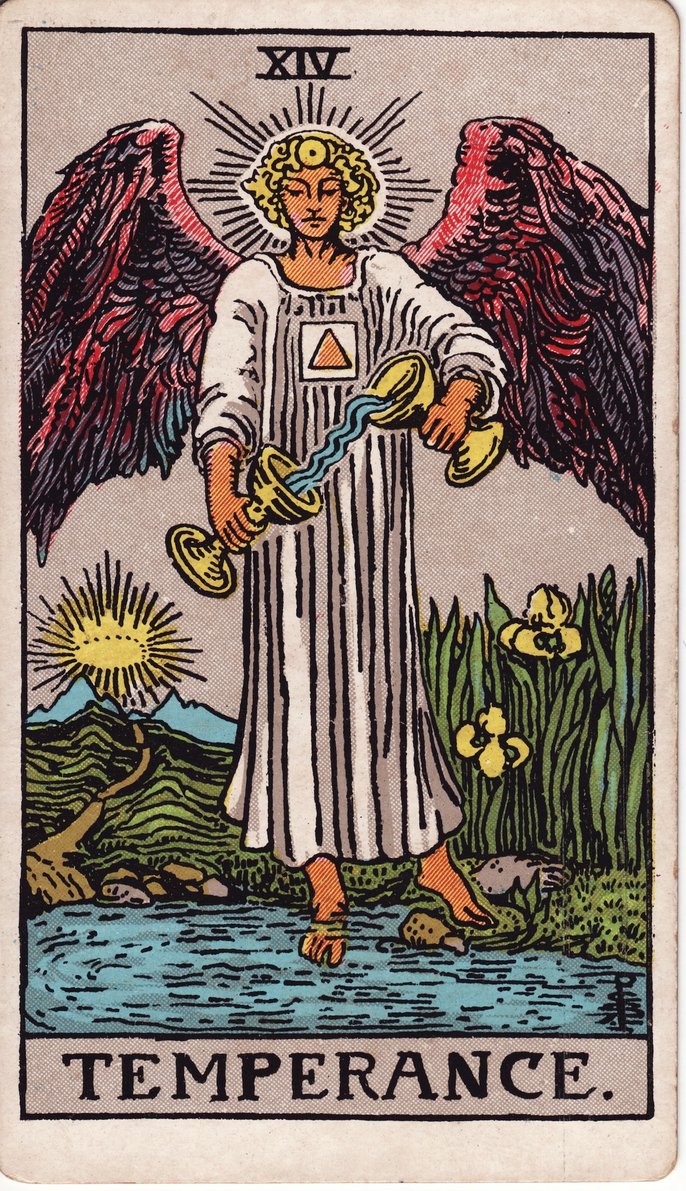
Look at the Rider-Waite image closely, because every detail is doing work. A great winged figure in a plain white robe stands at the edge of a pool, one foot on the stone bank, the other resting in the water. Red wings spread wide behind it. On its forehead sits the golden disc of the sun; on its chest, a triangle held inside a square, spirit contained within matter. The angel holds two golden cups and pours water between them in a stream that flows at an angle water should not be able to flow. It does not spill a drop.
Beside the pool grow yellow irises, the flowers of Iris, the Greek messenger goddess of the rainbow, the bridge between heaven and earth. Behind the angel a path winds up from the water’s edge through green hills toward two distant mountains, and above the gap between them a crown blazes in a halo of light. The road to that crown is long. The angel is in no hurry.
The card’s name comes from the Latin temperare, to mix in the right proportion. Not to abstain. To mix. The medieval virtue of temperance was never about denying yourself wine; it was about knowing how much water to add. In the Thoth deck this card is simply called Art, because that is what it depicts: the alchemist’s art of combining two things that should not combine and producing something finer than either.
One foot on land, one foot in water. Conscious and unconscious. Logic and feeling. What you plan and what you dream. The angel is not choosing between them. It is standing in both at once, comfortably, the way you eventually learn to hold two truths without needing one of them to lose.
Astrologically, Temperance belongs to Sagittarius, the mutable fire sign ruled by expansive Jupiter. That pairing surprises people. Fire, in a card about moderation? Exactly. Temperance is not the absence of fire. It is fire with a steady hand on the flame, an archer taking a long breath before the release. The arrow is aimed at that crown over the mountains, and the archer knows the shot cannot be rushed.
Temperance takes many forms in a reading. This guide covers all of them.
What does Temperance mean?
Upright, Temperance means the mix is working. Keep stirring, keep tasting, do not crank the heat.
This card appears when life is asking you to blend rather than choose. Two jobs, two loves, two versions of yourself, two households, two priorities that both feel non-negotiable. The untrained instinct is to pick one and amputate the other. Temperance says the wiser move is usually synthesis: take the best of each, combine them patiently, and let the result mature.
It is also, profoundly, a card of healing. Temperance follows Death in the Major Arcana for a reason. After a real ending, a divorce, a layoff, a diagnosis, a faith that quietly collapsed, you do not leap into your new life. You convalesce into it. Temperance is that convalescence: the slow, unglamorous middle chapter where the wound closes one day at a time and nothing dramatic happens except recovery.
Above all, this card blesses your current pace. We live in a culture that treats patience as a personality flaw, and Temperance stands against that with its whole chest. Think of everything that only works slowly: sourdough, marriages, muscle, compound interest, forgiveness. You cannot speed any of them up by yelling at them.
The angel pours water between two cups and never spills. That is the promise. Not that nothing is moving, but that what is moving is under control.
Temperance Keywords:
- Balance
- Moderation
- Patience
- Blending
- Synthesis
- Healing
- Recovery
- Calm
- Self-control
- Harmony
- The middle path
- Right timing
- Alchemy
- Steady progress
What does Temperance mean when Reversed?
Reversed, Temperance is the spilled cup. Something in your life is out of proportion, and you can probably feel it in your body before you can name it.
The classic signatures: too much of one thing, not enough of another. Eighty-hour weeks and no sleep. All passion and no plan, or all plan and no passion. A diet of extremes, financial, emotional, chemical, digital. The reversed Temperance person is not evil or broken; they are simply pouring with a shaky hand, overcorrecting left, then overcorrecting right, and wondering why the floor is wet.
It can also point to impatience as self-sabotage. You have been healing, building, or waiting, and you are so sick of the middle chapter that you are tempted to force the ending. Quit the whole thing, send the risky text, put it all on one number. Reversed Temperance is the moment you grab the pot off the stove because the recipe said forty minutes and you gave it twelve.
Watch for excess wearing the costume of a solution. The extra drink that manages the stress. The impulse purchase that manages the sadness. The fourth hour of scrolling that manages the loneliness. None of them are managing anything. They are the imbalance itself, dressed as relief.
The corrective is never a dramatic swing to the opposite pole. It is small, boring, deliberate adjustments. A degree or two on the thermostat, not smashing it off the wall.
Temperance Reversed Keywords:
- Imbalance
- Excess
- Impatience
- Extremes
- Burnout
- Overindulgence
- Discord
- Quick fixes
- Restlessness
- Overcorrection
- Clashing priorities
- Forcing the outcome
Temperance as How Someone (He/She) Sees You
When Temperance describes how someone sees you, congratulations: you are the person they call when everything is on fire.
They see you as the calm one. The level head. The friend who hears both sides of the story before reacting, the coworker who somehow keeps a civil tone in the meeting where everyone else is typing in all caps. Your presence lowers the temperature of a room, and people notice that even when they never say it out loud.
There is real admiration in this view. The person in question has likely watched you absorb something difficult without falling apart, and it made an impression. They may also see you as a bridge, someone who moves easily between different worlds, different friend groups, different kinds of people, the way the angel stands in water and on land at once.
One caution, and it is worth hearing. People who are seen as endlessly steady tend to get treated as infrastructure. Others lean, and lean, and forget the bridge has a weight limit. Being seen as the calm one is a compliment right up until it becomes a job description you never applied for. You are allowed to have your own storms.
Temperance Reversed as How Someone (He/She) Sees You
Reversed in this position, the picture is less flattering: they cannot get a read on you, and it is wearing on them.
Perhaps they see you as hot and cold. Effusive on Tuesday, unreachable by Friday, and they have quietly started bracing before every interaction because they do not know which version of you is going to answer. Inconsistency reads as unreliability from the outside, even when, from the inside, it just feels like being tired.
Or they may see you as someone currently living at the extremes. The friend who is always either juice-cleansing or bingeing, all-in on a new obsession or completely burned out on the last one. They might find it entertaining from a distance and exhausting up close.
There is a third possibility worth sitting with: they see you as lukewarm. Unwilling to commit, hedging every answer, mistaking indecision for balance. Real temperance is an active blending of things you actually care about. Fence-sitting is just standing still with better posture, and people can tell the difference.
The fix in all three cases is the same. Pick your temperature and hold it long enough for someone to trust it.
What does Temperance mean in Love?
In a love reading, Temperance is one of the quiet good cards, the kind that never makes the highlight reel and holds the whole relationship together.
For couples, it describes the great unglamorous art of blending two lives. Two schedules, two families, two ways of loading a dishwasher, two nervous systems that calm down differently. Temperance says the blend is working, or can work, if you keep pouring patiently. Disagreements get metabolized instead of stockpiled. Nobody has to win. Think less fireworks, more slow cooker: unimpressive to watch, and it feeds you for years.
If you have been through a rough patch, this card is genuinely hopeful. It favors repair over rupture, and it specifically favors repair done gradually, one honest conversation at a time, rather than one grand cinematic gesture that resets nothing.
If you are single, Temperance asks you to stop treating dating like a sprint with a deadline. The connection worth having will be built the way the angel pours, steadily, attentively, without spilling. It may also hint that your best match is someone unlike you in ways that combine well, water to your fire, rather than a mirror image of yourself.
For a deeper look at exactly where a connection stands, a tarot spread built for relationships will give you far more to work with than a single card.
What does Temperance Reversed mean in Love?
Reversed in love, Temperance points to a relationship where the pouring has gotten sloppy, and someone’s shoes are getting wet.
The most common pattern is asymmetry. One partner is overfunctioning, planning, soothing, apologizing, carrying, while the other coasts. One is all gas, pushing for the next milestone; the other is all brake, stalling every conversation about the future. A relationship can survive two different paces for a while, but reversed Temperance says the gap itself has become the problem, and pretending otherwise is no longer working.
It also shows up in hot-and-cold dynamics: intense closeness followed by withdrawal, breakups and reunions on a loop, the whole exhausting cycle where passion is measured in amplitude instead of depth. If your relationship feels like a fever chart, this is your card.
For singles, reversed Temperance often means forcing it. Texting too much too soon, editing yourself to match what someone else seems to want, mixing your life into theirs before you know whether the ingredients are even compatible.
The advice is not to give up. It is to stop overcorrecting and start adjusting. Small honest recalibrations, made consistently, save more relationships than dramatic ultimatums ever have.
What does Temperance mean in Friendship?
In friendship, Temperance is the card of sustainable give and take, the friendships that survive because nobody is keeping score and somehow the ledger still balances.
It often points to you, or someone close to you, playing the mediator: the one who keeps the group chat from combusting, who translates between the blunt friend and the sensitive one, who plans the trip that four wildly different people all somehow enjoy. That blending instinct is a gift. Groups do not hold together by accident; they hold together because someone keeps quietly adjusting the mixture.
Temperance also blesses unlikely friendships. The friend twenty years older, the one from a completely different world, the one you disagree with about nearly everything and love anyway. Like the card’s two cups, the exchange between different waters is exactly what keeps both fresh.
Practically, this card favors the slow build. The friendships forming in your life right now may not be intense yet, and that is fine. Regular small deposits, a coffee here, a check-in text there, compound into the kind of bond that intensity alone never produces.
What does Temperance Reversed mean in Friendship?
Reversed in friendship, Temperance means the mixture has gone lopsided, and you probably already know which direction.
Maybe you are the one who always organizes, always initiates, always listens, and it has quietly curdled into resentment. Maybe a friend treats you as their unpaid on-call therapist and vanishes the moment you need the favor returned. Or maybe, and this one is harder to admit, you have been the taker lately, leaning on someone’s steadiness without ever asking how they are doing.
It can also describe a group out of balance: one loud voice setting every plan, cliques forming inside the circle, a friend whose extremes, the drama, the drinking, the endless crisis of the week, have started to cost everyone else their peace.
Reversed Temperance does not tell you to torch the friendship. It tells you to rebalance it out loud. Say the quiet part kindly: I need this to flow both ways. A real friend adjusts the pour. Someone who refuses to, after being asked plainly, has answered a different question, and you are allowed to act on that answer.
What does Temperance mean in Career?
In career readings, Temperance is the card of compounding, and almost nobody wants to hear that, which is exactly why it is valuable.
It says the boring plan is working. Steady output, consistent quality, showing up on the days you are uninspired. No single week of it looks impressive, and three years of it looks like mastery. If you are waiting for the dramatic break, Temperance gently points out that the people you envy mostly got there the way the angel gets to the mountains: one unhurried step up a long path, eyes on the crown.
It is also the card of blended skill sets. The designer who understands code, the accountant who can actually write, the tradesperson who learned sales. Careers accelerate at the intersections. If you have been treating one of your abilities as a hobby, Temperance suggests mixing it into the main cup.
On money, the same law applies. This card loves the unsexy instruments: the automatic transfer on payday, the budget that leaves room for pleasure so you actually keep it, the portfolio built like a balanced diet instead of a lottery ticket. Temperance money is never a windfall. It is the quiet number that grew while you were busy being patient.
Teamwork sits under this card too. If you are mediating between departments, personalities, or egos, that translation work is more visible than you think.
What does Temperance Reversed mean in Career?
Reversed in career, Temperance has one word for you, and the word is burnout.
Somewhere the workload and the recovery stopped matching. You are running on stress hormones and reheated coffee, mistaking exhaustion for dedication, and calling it a season even though the season has lasted two years. The reversed angel is still pouring, but with trembling hands, and the work is starting to show it: sloppy errors, short tempers, a creeping numbness about projects you used to love.
It can equally mean spread too thin. Five side projects at ten percent effort each, a resume of unfinished starts, saying yes to everything because choosing feels like loss. Blending is a virtue; puree is not a career plan.
With money, reversed Temperance is the extremes card: the get-rich-quick position sized way too large, the revenge trade, the spending spree that manages a feeling, or the opposite extreme, hoarding so anxiously that you never invest in your own growth. Both poles come from the same place, a refusal to trust slow arithmetic.
The move is not to quit everything. It is triage: pick the two things that matter, resource them properly, and put the rest down without apology.
Temperance as How Someone Thinks of You
When Temperance describes someone’s private thoughts about you, the inside of their head is warmer than you might guess.
They think of you as steadying. Not boring, steadying, and there is a universe of difference. Around you their pulse comes down. They may associate you with the feeling of exhaling, of things being handled, of conversations that end better than they started. If they have chaos in their life, and most people do, you are the counterweight they think about when the noise gets loud.
They likely also credit you with fairness. When they imagine telling you something difficult, they expect to be heard rather than judged, and that expectation is one of the rarest compliments a mind can pay.
There is often a wistful note in it too. People who run hot tend to quietly envy people who run even. They may wonder how you do it, or wish they had your ability to wait things out.
The one shadow: they may assume you need nothing. Steady people rarely get checked on. If this person matters to you, occasionally letting them see the effort behind your calm will deepen the bond, not damage it.
Temperance Reversed as How Someone Thinks of You
Reversed here, their thoughts about you are unsettled, and the theme is inconsistency.
They may think of you as unpredictable in a way that costs them energy: someone whose warmth cannot be counted on, whose moods set the weather for everyone nearby. Or they think of you as scattered, twelve tabs open, five commitments deep, never fully present in any of them, and they have started assuming you will cancel.
There is a subtler version. They may think of you as diluted. Someone who agrees with whoever spoke last, whose opinions pour into the shape of any container. They cannot find the concentrated you underneath the mixing, and it makes them trust the surface less.
And sometimes, frankly, the reversal is theirs, not yours. Their own life is so far out of balance that your ordinary ups and downs look extreme through their lens. A person in freefall thinks everyone standing still is judging them.
Before taking this reading to heart, ask which of these is true. If it is the first two, tighten your consistency. If it is the last, their perception is not your homework.
What does Temperance mean in Conflict?
In conflict, Temperance is the de-escalation card, and it is worth more than a dozen victories.
It says the fight in front of you will not be won at high temperature. Someone has to lower the flame first, and this card nominates you, not because you are wrong, but because you are the one holding the cups. That might look like slowing the conversation down, repeating the other side’s position until they agree you have understood it, or simply refusing to match a raised voice with a raised voice. Water poured between two vessels, back and forth, until both hold something drinkable.
Temperance conflicts end in synthesis, not surrender. The goal is a third option neither party walked in with: the compromise on the estate, the revised plan that keeps the deadline and the quality, the custody schedule that serves the kid instead of the grievance. Look for the mix, not the win.
It also counsels timing. Sagittarius fires its arrow once, after aiming. Say the hard thing when the room is calm enough to hear it, not the moment it occurs to you.
What does Temperance Reversed mean in Conflict?
Reversed in conflict, Temperance warns that the temperature is past the point where talking helps, at least for now.
Every exchange escalates. Old grievances are being poured into new arguments until nobody can taste the original issue anymore. Positions have hardened into identities, and each side now needs to win more than it needs to solve. If your dispute has reached the stage where you are arguing about how you argue, this is your card.
Reversed Temperance also flags the extremist move: the ultimatum, the scorched-earth email, the lawyer called in anger, the door slammed for effect. These feel decisive and almost always purchase a week of satisfaction at the price of a year of cleanup. The card that follows this one in the deck is the Devil. Escalation is exactly how you get there.
The counsel is a strategic pause, which is not the same as losing. Step out of the pot while it boils. Set a time to return to it. Cool water can be blended; steam just scalds everyone in the kitchen.
One more honest note: check your own pour. In most runaway conflicts, both parties are certain the other one started the spilling.
Temperance as Feelings
As a feelings card, Temperance describes an emotional state that has no dramatic name, which is precisely what makes it precious: settled.
If you asked how they feel about you and drew this card, they feel calm around you. Not fireworks, not obsession, calm, the nervous-system kind, the kind a person only feels where they sense safety. Do not undervalue this because it is quiet. Plenty of people can make someone’s heart race; very few can make it settle. Racing is easy. Settling is rare.
It can also describe mixed feelings that are blending rather than warring. Affection with caution, grief with relief, excitement with fear about the same future. Temperance says the mixture is healthy. Feelings do not have to be pure to be true, and the ones worth trusting are usually poured from two cups.
If the question was about your own heart, this card is a quiet diagnosis of recovery. Something in you that was churning has begun to still. You may notice you have gone whole days without checking the emotional wound, and it startled you. That is what healing feels like from the inside: mostly like forgetting.
Temperance Reversed as Feelings
Reversed as feelings, Temperance is emotional whiplash, in them or in you.
If it describes someone else, their feelings swing. Adoration in the morning, distance by night, and both are real while they last, which is exactly the problem. They run hot until closeness gets real, then cold until distance gets real, and anyone attached to them lives on the pendulum. It is not necessarily malice. It is usually someone who has never learned to hold two feelings at once, so they alternate instead of blending.
It can also signal emotional flooding: so much feeling, poured so fast, that everything overflows. Or its mirror image, the numbness that follows flooding, when the system shuts the valves entirely and a person reports feeling nothing at all about things that should matter.
If the card describes you, be honest about the cycle you are in. Are you medicating one feeling with another? Rage to avoid grief, busyness to avoid loneliness, infatuation to avoid emptiness?
The way back is smaller than you think. Name one feeling at a time, out loud or on paper. Poured slowly, even the most volatile emotions can be carried without spilling.
Temperance as a Situation
As a situation, Temperance describes a work in progress that is actually progressing, however invisible that progress feels from inside it.
Classic Temperance situations: a recovery, medical, emotional, financial, that is genuinely on track but slower than you want. A merger of worlds, moving in together, blending families, combining teams after a reorganization, integrating a new country, language, or identity into your life. A long apprenticeship in anything, where competence is accumulating in deposits too small to notice day by day.
The defining feature is that time itself is an ingredient. This situation cannot be completed early any more than a cast can come off early or a barrel of whiskey can be rushed. The waiting is not a delay in the process. The waiting is the process.
Temperance also often marks the aftermath chapter. The card sits just after Death in the Major Arcana, and situationally it plays the same role: the estate being settled, the months after the breakup, the new normal assembling itself after the old one ended. Nothing cinematic is happening. Everything important is.
Keep the pace. The path on the card reaches the mountains, but only in the order of its steps.
Temperance Reversed as a Situation
Reversed as a situation, Temperance describes a setup that is structurally out of balance, and no amount of personal virtue inside it will fix the structure.
Think of the job where one person does the work of three, the household where one adult carries every invisible task, the project with two visions and one budget, the friendship group organized entirely around a single person’s crises. The situation itself is a badly mixed drink: too much of one ingredient, and everyone keeps sipping it politely while making the face.
It can also describe a situation that was rushed into existence and is now showing the cracks of its speed. The business launched before the model worked, the wedding planned before the second fight, the house bought at the top of the panic. What was forced together without blending is now separating, the way oil and water always eventually announce their true relationship.
The honest question this card asks: can the proportions be corrected, or is the recipe itself wrong? Some situations need a rebalance, redistribute the load, renegotiate the terms. Others need to be poured out entirely. Temperance reversed will not choose for you, but it insists you stop pretending the current mixture is drinkable.
Temperance as Intentions / What Someone Wants
As intentions, Temperance is one of the most reassuring cards a querent can pull, because what the person wants is peace, and they want it with you.
They intend to build slowly and properly. If this is romantic, they are not playing games with the pace; the pace is the sincerity. They want to blend lives rather than collide them, to introduce you to their people, to find the routines and rituals where two separate weeks become one shared one. Steady interest that survives ordinary time is exactly what their behavior is trying to tell you.
In family or friendship questions, this card means they want harmony restored. They may be looking for the bridge back after a rift, waiting for a signal that a calm conversation would be welcome. They are unlikely to make a dramatic move, drama is the opposite of their intent, so the signal may need to come from you.
In work and negotiation, Temperance intentions are collaborative: they want the deal where both sides walk away functional, the long relationship over the fast extraction.
What they want, in every context, is the mixture. Not to consume you and not to be consumed. To combine.
Temperance Reversed as Intentions / What Someone Wants
Reversed as intentions, the wanting itself is unstable, and you should read the wobble as information.
The most common version: they want the temperature without the commitment. Warmth on their schedule, distance on their schedule, a connection kept deliberately at simmer because boiling would demand a decision. If you have been confused about where you stand, reversed Temperance suggests the confusion is the design, or at least the symptom of someone who genuinely does not know their own mixture.
It can also mean they want too much, too fast. Merged finances by month two, instant best-friendship, the business partnership proposed before the second coffee. Speed like that is not always sinister, but it is always worth slowing, because whatever cannot survive a reasonable pace was never going to survive an unreasonable one.
Third possibility: their intentions toward you are currently drowned out by their intentions toward their own chaos. The addiction, the crisis, the unfinished divorce, the job that eats them. They may genuinely care for you and still be incapable of pouring steadily right now.
None of these make them a villain. All of them make them a poor place to store your peace, until something rebalances.
Is Temperance a Yes or a No?
Temperance is a yes, with one condition attached, and the condition is time.
Upright, this card answers your question the way a good doctor answers “will I recover?” Yes, if you follow the protocol. Yes, if you do not rip the stitches out early. Whatever you are asking about, the relationship, the job, the move, the reconciliation, the deck is telling you the outcome is favorable and the timeline is non-negotiable. A yes you must wait for is still a yes. Impatience is the only thing on the table that can turn it into a no.
If your question was about whether to do something extreme, quit dramatically, confront explosively, bet everything, Temperance softens toward no: not that, but there is a moderate version of that, and the moderate version is yes.
Reversed, Temperance leans no, or more precisely, not like this. The current mixture, the current pace, the current extremes, these will not produce the result you want. Rebalance first, then ask again; the answer may change when you do.
And if a bare yes or no feels too thin for what you are carrying, one of the best tarot spreads for guidance will show you the moving parts a single card cannot.
Temperance as a Place
As a place, Temperance is anywhere water meets land, and anywhere a body goes to be restored.
Picture the literal card: a pool at the edge of a green bank, flowers, a path, mountains far off. Riverbanks, lakeshores, hot springs, the shallow end at dusk. Places with the sound of moving water in them, which is, not coincidentally, the sound humans pipe into every spa on earth.
It is also the card of healing places: clinics and physiotherapy rooms, retreat centers, recovery meetings in church basements, the massage table, the garden your grandmother swore was better than any pill. Anywhere the explicit purpose of the room is to put a person back into proportion.
And it is the card of kitchens. Genuinely. The domestic alchemy of a kitchen, ingredients measured, opposites combined, heat applied patiently, is the closest most of us come to the angel’s work on an average Tuesday. If a reading points to a place where something important will happen, do not overlook the room where things get mixed.
Wherever it is, the Temperance place has one signature: your shoulders drop when you enter it.
Temperance Reversed as a Place
Reversed as a place, Temperance points to environments of excess or depletion, rooms where the mixture is wrong and everyone inside is absorbing it.
The obvious ones first: the bar at last call, the casino floor at 3 a.m., anywhere designed with no clocks and no windows so you cannot feel how much of yourself you are spending. Places engineered against moderation, where the architecture itself has intentions for you.
Then the subtler ones. The open-plan office that never gets quiet. The home where the television argues in every room. The gym you attend punitively rather than kindly. The childhood house where the emotional thermostat only had two settings. A place does not need neon to be intemperate; it only needs to make balance impossible for the people inside it.
Reversed Temperance can also mark parched or flooded ground, literally or spiritually: the drought-struck, the storm-damaged, the neighborhood after the factory closed, the room nobody has cleaned since the grief moved in.
The guidance is straightforward and hard: notice what each place does to your pour. Some rooms you can rebalance with a lamp and a plant. Some rooms you can only leave.
Temperance as an Obstacle / Challenge
As an obstacle, Temperance names a strange enemy: the requirement of patience itself is what stands in your way.
The thing you want is on the far side of a process that cannot be compressed. The certification takes two years. The trust you broke rebuilds in months, not conversations. The body heals on its schedule, not your calendar. Nothing is wrong, and that is exactly what makes it excruciating, because there is no villain to fight and no shortcut to find. The mountain path on the card is the obstacle, and it is also the only road.
Temperance as a challenge can also mean you are being asked to hold two things that resist blending: the demanding job and the young family, the aging parent and your own life, the honest art and the paying work. The difficulty is real. The card’s counsel is that the answer is ratio, not elimination, and finding the ratio will take experiments, spills, and adjustments you did not budget for.
One more reading: your own evenness may be the obstacle. There are moments that call for fire, for the unreasonable demand, the raised voice, the leap. If you have been moderating a situation that actually needs an arrow, the archer in you knows.
Temperance Reversed as an Obstacle / Challenge
Reversed as an obstacle, the block is an excess, and it is usually one you have been calling something nicer.
The habit that has quietly become the schedule. The drinking that is fine, the spending that is deserved, the scrolling that is just unwinding, the work that is just a busy season entering its third year. Reversed Temperance as a challenge says plainly: the thing you use to cope with the problem has become the problem, and no progress on any other front will hold until the proportions change.
It can also name the extremism of your approach. All-or-nothing thinking is the obstacle: the diet that must be perfect or abandoned, the project that must be brilliant or deleted, the person who must be flawless or blocked. All-or-nothing sounds like standards. It functions as a machine for producing nothing.
Sometimes the excess is not yours. A partner’s extremes, a colleague’s chaos, a family member’s crisis-generating gift. Their imbalance keeps flooding your carefully tended ground, and the challenge is building the levee without burning the bridge: limits, stated kindly, enforced consistently.
Name the excess out loud. Obstacles of this kind lose half their weight the moment they lose their alias.
Temperance as Action
As an action card, Temperance tells you to adjust, not overhaul. Turn the dial, not the tables.
Concretely: make the small correction now instead of the dramatic one later. Trim the budget ten percent rather than declaring financial martial law. Have the calm conversation this week rather than the explosive one next month. Add the rest day before the injury adds it for you. Temperance action is almost embarrassingly modest in the moment and unreasonably powerful in aggregate, the compound interest of tiny right moves.
It is also the card of blending as a verb. Combine the two plans instead of choosing. Introduce the two friends. Merge the side project into the day job pitch. Take the meeting between the two feuding parties and pour their positions back and forth until something drinkable appears. If you have been asking “this or that?”, Temperance suggests the strongest move on the board is usually “a measured amount of both.”
And sometimes the action is the angel’s other skill: keep pouring. Continue the routine that is working, at the pace that is working, resisting the itch to change things purely because progress has gotten quiet. Consistency, this card insists, is not the absence of action. It is action, repeated until it looks like fate.
Temperance Reversed as Action
Reversed as action, Temperance has a two-word instruction: stop pouring.
Something needs to be cut back, paused, or put down, and you already know its name. The commitment too many, the substance too frequent, the argument on round forty, the account you check like a slot machine. Reversed Temperance rarely demands forever; it demands a genuine interruption, long enough for the water to settle so you can finally see to the bottom of it. Call it a fast, a freeze, a thirty-day experiment, whatever lets your pride sign off.
The second instruction: stop overcorrecting. If your pattern is swinging, feast then famine, silence then outburst, sprint then collapse, then the reversed card forbids the next swing specifically. Do not answer excess with opposite excess. Answer it with something almost insultingly moderate: one change, held steadily, for longer than feels interesting.
Third, and gently: if the imbalance in question has teeth, if the drink or the debt or the despair has stopped responding to willpower, then the action is asking for help, and taking it. The angel on this card is, in some traditions, a healer. Letting one in counts as action. It may be the single most temperate thing a person ever does.
Temperance as Advice
As advice, Temperance says: protect the pace that heals you, and be suspicious of everything that promises to skip it.
This card carries a strong health current, so start with the body. Sleep like it is part of the job, because it is. Eat like someone you are responsible for. Take the walk, drink the water, keep the boring appointments. None of this is glamorous, and all of it is the actual mechanism by which lives get better. When Temperance appears as advice, the body is usually the first cup being neglected.
For the mind, the advice is proportion. Whatever currently occupies ninety percent of your thoughts deserves, at most, forty. Dilute obsession with other ingredients: other people, other projects, other rooms. You are allowed to care intensely about something and still refuse to let it colonize the whole vessel.
For decisions, the advice is the middle path, chosen actively. Not the mushy average of two options, but a deliberate blend of the best of each. Ask of every plan: what is the version of this that I could sustain for five years? That version is almost always the right one.
And in every dealing with other people: lower the heat first. You will never regret being the calmest person in the room.
Temperance Reversed as Advice
Reversed as advice, Temperance drops the gentle tone and gets specific: audit your excesses, this week, in writing.
Take a page and list where the proportions of your life have drifted. Hours worked against hours rested. Money out against money in. Drinks per week, honestly counted. Time spent on screens against time spent on people who can touch your shoulder. Complaints spoken against actions taken. Do not editorialize, just count. Reversed Temperance says at least one of those numbers will embarrass you, and that number is the assignment.
Then correct it the temperate way: one notch, held. Not the purge, the fast, the grand renunciation announced to everyone you know. Extremes of correction are just the old extremity wearing a halo. Cut back by a quarter and hold it for a month. Boring wins.
The reversed card also advises you to stop outsourcing your balance. No partner, substance, purchase, or algorithm can regulate you from the outside; they can only rent you the feeling. Regulation is an inside job, built from sleep, honesty, and repetition.
Last, if someone in your life keeps knocking over your cups, the advice is distance, calmly measured. You cannot pour steadily while someone shakes the table. Step back far enough to work.
Temperance as an Outcome
As an outcome, Temperance promises resolution by integration: the pieces of this situation will settle into a proportion you can live with, and better than that, one you can live in.
Expect the ending that looks like equilibrium rather than victory. The negotiation closes with both sides functional. The family conflict cools into a workable peace. The health scare resolves into a manageable regimen. The new job, city, or relationship stops feeling like a costume and starts feeling like clothes. Nobody will make a movie about this outcome, and you will thank the universe for that; the outcomes that make good movies are usually terrible to live through.
Temperance outcomes are also durable in a way dramatic ones rarely are. Because the result was blended slowly, it holds. The couple who repaired at this pace stays repaired. The money accumulated at this pace stays accumulated. What is built by patience is defended by habit.
One expectation to release: totality. This outcome will be a very good mixture, not a pure substance. The job will be right and imperfect, the peace will be real and occasionally strained. The crown on the card sits over the mountains, glowing, still a little distance off. That is not a flaw in the promise. That is what attainable looks like.
Temperance Reversed as an Outcome
Reversed as an outcome, Temperance forecasts a result undone by its own proportions: the win that costs too much, the peace that does not hold, the finish line crossed by someone too depleted to feel it.
This is the promotion that arrives together with the burnout. The deal closed on terms that guarantee a renegotiation. The reconciliation accepted before the underlying imbalance changed, which is to say, the same fight, scheduled for later. Reversed Temperance outcomes have a signature you can learn to recognize in advance: they require someone to keep overextending forever for the result to keep existing. Anything that only works if a human being never gets tired does not work.
It can also predict the swing. A situation resolved by extremes tends to re-resolve by opposite extremes: the crash diet’s rebound, the rebound relationship’s rebound, the austerity budget’s blowout. Pendulums do not stop at the top of an arc.
Here is the useful part: this outcome is the most preventable in the deck. It is not fate; it is arithmetic, and arithmetic can be redone. Rebalance the inputs now, the pace, the terms, the load, and you change the output. The card is not a sentence. It is a projection, shown to you early enough to matter.
Temperance in the Future
In the future position, Temperance is quietly wonderful news: a season of healing and consolidation is ahead of you.
Whatever turbulence defines your present, the road in front of you leads to calmer water. Wounds you are currently managing will become scars you occasionally notice. Chaotic arrangements, the finances, the schedule, the household, the heart, will settle into rhythms that hold without daily heroics. You will not be able to point to the day it happened. Balance never arrives; it accumulates, and one ordinary afternoon you will realize you have been standing in it for a while.
This card in the future also foretells synthesis ahead: threads of your life that currently feel unrelated, or even opposed, are going to braid. The skill and the passion, the old life and the new one, the person you were before the ending and the person the ending made. Card fourteen comes after card thirteen. What Death separated, Temperance is already learning to recombine.
Your only assignment between now and then is not to force it. The future this card shows is reached at walking pace, on the path behind the angel, toward mountains that do not move and a crown that does not dim.
Temperance Reversed in the Future
Reversed in the future position, Temperance is a weather warning, issued early enough to pack accordingly: a period of imbalance is forming ahead, mostly out of patterns already running now.
The current unsustainable thing, the pace, the spending, the silence in the relationship, the third coffee replacing the second meal, does not level off on its own. Projected forward, it wobbles harder. Expect a stretch where you feel pulled between extremes: too busy then too idle, too close then too distant, flush then strapped. Nothing catastrophic is written here, but the ride will be rougher than it needs to be if nothing changes.
The card can also warn of an intemperate influence approaching: a person, opportunity, or environment that will invite your excesses out to play. It will feel like relief at first. Extremes always do; that is their whole sales pitch.
Read this the way the deck intends it: not as doom, but as the one advantage prophecy offers, lead time. Futures shown in cards are momentum, not destiny. Begin the small corrections now, sleep, honesty, one notch back on the dial, and by the time you arrive at that forecast weather, you will be the person carrying an umbrella while everyone else gets soaked.
Temperance as a Person
As a person, Temperance is the one whose presence you only fully appreciate after a week around their opposite.
They are calm without being cold, warm without being chaotic. The friend who has known real storms and speaks of them without bitterness. The colleague who misses no deadlines and no birthdays. The relative who can sit at the holiday table between two feuding factions and somehow leave both feeling heard. They mix well with everyone, not because they are bland, but because they have blended themselves: passion and patience, conviction and curiosity, in proportions they mostly figured out the hard way.
Under the Sagittarius current, this person often carries quiet fire: a love of travel, learning, big questions, long horizons. They are aiming at something far off, a crown over distant mountains, and their steadiness is not the absence of ambition but its most efficient form.
They frequently end up as healers of one kind or another, formally or not: nurses, counselors, coaches, sponsors, the friend everyone calls first. One foot on land, one in water, they can stand in your storm without being swept into it.
If you have one of these people, keep them. If you are one, remember your own cups need filling too.
Temperance Reversed as a Person
Reversed as a person, Temperance describes someone who lives at the extremes and calls it passion.
You know this person, or you have been them. Everything is the best thing ever or a catastrophe. New obsessions arrive quarterly and depart with the receipts. They are wildly generous in the same month they cannot cover rent, intensely present until precisely the moment consistency is required. Their warmth is real and so is their vanishing; the pendulum is the personality.
Often there is an appetite running the show, work, substances, spending, drama, romance, approval, and everyone around them adjusts to it the way furniture gets adjusted around a leak. They are frequently charming, usually exhausted, and almost always the last to see the pattern, because from inside, every swing feels like a reasonable response to the previous swing.
Compassion is warranted. People become pendulums for reasons, and the reasons are rarely trivial. But compassion is not the same as contract: you can love this person and still decline to be their counterweight, their lender, their alibi, or their emergency service.
If the mirror stings because this is you, take heart from the card itself. Temperance is a skill, not a temperament. The angel is not lucky. The angel practiced.
What Zodiac Sign is Temperance?
Temperance belongs to Sagittarius, the mutable fire sign ruled by Jupiter, and the pairing is far shrewder than it first appears.
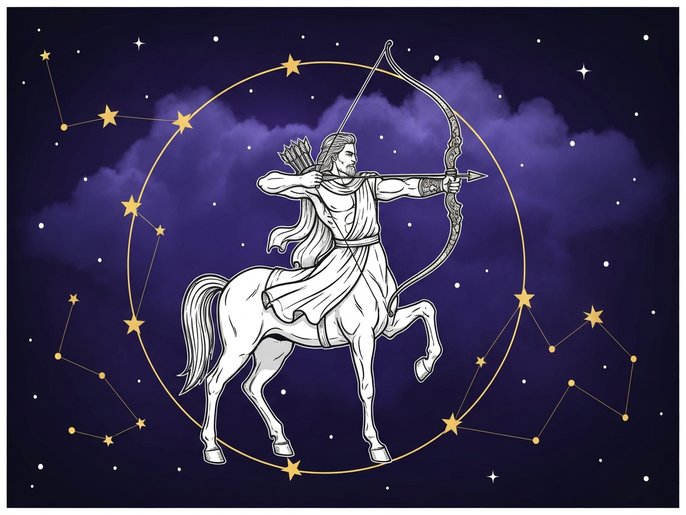
Sagittarius is the archer: a centaur, half animal instinct and half human aim, which is already a Temperance image, two natures blended into one working being. The sign burns with wanderlust, honesty, and a hunger for meaning; Jupiter, its ruler, expands everything it touches: faith, luck, appetite, horizons. Left unmixed, that energy scatters into a hundred enthusiasms and finishes none of them. Every Sagittarius knows this about themselves by about age twelve.
Temperance is what that fire looks like mastered. The archer’s whole art is a paradox of patience: enormous force, held completely still, released at exactly one moment. Draw, breathe, wait, loose. The crown over the mountains on the card is the archer’s mark, distant, elevated, and reachable only by a shot that refuses to be hurried.
As a fire card about moderation, Temperance settles an old argument: temperance was never water’s virtue. Water is effortlessly calm. It is fire that must learn proportion, and when it does, it stops being a hazard and becomes what fire was always for: light, warmth, and transformation, sustained.
Elementally, then: fire, tempered. Jupiter’s abundance, aimed.
Final Thoughts
Temperance is the Major Arcana’s quietest power move: an angel standing between an ending and a temptation, mixing something better than either. It will never be anyone’s favorite card at first. It becomes almost everyone’s favorite card eventually, usually around the time life teaches them that the dramatic chapters are survived but the balanced ones are lived.
If this card found you today, take its assignment seriously precisely because it sounds small. Adjust, do not overhaul. Blend, do not choose. Keep pouring at the pace that does not spill. The crown over the mountains is not going anywhere, and neither, anymore, are you.
To see where this energy sits in the deck’s larger story, read what comes on either side of it: the profound endings of the Death tarot card that make Temperance’s healing necessary, and the seductive extremes of the Devil tarot card that make its moderation heroic. For the card that shares its gentle, restorative spirit two steps later, spend some time with the Star tarot card meaning. And if you want to put Temperance’s patient wisdom to work on a real decision, one of the best tarot spreads for guidance is the natural next step.
Mix well. Take your time. That is the whole secret, and the angel has been holding it in plain sight all along.