What is the T-Square in Astrology?
Aspect patterns in astrology form when three or more planets align in geometric relationships that create a recognizable shape across the birth chart. The T-square is one of the most common and most discussed of these patterns, appearing in the charts of driven achievers and famously conflicted figures alike. Understanding what it means and how it functions gives a clearer picture of the particular kind of tension it describes.
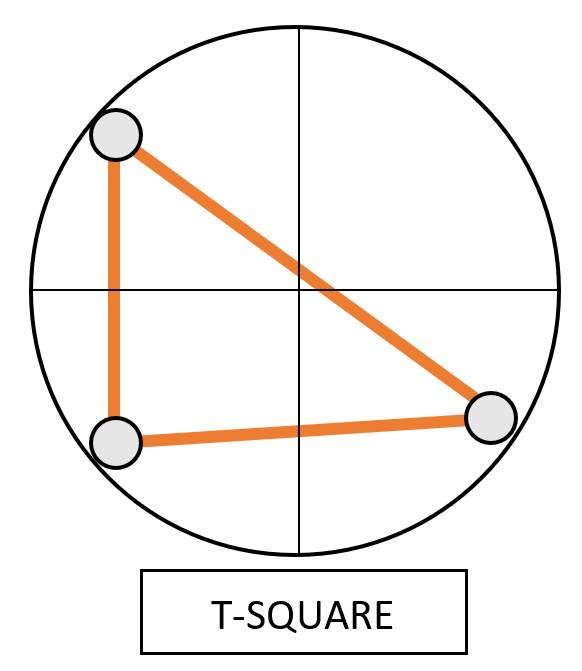
The short answer: a T-square forms when two planets oppose each other (180 degrees apart) and both square a third planet (90 degrees each), creating a triangular pattern. The third planet, called the focal or apex planet, carries the concentrated tension of the pattern.
The Basic Structure
Two planets in opposition sit directly across the chart from each other. They represent competing needs, drives, or life areas that pull in opposite directions. The square to the focal planet introduces a third energy that presses on both sides of that opposition, and the focal planet must somehow manage the friction generated by the other two.
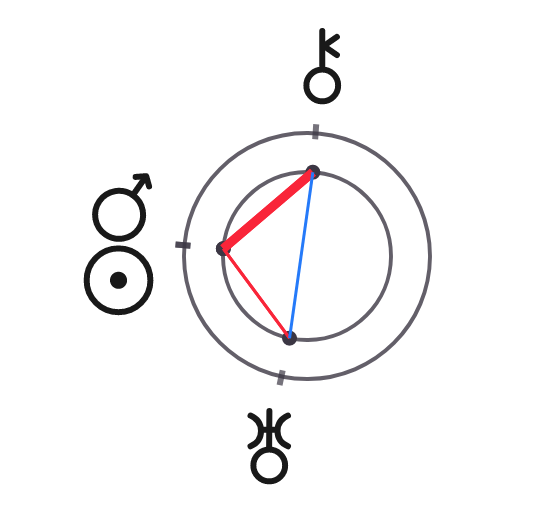
The focal planet is the most active point in the pattern. It sits at the pressure point of the opposition and absorbs the tension. In practice, it often becomes the most driven area of the chart, because the discomfort of the unresolved opposition tends to push action and decision-making through the house and sign where the apex planet sits. That house placement determines which life arena takes on the pressure, and jobs based on your birth chart is useful context for anyone whose focal planet falls in a career-relevant house.
Cardinal, Fixed, and Mutable T-Squares
The mode of the signs involved shapes how the T-square’s energy expresses itself. Cardinal signs (Aries, Cancer, Libra, Capricorn) push toward initiation and action. Fixed signs (Taurus, Leo, Scorpio, Aquarius) hold their ground and resist change. Mutable signs (Gemini, Virgo, Sagittarius, Pisces) adapt and disperse.
A cardinal T-square tends toward action, ambition, and the drive to initiate. The tension comes out through starting things, pushing forward, and taking charge. The challenge is completing what gets started before the next conflict redirects attention.
A fixed T-square is the most stubborn of the three. Fixed signs resist change and hold their ground through sustained commitment and, sometimes, inflexibility. The opposition can become entrenched, with both sides holding firm long after a more flexible approach might serve better. Once a fixed T-square finds a direction, it tends to pursue it without course correction.
A mutable T-square disperses its energy more widely. Mutable signs are adaptable, so the tension tends to scatter across many approaches and ideas rather than concentrating into a single sustained drive. That adaptability is the pattern’s real strength, but it also means the underlying conflict rarely gets resolved. The pattern simply moves on to the next iteration before anything settles.
The Empty Leg
The T-square gets its name from the letter it traces: a horizontal opposition with a vertical line dropping to the apex. The fourth corner of the implied square, the point in direct opposition to the apex, is empty. This is called the empty leg.
Astrologers often treat the empty leg as a pointer toward resolution. The sign and house of that empty point describe qualities and life areas that, when deliberately developed, tend to ease the pressure the T-square creates. It is not a guaranteed answer, but paying attention to that missing corner often reveals what the pattern is lacking.
For example, a T-square in mutable water, mutable fire, and mutable earth might have a mutable air empty leg, suggesting that the development of clearer communication, intellectual objectivity, and the ability to hold multiple perspectives at once could reduce the pattern’s friction.
T-Squares in Notable Charts
T-squares appear throughout the charts of people who are driven, sometimes compulsively, to achieve or resolve some fundamental internal tension. They do not guarantee success or failure. They describe an inner architecture that generates friction, and what the person does with that friction determines the outcome.
Kim Kardashian’s chart contains a T-square in mutable signs connecting Venus in Virgo, the Moon in Pisces, and Neptune in Sagittarius. For a detailed look at how that specific configuration shapes her chart, Kim Kardashian’s zodiac sign and chart explains the pattern and its context.
Working With T-Square Energy
Most experienced astrologers read the T-square as a source of motivation rather than a sentence. The tension it creates is real and persistent, and that persistence tends to generate action. People with prominent T-squares rarely remain passive for long.
The more productive approach is to work with the focal planet consciously, directing its energy toward a chosen aim rather than simply reacting to whichever pressure is highest in the moment. T-squares appear in synastry too, when planets across two people’s charts complete the pattern together, and the most important aspects of a synastry chart covers how those inter-chart configurations create shared dynamics. For a broader look at the major aspects and chart features that come up in a natal chart reading, the most important aspects of a natal chart covers the key elements in clear terms.