Six of Swords Tarot Card Meaning

The Six of Swords belongs to the suit of Swords, the airy company of the mind, where every card is some weather of thought, and this one is the long exhale after the storm. Swords is the suit of intellect, communication, and conflict, ruled by the restless element of Air, and in the old Golden Dawn attributions the six carries Mercury in Aquarius, the messenger working through the cool, detached air of the water bearer. The number six, wherever it falls in the deck, restores a measure of balance after the rupture of the five. Here that balance takes the shape of a journey across open water.
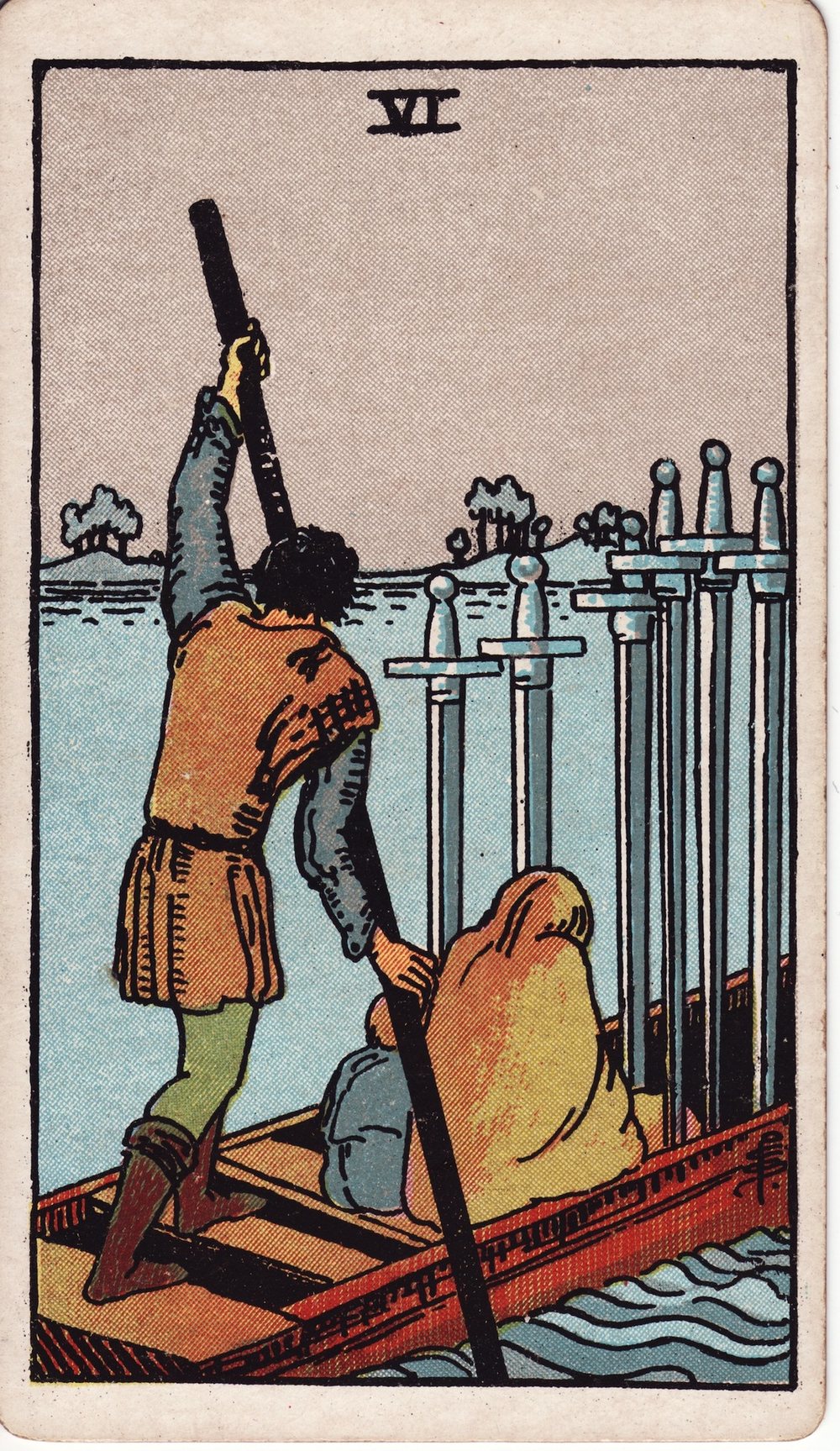
In the Rider-Waite image a ferryman stands in the stern of a shallow punt, pushing it forward with a long pole. He carries two passengers, a hooded woman and a small child, both wrapped against the cold and turned away from us toward the far bank. Six swords stand upright in the floor of the boat, driven into the wood at the front like a small fence of grief the travelers cannot put down.
The water tells you everything. On the near side, by the woman’s shoulder, it is choppy and broken into little waves. Ahead of the pole, toward the distant shore, it lies flat and still. The boat moves from the rough into the smooth, slowly, by the steady work of someone who knows the route.
It does not promise that the pain has been solved, only that it is being carried somewhere quieter. The swords come along for the ride because the mind does not heal by forgetting. It heals by moving, even while it remembers.
This is a card of passage rather than arrival. Every section below follows that same crossing, upright and reversed, and tries to read which shore your own boat is pointed toward.
What does the Six of Swords Tarot card mean?
Upright, the Six of Swords describes a transition already in motion. You are leaving something behind, a place, a habit of mind, a chapter that wore you down, and you are doing it deliberately rather than in a panic. The worst of the turbulence is behind the boat now.
It is rarely a triumphant card. Nobody on the boat is cheering. There is a tiredness to it, the flat calm of someone who has run out of fight and chosen, finally, to simply go. That choice is the quiet courage the card honors.
The swords standing in the hull matter. The grief, the lesson, the memory of what happened all travel with you. The Six of Swords is honest that you carry your sorrow across rather than leaving it on the dock. The point is direction, not amnesia.
When this card appears, look for where the water is smoothing out in your life. Something that was a daily storm is becoming a manageable swell. Keep the pole moving and trust that the far shore is real even when the mist hides it.
Six of Swords Keywords:
- Transition
- Moving on
- Recovery
- Mental distance
- Necessary departure
- Calm after turbulence
- Guided passage
- Travel and relocation
- Carrying the lesson
- Gradual healing
What does the Six of Swords mean when Reversed?
Reversed, the boat will not leave the dock. The Six of Swords inverted is the crossing that should be happening and is not. You know you need to move on, and yet the rope stays tied to the old post.
Sometimes this is circumstance. Money, obligation, or other people keep you anchored to a situation that has clearly run its course. More often it is internal. You keep rowing back to the rough shore because the misery there is at least familiar, and the far bank, with all its unknowns, frightens you more than the storm you know.
The reversed card can also mean the baggage has become too heavy to move. The swords are no longer being carried across, they are dragging in the water and slowing everything down. Old resentments and unfinished thoughts have stopped being passengers and become an anchor.
This is not a verdict of failure. It is a question. What is keeping the boat in place, and is that reason still true, or is it only a habit of staying?
Six of Swords Reversed Keywords:
- Resistance to change
- Feeling stuck
- Unfinished business
- Returning to old patterns
- Emotional baggage
- Delayed transition
- Running from a problem
- No clear direction
- Carrying too much
The Six of Swords as How Someone Sees You
When this card describes how another person sees you, they see someone in the middle of moving on, and they sense it clearly. You read to them as a person who has been through something and is quietly putting distance between themselves and it. There is a composed, slightly faraway quality they pick up on.
They may see you as steady but withdrawn, the sort of person who has gone somewhere inside themselves to recover. Not cold, exactly, but no longer fully docked where they can reach you.
To some, this is reassuring. They view you as mature, as someone who handles hardship by walking forward rather than making a scene. Others may feel you are slipping away from them, half on the far shore already, and wonder whether they are part of the journey or part of what you are leaving.
The Six of Swords Reversed as How Someone Sees You
Reversed, they see you as someone who keeps circling the same trouble. You talk about leaving, about changing things, and then nothing moves, and they have started to notice the gap between the two.
They may perceive you as stuck or weighed down, dragging an old story into every conversation. The grief that read as dignified when upright now reads as something you will not set down. To a friend this can look like loyalty to your own wound.
There is sometimes a sense of frustration in how they see you, the feeling of watching someone refuse a door that is standing open. They may have stopped offering to help, tired of rowing toward a shore you keep steering away from.
What does the Six of Swords mean in Love?
In love, the Six of Swords is the card of moving through a hard patch into calmer water together. If a relationship has been stormy, this is the slow truce that follows, the cooling of tempers and the decision to keep going side by side rather than to keep fighting.
For couples, it can mean a literal move or a shared journey, leaving a city, a living situation, or a phase that strained you both, and crossing into something gentler. The closeness here is quiet. It is two people in the same small boat, not talking much, simply going the same way.
It can also describe leaving a relationship behind. Sometimes the calmer shore is solitude, and the card blesses the dignified exit, the choice to stop bleeding in a situation that only hurts. For someone single, it often points to recovery after heartbreak, the stretch where you are not ready for romance yet because you are still crossing the water away from the last one. If you want to read the card in a fuller relationship context, a spread built for love readings can help you see both banks of the water and what the boat is actually carrying.
What does the Six of Swords Reversed mean in Love?
Reversed in love, the relationship cannot get out of its old waters. The same argument, the same wound, the same town you both swore you would leave. Forward motion stalls and the two of you keep washing back to where it hurts.
For couples, this can mean clinging to a bond that has clearly ended, staying out of fear of the unknown rather than out of love. The swords are dragging. Unresolved hurts surface again every time you try to move past them, and the crossing never finishes.
For the single person, the reversed Six of Swords is the heart that has not let the last love go. You may be physically free of someone and still emotionally rowing back to them at night. Before any new shore appears, that rope to the past has to be cut. Some of that difficulty traces back to the wreckage of the Three of Swords, the heartbreak this crossing is so often trying to leave behind.
What does the Six of Swords mean in Friendship?
Among friends, the Six of Swords speaks of moving on together, or of a friendship that helps you move on. A good friend here is the ferryman, the one who quietly gets you across a bad season without asking for a parade. This card values the friend who shows up and simply helps you go.
It can also mark a natural drift, the friendship that is gently changing as one or both of you head into a new chapter. Not a falling out, just two boats taking slightly different routes across the same water, still fond, still waving.
Travel and shared journeys often attach to this card in friendship, the trip you take to clear your heads, the road trip that becomes a turning point. There is healing in going somewhere with people who let you be quiet.
What does the Six of Swords Reversed mean in Friendship?
Reversed, a friendship is stuck in an old grievance nobody will name. The crossing that should have moved you both past a misunderstanding never happened, and now you circle it politely, both aware of the snag under the surface.
It can also point to the friend who keeps you anchored, the one whose constant crisis or old grudge pulls you back into rough water every time you try to row clear. You may be the steady boat that never gets to leave because someone keeps grabbing the rope.
Sometimes the reversal is about you returning, again, to a friendship that has run its course, mistaking familiarity for connection. Ask whether you are still traveling together or just refusing to admit the trip is over.
What does the Six of Swords mean in Career?
In work, the Six of Swords is a steady, low-drama transition. A new job, a transfer, a department change, a move to a different city for the role. You are leaving a difficult work situation behind and the change, while real, is being navigated calmly rather than dramatically.
It frequently carries the literal sense of travel and relocation, the commute that gets longer, the assignment in another place, the business that takes you over water. If you have been weighing a move for the sake of your sanity, this card supports the crossing.
There is recovery in it too. If your working life has been a storm of conflict or burnout, the Six of Swords marks the slow return to even keel. You are not thriving yet, but you are no longer drowning, and the direction is right.
What does the Six of Swords Reversed mean in Career?
Reversed, you are stuck in a job you have outgrown and cannot seem to leave. The transfer falls through, the resignation never gets written, or you keep talking yourself back into staying because the unknown costs more nerve than you have today.
It can warn of a move that is poorly planned, a leap to a new role or city that carries all the old problems along with it because nothing was actually resolved first. The swords come too, and you arrive at the new desk with the same dread.
Sometimes it points to a workplace transition that has been delayed or blocked by others, a promotion stalled, a relocation tangled in red tape. The boat is loaded and ready and still tied to the dock. Patience and a clear plan matter more than another anxious push.
The Six of Swords as How Someone Thinks of You
In someone’s thoughts, the Six of Swords casts you as a refuge, a calmer shore. They think of you as the person who helped them get through something, or as the steadier place they would like to reach. There is gratitude or longing in it, the way you think of land when you have been at sea.
They may associate you with a particular passage in their life, a time you guided them out of trouble. You live in their mind as a chapter of recovery, someone tied to the feeling of finally breathing again.
If the relationship has cooled, they may think of you as someone they are gently leaving behind, not with anger, just with the quiet acceptance of someone facing forward in the boat. You are part of a shore that is slowly receding from view.
The Six of Swords Reversed as How Someone Thinks of You
Reversed, their thoughts of you are tangled with something unresolved. They cannot quite move past you, and they are not at peace about it. You occupy the part of the mind that keeps rowing back to a question that never got an answer.
They may think of you as someone they are stuck on, or as the reason they feel stuck, depending on the history. Either way there is a lack of resolution in how you sit in their head, a story they keep rereading instead of closing.
Sometimes it shows someone who knows they should let the thought of you go and will not. You are the familiar shore they keep returning to in their mind even though they sense the calmer water lies the other way.
What does the Six of Swords mean in Conflict?
In conflict, the Six of Swords is the decision to withdraw rather than to keep fighting. It is not surrender and not victory. It is the wisdom to pole the boat away from a battle that has nothing left to win, taking your losses with you and leaving the field behind.
This card favors de-escalation. The smartest move is to put distance between yourself and the trouble, to let the rough water churn on without you in it. You step back, you cool down, you choose the longer route toward peace over the short, hot road of being right.
It can also mean a conflict is genuinely winding down, the heat of the argument giving way to a tired, workable calm. Nobody got everything they wanted. Everybody gets to move on. Where the Five of Swords is the sharp cost of fighting to win, the Six is the quieter choice to simply leave the field.
What does the Six of Swords Reversed mean in Conflict?
Reversed, you cannot disengage. The conflict keeps pulling you back in, or you keep wading back into it, unable to leave a fight that is clearly finished. The boat will not push off because part of you still wants to argue the point.
It can show a dispute that resurfaces every time it seems settled. The same wound reopens, the same old grievance gets dragged back to the table, and no real distance is ever achieved. You are rowing in circles in rough water.
Sometimes the reversal warns against running from a conflict that actually needs to be addressed before you can leave it cleanly. Fleeing without resolution just means you load the unfinished fight into the boat and carry it to the next shore.
The Six of Swords as Feelings
As feelings, the Six of Swords is muted and bittersweet. Not joy, not despair. The gray, steady calm of someone who has cried themselves out and feels, finally, a little lighter for it. Relief and sadness sit in the same boat here.
Someone feeling the Six of Swords is emotionally moving on. They have accepted that something is over and they are letting it recede, not without grief, but without drama. There is a numbness to it, the protective quiet the mind wraps around a fresh loss.
This is the feeling of being mid-recovery. Where the Four of Swords is the deliberate rest before the crossing, the Six is what it feels like when you finally lift your head and find that you can move. The acute pain has passed and full healing has not arrived. It is the long middle stretch of water, where you are simply tired, simply going, and quietly grateful the storm is behind you.
The Six of Swords Reversed as Feelings
Reversed, the feelings will not settle. There is a churning sense of being stuck, of wanting to feel better and being unable to push off from the pain. The mind keeps returning to the rough shore it is trying to leave.
It can describe emotional baggage that has grown too heavy, grief that has curdled into something stagnant. The sadness is no longer moving through them, it is pooling, and they feel weighed down by feelings they cannot seem to process or release.
There can be anxiety in this position, the restless dread of someone caught between an old hurt they cannot forget and a future they cannot yet face. The crossing they need is emotional, and it has not begun.
The Six of Swords as a Situation
As a situation, the Six of Swords is a passage between two states. You are leaving one set of circumstances and have not fully landed in the next. The defining feature is movement, slow and deliberate, away from difficulty toward something calmer.
It often marks the aftermath of a hard time, the recovery phase rather than the crisis itself. The dramatic part is over. What is left is the work of getting across, the unglamorous distance between the wreck and the rebuild.
This is a situation that rewards patience and direction over speed. You will not arrive today. The current is with you, the route is known, and the only real task is to keep the boat pointed at the far shore and let the crossing take the time it takes.
The Six of Swords Reversed as a Situation
Reversed, the situation is stalled. A change that should be happening has jammed. You are caught between two shores with no momentum, unable to go back and unwilling, or unable, to go forward. The water sits flat and you sit with it.
It can describe being pulled back into an old circumstance just as you were beginning to leave it, the move that falls through, the return to a place you had outgrown. Progress reverses and you find yourself bailing the same water again.
Sometimes the held situation is a sign that something was skipped. A debt unpaid, a conversation unhad, a loose end that has to be tied before the boat can leave. The reversal asks you to find the rope still tying you to the dock.
The Six of Swords as Intentions / What Someone Wants
As intentions, the Six of Swords means someone wants peace and distance. They are looking to move past the trouble, to get somewhere calmer, and their aim is recovery rather than confrontation. They want the storm to be over more than they want to win it.
They may intend to take you along on that crossing, wanting your company in the calmer water ahead. There is a gentle, forward-facing wish here, the desire to leave hard things behind and build something quieter with you on the other side.
It can also mean someone wants out, cleanly and without a scene. Their intention is the dignified departure, to pole away from a situation that has hurt them and not look back. Read the surrounding cards to see whether you are the shore they are leaving or the one they are rowing toward.
The Six of Swords Reversed as Intentions / What Someone Wants
Reversed, their intentions are caught between leaving and staying. They want to move on and they keep choosing not to, so the want never becomes a plan. There is indecision at the center of what they are after.
It can show someone who wants to drag an old issue back into the present, who is not ready to let a finished matter rest. Their aim, conscious or not, is to keep circling the rough water rather than to cross it.
Sometimes the reversal reveals a wish to escape without doing the work, to flee a problem rather than resolve it. They want the relief of the far shore without paying for the passage, and that shortcut tends to load the swords right back into the boat.
Is the Six of Swords a Yes or a No?
The Six of Swords is a cautious, qualified yes. Things are moving in the right direction and the difficult part is easing, but this is a card of process rather than of arrival, so the yes comes slowly and through some effort. Expect progress, not an instant result.
It answers best when the question is about change, travel, recovery, or moving on. To those it says yes, the crossing succeeds, give it time. To questions hoping for things to stay exactly as they are, it leans no, because its whole nature is departure.
Reversed, the answer turns to not yet. The transition is blocked, the timing is off, or something must be settled before the path opens. It is rarely a flat no, more a no for now, a sign to clear the obstacle before you ask again.
The Six of Swords as a Place
As a place, the Six of Swords points to water and to passage. Rivers, ferries, harbors, bridges, the in-between spaces of travel. It is the airport at dawn, the train pulling out, anywhere that is less a destination than a means of getting from one life to another.

It can also indicate a new place reached after a move, a calmer town or quieter home found on the far side of upheaval. There is a settled, slightly muted quality to such a place, somewhere safe rather than thrilling, which after a storm is exactly the point.
On an inner level, the place of the Six of Swords is that calm clearing in the mind you reach once the panic subsides, the quiet room you finally find after a long, loud season. It is the feeling of arriving somewhere you can hear yourself think again.
The Six of Swords Reversed as a Place
Reversed, the place is one you cannot leave. The house you have outgrown, the city that holds bad memories, the same four walls you keep meaning to escape. There is a stuck quality to the location, a sense of being marooned where you no longer belong.
It can also describe a journey gone wrong, a relocation that brought no relief because the trouble came along in the luggage. The new place feels exactly like the old one, because nothing was actually left behind.
Sometimes it is the place you keep returning to against your better sense, the old haunt, the bar, the doorstep, the corner of the past your feet carry you back to. The reversal asks why the boat keeps drifting back to a shore you swore you had left.
The Six of Swords as an Obstacle / Challenge
As an obstacle, the Six of Swords is the difficulty of moving on when part of you wants to stay. The challenge is letting go, trusting an unseen shore, making the crossing before you can see where you are going to land.
It can mark the weight of what you carry as the real barrier. The swords in the boat slow the trip. Old grief, old grudges, and unfinished thoughts make every stroke harder. The challenge is to keep moving despite the load, and to set down what you can.
There is also the obstacle of the in-between itself, the discomfort of no longer being where you were and not yet being where you are headed. That long gray middle tests your patience. The card asks you to endure the crossing rather than to leap out and swim back.
The Six of Swords Reversed as an Obstacle / Challenge
Reversed, the obstacle is full paralysis. You are not moving at all, and the longer you sit still the heavier the boat feels. The challenge has hardened from a difficult crossing into a refusal, or an inability, to begin one.
It can show that the thing blocking you is something you have not dealt with, a fear, a debt, a conversation, a grief you keep dodging. Until you face it, the boat stays tied, and every attempt to leave just slackens the same rope. If the stuckness has tightened into something that feels like a trap, the Eight of Swords maps that corner of the mind where paralysis becomes the whole horizon.
The deeper challenge here is honesty about what you are actually clinging to. Sometimes we call it caution when it is really comfort in the familiar pain. Naming that is the first push of the pole.
The Six of Swords as Action
As an action, the Six of Swords says to move on, calmly and deliberately. Step back from the storm, gather what matters, and make your crossing without theatrics. The right move is a quiet exit toward steadier ground, not a dramatic stand.
It counsels taking the gentler route. Where another card might urge you to fight or to charge, this one tells you to disengage, to put real distance between yourself and the source of the strain, and to let time and travel do their slow work.
The action can be literal. Take the trip. Make the move. Change the scenery. Sometimes the most healing thing you can do is physically go somewhere new and let the change of place begin the change of mind.
The Six of Swords Reversed as Action
Reversed, the action being asked is the one you keep avoiding. Stop circling and either commit to the crossing or deal with what is keeping you tied to the dock. Half-measures and anxious loops are getting you nowhere.
It can mean you need to stop running and turn around to face the thing you have been fleeing. The reversal sometimes warns that the move you keep attempting will not work until the underlying issue is resolved, so the real action is inward, not outward.
Either way, the call is to break the stalemate. Lighten the load, cut the rope, or address the snag, but do not keep sitting in still water pretending the boat is moving when it is not.
The Six of Swords as Advice
As advice, the Six of Swords says it is time to move on, and to do it gently. Leave the rough water behind. You do not have to resolve every grievance or win every argument before you go. Sometimes the wise thing is simply to point the boat at calmer water and start poling.
It advises you to accept help on the crossing. The ferryman is there for a reason. Let someone steady guide you through the transition, a friend, a counselor, a person who knows the route. You were not meant to make every passage alone.
The card also counsels patience with your own recovery. Healing is a crossing, not a leap. Let it take the time it takes, carry what you must, and trust that the still water ahead is real even while the far shore is hidden in mist. If you want to map the crossing more intentionally with the cards, a spread built for guidance can help you see where the boat is now and what the far bank might hold.
The Six of Swords Reversed as Advice
Reversed, the advice sharpens. Look honestly at what is keeping you stuck. You have been meaning to move on for a while now, and something keeps tying you back. Find that rope and decide, consciously, whether to cut it.
It warns against fleeing without finishing. If there is an unpaid debt, an unsaid word, or an unprocessed grief, deal with it before you cross, or you will only carry it with you. Running is not the same as healing.
Above all, the reversal asks you to stop romanticizing the familiar pain. The known shore is not safer just because it is known. Gather your courage, lighten the boat, and let yourself go toward the water you cannot yet see.
The Six of Swords as an Outcome
As an outcome, the Six of Swords promises a calmer aftermath. Whatever storm the reading concerns, the resolution is a passage out of it, a gradual easing into steadier conditions. You come through, tired but intact, and the worst is genuinely behind you.
It is a hopeful ending told in a quiet voice. Not a celebration, not a fresh start with fireworks, but the deep relief of finally reaching smoother water. The outcome is recovery, distance from the trouble, and the slow return of peace.
The card suggests the conclusion involves moving on in some literal sense, a change of place, a clean departure, a chapter closed and left on the far bank. Whatever you were carrying, you carry it somewhere better.
The Six of Swords Reversed as an Outcome
Reversed, the outcome stalls short of relief. The situation does not resolve cleanly because the transition out of it never completes. You end up caught between the old trouble and the calm you were hoping for, with neither fully won.
It can mean the matter drags on, that an attempt to leave fails and pulls you back to where you started. The swords stay heavy, the water stays rough, and the longed-for shore recedes a little further. Something has to change before this can end well.
This is not a permanent verdict, only an unfinished one. The reversal points to a crossing that needs a second, better-prepared attempt, made once the anchor has been found and raised.
The Six of Swords in the Future
In the future position, the Six of Swords foretells a coming transition, a passage out of present difficulty into something calmer. A change is on the way, likely involving a move, a journey, or the quiet closing of a chapter that has worn you thin.
It is a gentle, reassuring forecast. Whatever rough water you are in now, the card says you will not be in it forever. Ahead lies steadier ground, reached not by a single dramatic event but by a slow, deliberate crossing you are already beginning to make.
Travel may be literal in your future, a trip that matters, a relocation, a road that carries you somewhere new. Whether outward or inward, the journey ahead leads toward recovery and a quieter mind.
The Six of Swords Reversed in the Future
Reversed, the future warns of a transition that keeps getting delayed. The move you are counting on may stall, or you may find yourself returning to a difficulty you thought you had left. The crossing ahead is snagged and will take more than wishful thinking to free.
It can caution that you are heading toward a change without dealing with what made the change necessary, so the new chapter risks carrying the old weight. Prepare the ground before you go, or the future simply repeats the past in a different place.
This is a call to look ahead with honesty rather than dread. The stuckness is not fate. It is a signal to find and address the anchor now, so that when the crossing does come, you are light enough to make it.
The Six of Swords as a Person
As a person, the Six of Swords describes someone in transition, quietly resilient, carrying their losses with a kind of weary grace. They have been through something and are moving on from it, composed on the surface and still tender underneath. There is a calm, slightly distant air about them.
This person is often a guide or a protector, the steady one who gets others safely through hard times, like the ferryman doing the unshowy work of the crossing. They are practical in a crisis and gentle with the wounded. People in trouble tend to gravitate toward them.
It can also point to a traveler, a literal one or a restless soul forever moving toward calmer water, or to someone in the middle of a major life change, between homes, between jobs, between selves. Meet them with patience. They are mid-passage, and not yet fully arrived.
The Six of Swords Reversed as a Person
Reversed, the person is stuck, weighed down, unable to move past an old hurt. They may be the friend who keeps returning to the same trouble, the one who talks about leaving and never does, carrying baggage that has grown heavier than they can lift.
They can be someone running from a problem rather than resolving it, restless without direction, changing places and faces while the real issue follows them everywhere. There is an unsettled quality to them, a journey that never seems to land.
Approach them with compassion rather than impatience. Beneath the stuckness is usually fear, an old grief they cannot set down or a shore they are too frightened to leave. What they need is not pushing but a steady hand and the trust that the crossing is survivable.
What Zodiac Sign / Element is the Six of Swords?
The Six of Swords belongs to the element of Air, the breath of the mind, of thought, language, and the long internal conversations we have while deciding whether to stay or go. Air is the medium the boat travels under, the clear cold sky over still water, and it gives this card its mental, reflective character. The crossing of the Six of Swords is above all a journey of the mind.
By the old esoteric attributions the card sits with Mercury in Aquarius, the planet of communication and travel moving through the detached, forward-looking air sign of the water bearer. Mercury rules journeys and messages, which is why this card carries such a strong note of movement and transition, while Aquarius lends it that cool, slightly removed perspective, the ability to step back from the storm and see the calmer route.
Within the wider suit of Swords, the air signs are Gemini, Libra, and Aquarius. The Six leans most naturally toward Aquarius, the detached, future-facing observer who knows when it is time to move on, though its restless travel and quick changes of place also carry a flicker of Mercury-ruled Gemini. It is the part of the Air temperament that grieves quietly, thinks its way across the water, and trusts the far shore before it can see it.
Final Thoughts
The Six of Swords is a card of purposeful movement, of leaving the rough water for the smooth without pretending the swords were ever weightless. Whatever has been difficult is loosening its hold, and the direction is forward, even when the far shore is still hidden in mist. Keep the pole moving and let the crossing take its time. If you want to follow the suit’s story further, the Seven of Swords takes up what happens once you reach firmer ground and the question shifts from escape to strategy, and the broader guide to reading the Minor Arcana sets this quiet little boat in the wider current of the suits. The other shore is real. Trust it, and go.