Three of Swords Tarot Card Meaning
Swords belong to the element of Air, the suit of the mind, of language, judgment, and the cold clarity of thought. Where Cups feel and Pentacles build, Swords think, and thinking is where we cut ourselves. The Three of Swords is the moment the cut lands.
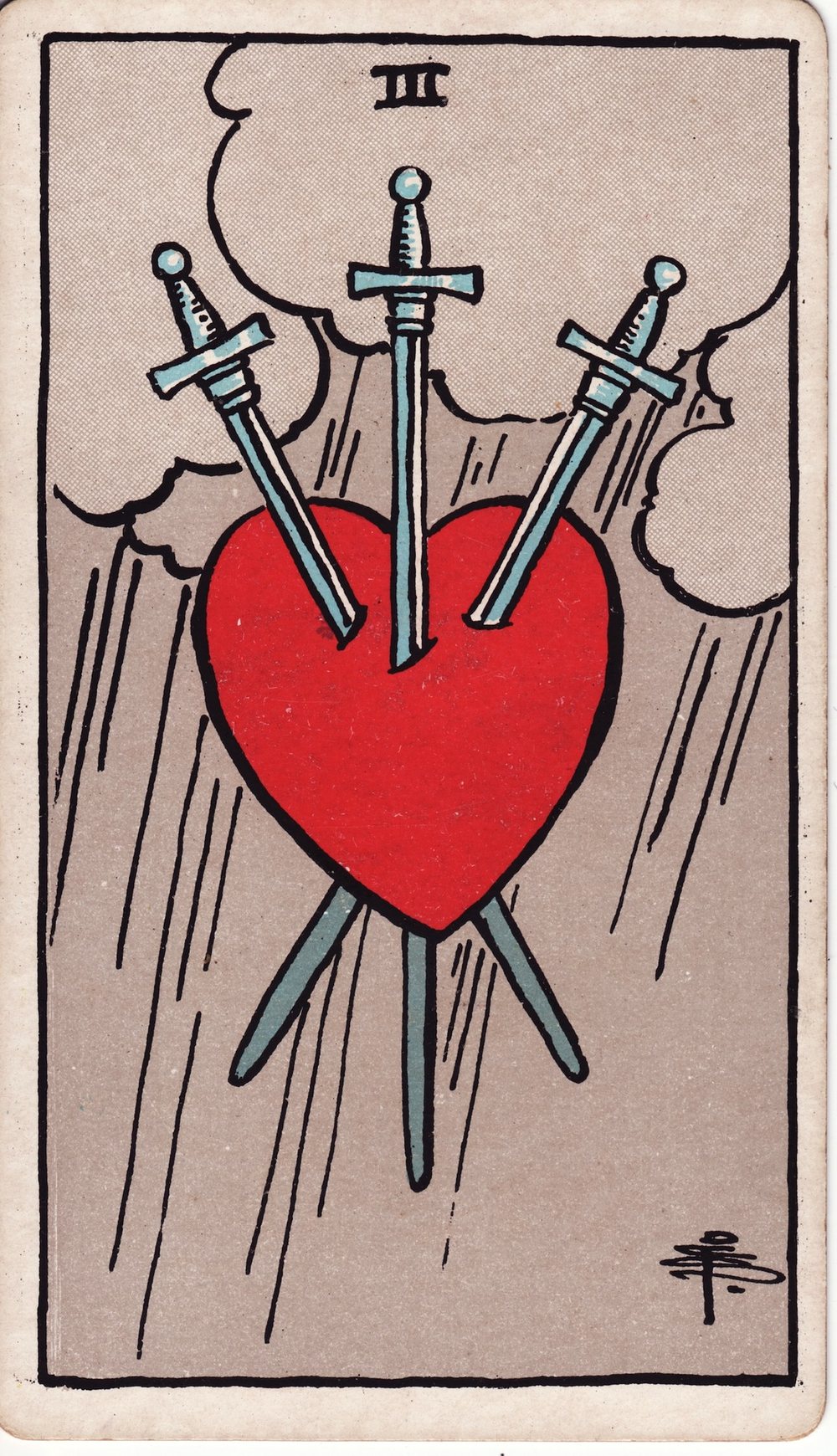
The Rider-Waite image is almost brutally simple. A single red heart hangs in the center of the card, plump and exposed, and through it pass three straight blades, crossing in the middle so the points push out the far side. There is no figure here, no hero, no villain, only the wound itself. Behind it stretches a flat grey sky, swollen with rain, the kind of weather that does not threaten a storm so much as settle into one.
That bareness is the whole message. The card refuses to dress up the pain. It does not offer a person to blame or a story to soften the blow. It shows you the heart and the three things that pierced it, and it lets the grey rain fall.
Three is the number of expression, the point where two becomes a crowd and something gets said out loud. In the Cups suit that brings a circle of friends raising glasses, the kind of joy you can read about in the Three of Cups tarot card meaning. In Swords the same number turns the spoken word into a weapon. A truth named, a confession made, a third party stepping into a relationship that was meant for two. The mind has finally said the thing it could not unsay.
Yet the rain in this card is not only sorrow. Rain clears the air. It washes the dust from a sky that has been heavy for too long. The Three of Swords hurts because something real has been seen, and seeing it, however much it stings, is the first honest step out of confusion. This is a card of grief, but grief is what we do when we have finally stopped pretending.
The many shapes this ache can take, upright and reversed, are worth sitting with, so that the next time those three blades appear in a spread you can meet them with understanding rather than dread.
What does the Three of Swords Tarot card mean?
Upright, the Three of Swords names heartbreak plainly. Something has hurt you, or is about to, and the card is not interested in cushioning it. A betrayal, a rejection, a loss, a piece of news you did not want to hear. The pain is sharp because it is sudden and because it strikes at the place we guard most carefully.
What separates this card from simple bad luck is the role of truth. The three blades are made of the same airy metal as every Sword, which is to say they are made of thought and speech. Often the wound comes from something being said aloud, a fact admitted, a feeling confessed, a reality that can no longer be denied. The hurt and the honesty arrive together.
There is a strange mercy buried in that. As long as the heart could pretend, it stayed stuck in a fog. Now the fog is gone. You know where you stand, even if where you stand is in the rain. The Three of Swords marks the end of comforting illusions, and while that ending bleeds, it also frees you to deal with what is actually true.
Do not rush past the feeling. This card asks you to let the grief move through you rather than around you. The rain falls until it is finished falling. Your task is not to stop it but to stand in it honestly, knowing the sky will clear once it has emptied itself.
Three of Swords Keywords:
- Heartbreak
- Grief
- Painful truth
- Betrayal
- Rejection
- Sorrow
- Separation
- Emotional release
- Honesty that wounds
- Clearing the air
What does the Three of Swords Tarot Card mean when Reversed?
Reversed, the three blades begin to slide free of the heart. The reversed Three of Swords is the long, awkward work of recovery, the part that comes after the worst of the pain but before you feel whole again. That in-between territory, where the sharpness has passed but wholeness is still ahead, is something the Four of Swords describes well.
This position can read two ways, and the surrounding cards will tell you which. At its best, it is healing in progress. The wound is closing, forgiveness is becoming possible, and you are learning to breathe without flinching. The rain is thinning to a drizzle.
At its more difficult, the reversed card shows pain that refuses to leave. You are holding the blades in place yourself, replaying the hurt, nursing a grudge, refusing to let the heart knit back together. The grief has curdled into something stagnant. Reversed Swords often point to a mind that loops, and here the loop is an old wound picked open again and again.
Either way, the card turns your attention inward. Where the upright Three points to a fresh cut, the reversed Three asks what you are doing with the cut you already have. Are you tending it or feeding it? The choice, for once, is mostly yours.
Three of Swords Reversed Keywords:
- Recovery
- Healing
- Forgiveness
- Releasing pain
- Lingering grief
- Self-pity
- Reopened wounds
- Repression
- Optimism returning
- Letting go
The Three of Swords as How Someone (He/She) Sees You
When this card describes how someone sees you, it is rarely flattering and rarely simple. They may see you as a source of pain, fairly or not. Perhaps you said something that landed hard, or you represent a hurt they have not finished feeling. To them, your face is tangled up with a wound.
It can also mean they see you as someone they have hurt, and the guilt colors how they look at you. They cannot meet your eyes cleanly because the memory of what happened sits between you.
In gentler readings, this card says they see you as wounded, as someone going through a sorrow they want to understand. They notice the heaviness you carry and they read it, even if you have tried to hide it.
The common thread is that you appear to this person through the lens of hurt. The Three of Swords does not show neutral perception. Something painful has marked the way they regard you, and that pain wants acknowledging before anything warmer can grow.
The Three of Swords Reversed as How Someone (He/She) Sees You
Reversed, the hurt in their view of you is softening. They may see you as someone who is healing, who is finally moving past whatever stood between you. The sharpness has dulled.
Sometimes this is the position of someone ready to forgive, or hoping to be forgiven. They look at you and feel the wound closing rather than aching. The accusation has left their gaze.
Watch, though, for the shadow reading. The reversed card can show someone still quietly bruised who is pretending not to be. On the surface they treat you as fine, but underneath the resentment has only gone quiet, not away. If other cards suggest avoidance, take the calm at face value with caution.
What does the Three of Swords Tarot Card mean in Love?
In love, the Three of Swords is one of the harder cards to pull, and there is little point dressing that up. It speaks of heartbreak inside a relationship: a betrayal discovered, a painful conversation, a truth that changes everything. The third blade often hints at a third person, a love triangle or an affair, but it can just as easily be a third presence of another kind, an old wound, a family pressure, a secret that has wedged itself between two people.
For couples, this card frequently marks the moment the hidden becomes spoken. Something has been festering, and now it is out in the open. That is painful, but secrets corrode a bond far more slowly and surely than honest pain does. The rain in the card is the relief of finally saying it, even as it soaks you.
For those who are single, the Three of Swords can point to a heart still tender from a past hurt. You may be carrying grief from a love that ended badly, and that sorrow is shaping how you approach anyone new. The card does not forbid love. It asks you to notice the wound first, so you are not handing someone a heart that is still bleeding and asking them to be the bandage.
This is not a card of permanent doom in love. It is a card of necessary pain, the kind that, faced honestly, can clear the way for something more truthful than what came before. If the Three of Swords lands in a love reading and the stakes feel high, a relationship spread often brings more context to the surface.
What does the Three of Swords Reversed mean in Love?
Reversed, the love reading shifts toward repair. The blades are coming out. A couple that weathered a betrayal or a brutal argument may be finding their way back, slowly, with the wound still visible but no longer fresh. Forgiveness is on the table.
For the single reader, the reversed Three is often the better news. The old heartbreak is loosening its grip. You are ready, or nearly ready, to let someone in again without bracing for the next blade.
The caution sits with the shadow form. Reversed, this card can show a refusal to grieve a relationship that is over, a clinging to hurt because letting go feels like losing the last connection to the person. If you find yourself rehearsing old wrongs to keep the feeling alive, the card is naming that habit. Healing asks you to set the blades down, not to keep them sharp.
What does the Three of Swords Tarot Card mean in Friendship?
Among friends, the Three of Swords usually marks a falling out. Harsh words have been exchanged, or a confidence was broken, and the warmth has gone cold. Friendship runs on trust, and trust is exactly what the three blades have pierced.
Sometimes the card points to a friend who let you down at a moment you needed them, or to gossip that traveled back to you and stung. The hurt feels personal because friendship is supposed to be safe ground, and this card shows that ground giving way.
It can also flag a third friend disrupting a close pair, jealousy or competition souring what used to be easy. The triangle that brought celebration in the Cups suit brings tension here.
The card does not always mean the friendship is finished. It means there is a real wound that needs naming. Pretending nothing happened only buries the blade deeper. If the friendship matters, the honest conversation, however uncomfortable, is the way through.
What does the Three of Swords Reversed mean in Friendship?
Reversed, a wounded friendship is mending. An apology may have been offered, or both of you have simply softened with time and decided the bond is worth more than the grievance. The frost is thawing.
This can also be the moment you make peace with a friendship that has run its course, releasing the resentment you carried and wishing the person well from a distance. Not every reconciliation means reuniting. Some mean finally letting go without bitterness.
The harder reading is a friendship where the hurt is being swept under the rug rather than resolved. Surface politeness hides a grudge that still smolders. If that fits, the card suggests that real repair has not happened yet, only a truce.
What does the Three of Swords Tarot Card mean in Career?
At work, the Three of Swords brings disappointment and conflict. A promotion that went to someone else, a project that collapsed, a colleague whose criticism cut deeper than expected, a job lost. Something you cared about has been taken or denied, and it hurts.
The card often involves other people directly. Office politics, a betrayal by someone you trusted, a clash that left you wounded in front of others. The mind of the Swords suit is here too, in sharp memos and sharper meetings, in words that were meant to land hard.
There is sometimes a painful truth in this position about the work itself. Perhaps a role you fought for has shown you it was never going to make you happy, or feedback you did not want to hear has named a real weakness. The blade stings, but it also clarifies.
The Three of Swords does not promise the situation is permanent. It marks a low point and asks you to feel it without pretending you are fine. From an honest assessment of what went wrong, a wiser next step becomes possible.
What does the Three of Swords Reversed mean in Career?
Reversed, the professional wound is beginning to close. A conflict at work is settling, a disappointment is losing its sting, and you are recovering your footing after a setback. The atmosphere is clearing.
This can be the moment you forgive a colleague, or simply stop letting an old slight occupy your thoughts. Energy you were spending on resentment becomes available for the work again.
The shadow form warns of stewing. You may be holding onto a workplace grievance long past its usefulness, replaying the unfairness instead of moving forward. If a setback has become an identity, the card asks you to release it before it quietly shapes every decision you make.
The Three of Swords as How Someone Thinks of You
When the Three of Swords describes someone’s thoughts about you, those thoughts are heavy with hurt. They may think of you with pain, associating you with a wound they have not healed. Your name brings a pang rather than a smile.
This does not always mean they dislike you. Sometimes we ache most over the people we loved, and the sorrow in their thoughts is a measure of how much you mattered. The grief and the caring are tangled together.
In other readings, they are thinking of you with regret, turning over something they did or failed to do, wishing they could undo the damage. The blade points back at them.
What this card rarely shows is indifference. You occupy a painful place in their mind, and that pain wants to be addressed honestly before it can ease into anything gentler.
The Three of Swords Reversed as How Someone Thinks of You
Reversed, the painful thoughts are easing. They are beginning to think of you without the old flinch, the hurt fading into something they can hold more calmly. Time, or forgiveness, has done its work.
This can be someone ready to make amends in their own mind, having forgiven you or themselves for whatever went wrong. The thought of you no longer cuts.
Be alert, though, to suppression. The reversed card can show someone who has buried their feelings about you rather than processed them. They may insist they are over it while a quiet ache remains underneath. Calm on the surface does not always mean peace below.
What does the Three of Swords mean in Conflict?
In a conflict reading, the Three of Swords shows a dispute that has drawn blood. This is not a polite disagreement. Words have been weaponized, and someone has been genuinely hurt, perhaps both of you. The fight has cut to the core.
The card often marks the moment a painful truth gets spoken in the heat of things, a long-held grievance finally voiced, a betrayal named out loud. Once said, it cannot be unsaid. The conflict has changed shape because something real is now on the table.
The Three of Swords counsels you to recognize the genuine pain involved, on both sides. This is not a clash of egos to be won. It is a wound to be tended. Trying to score points will only drive the blades deeper.
If there is any path forward, it runs through honest acknowledgment. The air needs the rain to clear. Pretending the hurt did not happen leaves it to poison everything that comes after.
What does the Three of Swords Reversed mean in Conflict?
Reversed, the conflict is moving past its sharpest point. The shouting has stopped, the worst has been said, and now comes the slow process of repair or, at least, of disengaging without further damage.
This position can show a willingness to forgive, to lay down the weapons and accept that everyone bled. The dispute is winding down rather than escalating.
It can also reveal a conflict that has gone underground. The open fighting has ended, but resentment lingers and could resurface. If the issue was buried rather than resolved, the reversed card warns that the calm may be temporary. Better to finish clearing the air than to leave a blade hidden in the dark.
The Three of Swords as Feelings
As feelings, the Three of Swords is unambiguous. There is heartbreak here, raw and present. Sorrow, grief, the ache of betrayal or rejection. The person feels wounded, and the feeling is too large to hide.
This is not a passing mood. The card shows a hurt that has gone deep, the kind that sits in the chest and colors everything. If it describes how someone feels about you, they are in real pain connected to you, whether that pain is anger, loss, or disappointment.
There is honesty in this card’s feelings, however much they hurt. The mask is off. Whatever was being held in has broken through, and the heart is showing exactly how it has been pierced.
The Three of Swords as feelings asks for compassion rather than fixing. The kindest response to this much pain is usually to witness it, not to argue it away. Sorrow that is allowed to be felt will eventually run its course. Sorrow that is denied only digs in.
The Three of Swords Reversed as Feelings
Reversed, the feelings are starting to mend, though slowly and not always cleanly. The acute pain has passed, and what remains is a tender, recovering heart learning to feel safe again.
At its best, this is hope returning after grief, the first warmth after a long cold spell. The person is forgiving, releasing, beginning to imagine feeling whole.
At its more troubled, the reversed card shows feelings that are stuck, a sorrow that has been pushed down rather than felt through, or a hurt that the person keeps reviving. Repressed grief has a way of leaking out sideways. If the feelings seem suspiciously quiet, they may simply be hidden, waiting.
The Three of Swords as a Situation
As a situation, the Three of Swords describes circumstances marked by loss or painful revelation. Something has gone wrong in a way that hurts, and the dominant texture of the moment is grief. This is a season of rain.
The situation often turns on a truth coming to light. A secret exposed, a deception uncovered, a hard fact that reorders how everything looks. The pain and the clarity arrive at once, and you cannot have one without the other.
It is rarely a situation you can fix by force or hurry through by willpower. It asks to be lived through. The card describes the low passage, the part of the story where things hurt before they heal.
The grey sky behind the heart is the situation entire: heavy, overcast, in the middle of its weather. The card promises nothing about how long it lasts, only that it is real and that pretending otherwise will not move it along any faster.
The Three of Swords Reversed as a Situation
Reversed, the painful situation is past its peak and beginning to lift. The worst has happened, and now recovery is underway. The clouds are starting to break, even if the ground is still wet.
This is the aftermath, the slow return to normal after a blow. Wounds are closing, lessons are being absorbed, and the future is becoming thinkable again.
The shadow reading warns of a situation that refuses to resolve because someone will not let it. The hurt is being kept alive deliberately, the grievance nursed, the page refused. If the circumstances seem stalled in old pain, the card points to that clinging as the obstacle.
The Three of Swords as Intentions / What Someone Wants
As intentions, the Three of Swords is uncomfortable, because it can show a wish to wound. Sometimes a person wants to speak a hard truth, to confront, to get something painful off their chest regardless of the damage. The intention is honesty, even at a cost.
In its more troubling form, the card shows someone intending to hurt, to retaliate for their own pain by inflicting it. Hurt people sometimes want to spread the hurt around. If the reading carries that flavor, the intention is not kind.
More often, though, this card reveals someone who wants release. They are carrying a sorrow or a secret and they intend to let it out, to finally say the thing and accept what follows. The aim is the clearing of the air more than the wounding itself.
Read the surrounding cards to tell harsh confrontation from honest unburdening. Both involve the blade, but one means to clean a wound and the other means to make one.
The Three of Swords Reversed as Intentions / What Someone Wants
Reversed, the intention turns toward healing. The person wants to make peace, to forgive or be forgiven, to put down whatever weapon they were holding. They are done with the fight and ready to mend.
This can be someone intending to move on, to release an old grievance and stop letting it run their life. The wish is for closure rather than confrontation.
The shadow form, again, is avoidance. The person may intend to bury the hurt rather than resolve it, to smile and pretend while the real feeling stays locked away. That is not the same as healing, and the card knows the difference even when the person does not.
Is the Three of Swords a Yes or a No?
The Three of Swords is a no. It is one of the clearest no cards in the deck, weighted with heartbreak, loss, and disappointment. When you ask whether something will work out the way you hope and these three blades appear, the answer leans firmly toward pain rather than fulfillment.
That said, a no is not always a verdict against you. The card’s no often protects you from something that would have hurt more in the long run, a relationship that was built on a lie, a path that was quietly leading nowhere good. The truth it delivers is harsh but useful.
Reversed, the no softens slightly. It becomes a not yet, or a not without recovery first. There is healing on offer, and the worst may already be behind you, but the card still does not hand you an easy yes.
Treat the Three of Swords as a no that comes with a reason. Listen to the reason rather than only the refusal.
The Three of Swords as a Place
As a place, the Three of Swords points to somewhere associated with pain or sorrow. A house where a painful memory lives, a city you left after a heartbreak, a room where hard words were spoken. The location carries an emotional charge.
It can describe a hospital, a place of grief, or anywhere connected with loss and recovery. The atmosphere is heavy, marked by something that hurt.
Given the grey, rain-filled sky on the card, it can also suggest a cold, exposed, comfortless place, somewhere that mirrors the bleakness of the heart in the image. Think of a setting that offers no shelter from the weather of your feelings.
This is not a place to seek out but one to recognize. If a location keeps reopening an old wound, the card names it. Sometimes healing means knowing which places to avoid for a while.
The Three of Swords Reversed as a Place
Reversed, the painful associations of a place are fading. A location that once held heartbreak is becoming bearable again, the charge draining out of it as you heal. You can stand there now without the old ache flooding back.
It can suggest a place of recovery, somewhere you go to mend, quiet and removed from the source of the hurt. A retreat rather than a battlefield.
The shadow reading is a place you return to in order to keep a wound fresh, revisiting the scene of an old hurt because part of you is not ready to leave it behind. If that fits, the card gently suggests it is time to stop going back.
The Three of Swords as an Obstacle / Challenge
As an obstacle, the Three of Swords names heartbreak itself as the thing in your way. A past hurt is blocking your progress, a grief you have not finished feeling, a betrayal that taught you to keep your guard up too high. The wound has become a wall.
The challenge is often emotional armor. Having been pierced once, you brace against being pierced again, and that bracing keeps out the good along with the bad. Your defense has become your limit.
Sometimes the obstacle is a painful truth you have been avoiding, a fact about a situation or yourself that you have not let yourself fully see. Until you face it, you cannot move past it, because the thing you are avoiding is exactly where the road continues.
The Three of Swords as a challenge does not ask you to toughen up or push the pain aside. It asks you to face the hurt directly so it stops running the show from behind the scenes. Felt honestly, grief loosens. Avoided, it hardens into a barricade.
The Three of Swords Reversed as an Obstacle / Challenge
Reversed, the obstacle of old pain is breaking down. The heartbreak that blocked you is healing, and the wall is coming apart brick by brick. You are recovering your ability to move forward.
This position can show that you are finally working through a hurt you long avoided, doing the slow inner labor that clears the path. The challenge is in hand even if it is not finished.
The shadow form warns that the obstacle persists because you are holding it in place. Refusing to forgive, refusing to grieve, refusing to let the wound close keeps the barricade standing. Here the card names you as the one maintaining the very thing you say you want gone.
The Three of Swords as Action
As advice for action, the Three of Swords suggests that the honest move, however much it hurts, is the right one. Speak the difficult truth. Have the painful conversation. Stop avoiding the thing you both know needs saying. The card favors clearing the air over keeping a comfortable silence.
It can also counsel you to let yourself grieve as an action in itself. Do not power through. Sit with the loss, feel it fully, give the sorrow its due. Sometimes the most necessary thing you can do is stop pretending you are fine.
The action this card warns against is denial. Burying the hurt, smiling through it, pretending the wound is not there only postpones the reckoning and worsens it. The blade does not dissolve because you look away.
Choose honesty over comfort. The rain has to fall before the sky can clear, and the action that lets it fall is usually the brave one of facing what is true.
The Three of Swords Reversed as Action
Reversed, the action turns toward healing rather than confrontation. The move now is to forgive, to release, to begin mending instead of reopening. The time for the hard truth has passed, and the time for repair has come.
This card advises letting go. Set down the grudge, stop replaying the wound, allow yourself to recover. The action is gentle, inward, and patient.
It can also caution against the false action of suppression. Pushing the feeling down is not the same as releasing it. If the reversed card is warning rather than encouraging, it is telling you that pretending to heal is not healing, and the wound will wait.
The Three of Swords as Advice
As advice, the Three of Swords tells you not to run from the pain. Whatever has hurt you, or whatever truth is pressing to be acknowledged, the way through is to face it squarely. Avoidance only lets the wound fester out of sight.
The card advises honesty above all, both with others and with yourself. If something needs to be said, say it. If something needs to be grieved, grieve it. The discomfort is the price of clarity, and clarity is what lets you finally move.
There is gentleness in this advice too. The card does not ask you to be tough or to deny what you feel. It asks the opposite, that you let yourself feel the hurt so it can pass through rather than lodge. Grief honored is grief that eventually ends.
Above all, trust that the rain is temporary. The grey sky on the card is weather, not climate. Feel the storm, do not pretend it away, and know that clearing it honestly is what brings the eventual calm.
The Three of Swords Reversed as Advice
Reversed, the advice is to begin the work of healing in earnest. You have felt the worst of it. Now choose recovery. Forgive where you can, release what you are clutching, and let the wound close instead of picking at it.
The card counsels patience with yourself. Healing is rarely a straight line, and a tender heart deserves time. Do not rush to declare yourself fine, but do let the mending happen.
It also warns, in its shadow, against the trap of holding on. If you are nursing a hurt because letting go feels like betrayal of your own pain, the card asks you to question that. You are allowed to set it down. Keeping the blade in does not honor the wound. It only prolongs it.
The Three of Swords as an Outcome
As an outcome, the Three of Swords is a hard card to land on, because it points to a painful end. A relationship that breaks, a hope that disappoints, a situation that resolves in grief rather than joy. The truth comes out, and the truth hurts.
It is honest, though, in a way that matters. The outcome may be painful, but it is real. There are no more illusions, no more waiting in suspense. You know, finally, where things stand, and from that knowing you can begin again.
The card often marks the moment a slow ache becomes a clean break. As cruel as that feels, a clean break can heal where a lingering uncertainty only festers. The blade that ends something also frees you from it.
Do not read this outcome as the end of all good things. It is the end of a particular chapter, written in rain. What grows after the storm is not shown here, but the storm passing is the necessary first step toward it.
The Three of Swords Reversed as an Outcome
Reversed, the outcome is recovery. The painful chapter is closing, and what follows is healing, forgiveness, and the gradual return of hope. The worst is behind you, and the heart is learning to mend.
This is the rainbow after the rain, the relief that arrives once the grief has run its course. The wound leaves a scar, but scars are healed wounds, and you carry on stronger for having felt it fully.
The shadow reading is an outcome stalled in unresolved pain, a situation that should have healed but has not because someone is holding it open. If that is the warning, the card asks for one more act of release before the chapter can truly close.
The Three of Swords in the Future
In the future position, the Three of Swords cautions that a painful experience may lie ahead. A heartbreak, a hard truth, a loss you have not yet met. The card does not predict it to frighten you but to prepare you, so that when the rain comes you know it is weather and not the end of the world.
Sometimes this foretells a necessary reckoning, a truth that has to surface for things to move forward honestly. The pain is real, but it clears something that needed clearing. Forewarned, you can meet it with more grace than you would have managed by surprise.
The future shown by any card is a current, not a fate. The Three of Swords names a likely sorrow on the horizon and asks you to face it openly when it arrives. Bracing against it changes little. Meeting it honestly changes everything.
Whatever is coming, it is survivable. The card shows a pierced heart, not a stopped one. The rain falls, and then it stops, and you are still standing.
The Three of Swords Reversed in the Future
Reversed, the future looks toward healing rather than fresh wounds. If you are in pain now, the card promises it will ease. The blades come out, the heart mends, and brighter weather waits ahead.
This is one of the more hopeful messages the card can carry. Whatever grief you are moving through is temporary, and the future holds recovery, forgiveness, and renewed peace. You are closer to the other side than you may feel.
The one caution is the familiar shadow. If you keep the wound open by refusing to let go, the future you build around it will carry the same old ache. The healing is available, but you have to allow it.
The Three of Swords as a Person
As a person, the Three of Swords often describes someone who is hurting, carrying a grief or a heartbreak that shapes how they move through the world. There is a sorrow about them, sometimes visible, sometimes held just beneath the surface.
It can also point to a person who has been wounded into wariness, who guards their heart because it was once pierced and they have not forgotten the lesson. They may seem distant or hard to reach, and the distance is armor over an old hurt.
In its difficult form, the card can show a person who, out of their own pain, tends to hurt others, someone whose sharp words and cold withdrawal come from a heart that has not healed. Understanding the wound behind the behavior does not excuse it, but it explains it.
This is a person who needs compassion and honesty in equal measure. The kindest thing you can offer them is usually not a fix but a steady, truthful presence that does not flinch from their grief.
The Three of Swords Reversed as a Person
Reversed, the person is on the mend. They are someone working through an old heartbreak, learning to forgive, slowly opening a heart that had been closed. The sorrow is lifting from them.
This can describe a person ready to reconcile, to put down a grievance and reconnect. The wariness is softening, and warmth is becoming possible again.
The shadow form shows someone clinging to their pain, defining themselves by an old wound, perhaps using their hurt to keep others at arm’s length or to avoid moving forward. They are stuck, and until they choose to let go, the healing the card offers stays just out of reach.
What Zodiac Sign / Element is the Three of Swords?
The Three of Swords belongs to the element of Air, which governs the mind, communication, and ideas. Air is the suit of thought, and the Three of Swords shows what happens when thought turns against the heart, when an idea, a truth, or a spoken word does its cutting.
The Air signs are Gemini, Libra, and Aquarius, and each lends the card a different shade of meaning. The Three of Swords most often carries the energy of Libra, the sign of relationships and the painful pursuit of balance. Libra weighs and judges, and this card shows the verdict landing hard, the moment fairness or honesty demands a sacrifice of comfort. The heartbreak so often tied to partnership fits Libra’s relational nature exactly.
Gemini’s influence shows in the role of words. As the sign of communication, Gemini speaks the truths that wound, the confessions and revelations that pass through the heart like blades. Aquarius adds the cool, detached clarity of seeing a hard reality plainly and accepting it, however much it stings.
Above all, the airy nature of Swords reminds us that this pain is born of the mind and of language. The blade is a thought made sharp, a truth made unavoidable. You can trace that charge all the way back to the Ace of Swords and its cold, clarifying edge. Understanding that is the beginning of healing, because what the mind has cut, the mind can also help to mend.
Final Thoughts
The Three of Swords is one of the deck’s most honest cards, and honesty of this kind always costs something. It shows the heart pierced and the sky grey with rain, and it refuses to pretend the wound is anything but real. Yet the rain that soaks you is the same rain that clears the air, and the truth that hurts is the truth that finally lets you stop pretending. Grief faced fully is grief that passes. Grief denied only digs in.
If this card has appeared for you, let yourself feel it before you rush to fix it. The pain has something to teach, and the clarity on the far side of it is worth the storm. When you are ready to look at where the wound came from, the mental conflict of the Two of Swords tarot card shows the impossible choice that often precedes this heartbreak, and the upheaval of the Tower tarot card meaning speaks to the sudden ruptures that crack us open so the light can eventually get in. The heart on this card is pierced, but it is still beating. That has always been enough.