Five of Swords Tarot Card Meaning
The Five of Swords belongs to the suit of Swords, the airy company of the mind, where thought becomes a blade and words can cut deeper than any weapon. Swords is the suit of intellect, communication, and conflict, ruled by the restless element of Air, and in the old Golden Dawn attributions this particular card carries Venus in Aquarius, a cold and clever combination of charm bent toward detachment. The number five, wherever it lands in the deck, marks the place where harmony breaks and tension enters. Here that tension turns into open battle.
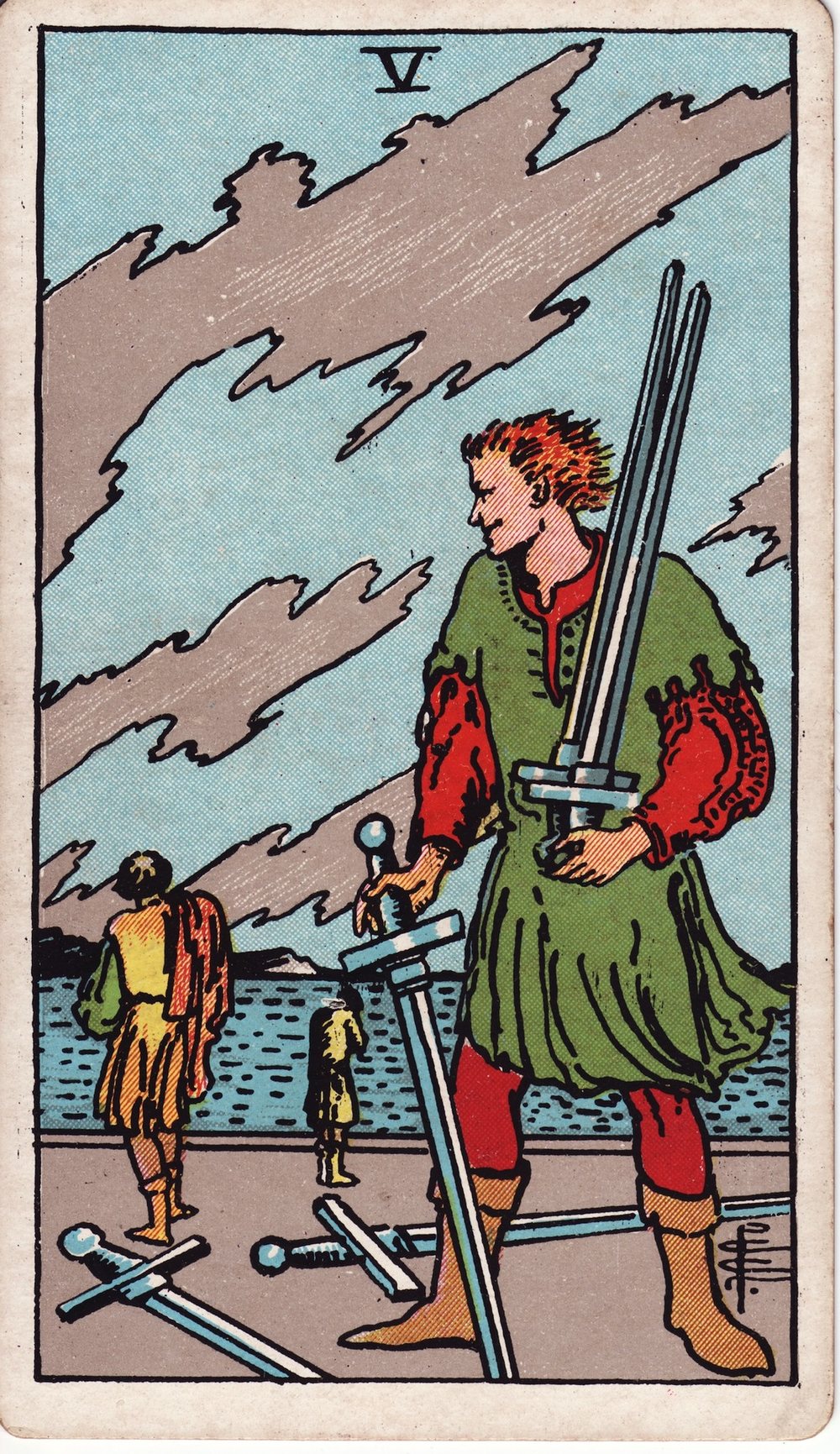
In the Rider-Waite image, a man stands in the foreground with a faint, self-satisfied smirk. He has gathered three swords into his arms and two more lie at his feet on the trampled ground. Behind him, two figures walk away with their heads bowed and their shoulders slumped, defeated and turning their backs on the field. The sky above is jagged and torn, scudding clouds raked into ragged streaks as though the wind itself were quarrelsome.
The man has clearly won. He holds the weapons, he holds the ground. Yet the picture refuses to feel like a victory. The two who leave have not been killed, only beaten, and they carry their resentment off with them into the rest of their lives. The victor is left alone with an armful of swords he cannot use against anyone, standing on ground nobody else wants.
That is the riddle at the heart of this card. It asks what a win is worth when it costs you everyone you fought. The Five of Swords is not always about losing. Often it is about winning and discovering the prize was never the point.
What follows explores the many faces of that hollow triumph, upright and reversed, and tries to find where the swords are pointing in your own reading.
What does the Five of Swords Tarot card mean?
Upright, the Five of Swords describes conflict that has already been decided, usually in nobody’s real favor. Someone has gone for the win at the expense of the relationship, and the dust is settling on a field that feels emptier than expected.
This card often shows up after an argument where you were proved right but feel worse for it. The satisfaction of being correct curdles quickly when the people you were arguing with stop speaking to you. The Five of Swords is the cost ledger of being right.
It can also place you among the defeated, the figures walking away. In that case the lesson is about choosing which battles deserve your energy and which simply drain it. Not every challenge needs to be answered.
There is a streak of ego in this card, a willingness to use cleverness or cruelty to come out on top. Sarcasm, point-scoring, the last word delivered with a smile. The Five of Swords knows exactly how to wound and sometimes does it for sport.
When it appears, take an honest look at the most recent conflict in your life. Ask who actually benefited. The answer is rarely as flattering as the moment of triumph made it seem.
Five of Swords Keywords:
- Conflict
- Hollow victory
- Tension
- Defeat
- Win at all costs
- Resentment
- Disagreement
- Hostility
- Betrayal
- Pyrrhic victory
- Ego
- Discord
- Bad sportsmanship
What does the Five of Swords Tarot Card Mean when Reversed?
Reversed, the Five of Swords turns toward the aftermath. The fight is over and now comes the question of whether anything can be rebuilt from the wreckage. This is the card of the truce, the apology, and the long walk back from a grudge.
Sometimes the reversal is genuinely hopeful. People who fell out are ready to bury the hatchet, to release the resentment they have been carrying, to forgive without keeping score. The swords are being set down rather than swung.
Other times it darkens instead of softening. Reversed, this card can show a conflict that refuses to die, an old wound picked at until it festers, a person unable to let go of a defeat that happened long ago. The reversal can trap you in replaying the battle.
There is often a moment of clarity here too, a recognition that the victory was empty and the cost too high. That regret can be the first honest step toward repair.
The reversed Five of Swords asks one plain question. Do you want to be right, or do you want to move on? You usually cannot have both.
Five of Swords Reversed Keywords:
- Reconciliation
- Making amends
- Releasing resentment
- Lingering grudges
- Regret
- Moving on
- Unresolved tension
- Forgiveness
- Surrender
- Open wounds
- Letting go
- Desire for peace
The Five of Swords as How Someone (He/She) Sees You
When this card describes how another person sees you, it carries a wary edge. They view you as someone who plays to win, sharp-tongued and difficult to argue against. They may respect your cleverness while quietly bracing themselves against it.
There is a sense that they feel they have lost ground to you. A disagreement ended in your favor and they have not forgotten it. They see you as the one who came out on top. That sits uneasily.
It can also mean they find you guarded, someone who keeps score and rarely concedes a point. They may admire your mind and still feel they cannot fully relax around you.
If this is a closer relationship, the card is a warning that they feel a little defeated by you. That is worth attending to before it hardens into distance.
The Five of Swords Reversed as How Someone (He/She) Sees You
Reversed, the picture softens. They are starting to see you as someone willing to make peace, to set down old arguments and meet them halfway. The hostility they once felt is loosening.
This can mark the moment they decide you are worth reconciling with. They have weighed the grudge against the relationship and chosen the relationship. They see you reaching out, and they are inclined to reach back.
Less happily, it can mean they still see you through the lens of an old wound that has never properly healed. They have not forgotten the fight, and part of them is still standing on that trampled ground.
Either way, the reversal says the door is not fully shut. How you act now decides whether it opens.
What does the Five of Swords Tarot Card mean in Love?
In love, the Five of Swords is one of the more uncomfortable cards to draw. It points to a relationship soured by conflict, where arguments have become about winning rather than understanding. Someone is keeping score.
This is the dynamic where being right matters more than being kind. Old grievances get dragged into new fights. Words are chosen to wound, and apologies, when they come at all, are grudging. The warmth has been replaced by a cold campaign.
For couples, it asks an honest reckoning. Are you fighting to solve something, or fighting to win? A relationship cannot survive long if one person always has to lose. The trampled field in the image is what a home becomes when every disagreement is total war.
For the single reader, it can warn against carrying the resentment of a past relationship into a new one, or against a tendency to treat dating as a contest of leverage. Guardedness keeps people safe and also keeps them alone.
The card is not a sentence of doom. It is a mirror held up to a destructive pattern, asking whether the prize of being right is worth the loneliness that follows.
What does the Five of Swords Reversed mean in Love?
Reversed in love, the Five of Swords usually brings relief after a hard stretch. The arguing has worn both people out, and now there is a willingness to apologize and rebuild. The need to win has finally given way to the wish to be close again.
This is the card of the real apology, the kind that does not come with conditions or a final dig. Both partners are tired of the cold war and ready to lay down their weapons. Reconciliation is genuinely possible here.
It can also signal a couple consciously deciding to stop the cycle, to break the habit of point-scoring before it destroys what they have built. That decision, made together, is quietly powerful.
The shadow reading is a relationship where the resentment cannot be released, where one person clings to an old injury and keeps the wound open. If that is the case, the card asks whether you are protecting yourself or simply punishing them.
For singles, the reversal suggests healing from a relationship that left you bruised and finally being ready to trust again.
What does the Five of Swords Tarot Card mean in Friendship?
Among friends, the Five of Swords signals a falling out, often over something that grew larger than it ever needed to be. Pride dug in on both sides, and what should have been a small disagreement became a line in the sand.
It can describe a friendship where one person dominates, always steering, always right, leaving the other feeling small. That imbalance breeds quiet resentment that eventually surfaces. The friendship starts to feel like a competition nobody agreed to enter.
Sometimes the card warns of gossip or betrayal, a confidence broken or a loyalty used as ammunition. Air is the suit of words, and here words have been turned into weapons against someone who trusted you.
If you recognize yourself as the one who won the argument, this card asks whether the friendship survived the victory. Some battles cost more than they are worth, and a friend lost to ego is a poor trade.
What does the Five of Swords Reversed mean in Friendship?
Reversed, the card points toward friends finding their way back to each other. The argument has cooled, pride has softened, and someone is ready to make the first move toward repair. Old companions can reconcile here.
This is a good omen for clearing the air after a long silence. The grudge that kept you apart is losing its grip, and the friendship may emerge from it more honest than before. Time has done some of the work for you.
It can also show you releasing a friendship that was never healthy, walking away from a dynamic that only ever made you feel defeated. Not every reconciliation is worth making, and the reversal honors that too.
The lingering risk is a friend who keeps reopening the old wound, unable to forgive even after you have apologized. If they will not set down the sword, you cannot force them to.
What does the Five of Swords Tarot Card mean in Career?
In work, the Five of Swords describes a hostile or competitive environment where colleagues undercut one another and victory comes at someone else’s expense. Office politics have turned sharp. Trust is thin.
It may point to a conflict with a coworker or boss that you technically won but that left you isolated. You made your case, you came out ahead, and now you eat lunch alone. The card asks whether the win advanced your real goals or just your pride.
There can be an ethical edge to it as well, a temptation to cut corners or step on others to get ahead. The smirking victor in the image got the swords, but he also earned two enemies. In a workplace, those enemies have long memories.
If you are on the losing end, the card suggests a battle not worth fighting, a hill not worth dying on. Strategic retreat is sometimes the smartest career move you can make. Conserve your energy for fights that actually matter.
What does the Five of Swords Reversed mean in Career?
Reversed, the workplace tension begins to ease. A conflict is being resolved, a rivalry set aside, a difficult colleague met halfway. The atmosphere is recovering from a hard patch.
This can mean you are choosing collaboration over competition, deciding that the team’s success matters more than your individual scoreboard. That shift tends to repair reputations that conflict has damaged.
It may also show you leaving a toxic situation behind, finally walking away from a job or a dynamic that turned every day into a battle. Sometimes the healthiest career move is to stop fighting and exit.
The cautionary note is unfinished business, a workplace grudge that simmers under the surface despite the appearance of peace. Watch for the colleague who smiles and remembers.
The Five of Swords as How Someone Thinks of You
When the Five of Swords reflects another person’s thoughts about you, it suggests they think of you as a worthy but exhausting opponent. You occupy their mind as someone they cannot quite get the better of, and that nags at them.
They may be replaying a disagreement, turning it over, wishing they had said something sharper. You loom in their thoughts as the one who won, and the memory is not a warm one.
There can be a grudging admiration mixed in. They respect your intelligence and your nerve even while they resent how you used them. You are not easily dismissed from their head.
If you want a better place in their thinking, the card hints that letting them save a little face would go further than any further argument ever could.
The Five of Swords Reversed as How Someone Thinks of You
Reversed, their thoughts are turning from resentment toward resolution. They are thinking about making peace, about whether the grudge is worth keeping, and increasingly they conclude it is not.
This often marks the inner thaw that comes before an apology. In their mind they have already begun to forgive you, or to hope you might forgive them. The bitterness is draining out of the memory.
Sometimes, though, the reversal shows someone stuck, mentally chewing on an old defeat they cannot release. You live in their head as an unsettled score, and that says more about their wound than about you.
The reading turns on whether they choose to move forward or keep circling the same painful spot.
What does the Five of Swords mean in Conflict?
This is the card’s home ground. In a conflict reading the Five of Swords describes a fight that someone is determined to win at any cost, where the goal has shifted from resolution to domination. Tactics matter more than truth.
It warns that even the winner of this conflict loses something. Relationships fracture, trust evaporates, and the ground you fought over may not be worth standing on once it is yours. The victory tends to be a lonely one.
The card asks you to clarify your aim. Do you want to resolve this, or do you want to crush the other person? Those are different goals and they lead to different futures. Only one of them leaves anything intact.
If you are being baited into a fight that serves only the other person’s ego, the wisest response may be to refuse the contest entirely. You cannot lose a battle you decline to enter.
What does the Five of Swords Reversed mean in Conflict?
Reversed, the conflict is finally winding down. The combatants are weary, the heat has gone out of it, and the possibility of resolution opens up. Someone is ready to lower their guard.
This is often the moment of de-escalation, where pride yields just enough to allow a handshake. The reversal favors compromise, the laying down of arms, the quiet decision that the fight is not worth continuing.
It can also signal a hard-won lesson learned, the recognition that the last battle was a mistake. That regret, uncomfortable as it is, makes the next conflict less likely to spiral.
The risk remains a quarrel that smolders despite the apparent calm, resentment driven underground rather than resolved. Make sure the peace is real and not merely a pause.
The Five of Swords as Feelings
As a feeling, the Five of Swords is the cold aftertaste of a hollow win, satisfaction shading into emptiness. You got what you wanted and it did not feel the way you imagined. Triumph and loss are tangled together.
It can describe bitterness, the slow burn of feeling wronged, the urge to even a score. There is pride here, and beneath the pride, hurt. The smirk in the image hides a more complicated face.
If you are the one feeling defeated, the card speaks of humiliation and the sting of being bested, the deflated walk away from a field you have given up. Those feelings are heavy and they do not lift on command.
Whichever side you stand on, the emotion is unresolved. Something needs to be released before peace can return.
The Five of Swords Reversed as Feelings
Reversed, the feelings move toward release. The bitterness is loosening its grip, and in its place comes a tired willingness to let go. You are ready to stop carrying the weight of the fight.
This can feel like relief, the exhale after a long-held breath. Forgiveness, of another or of yourself, becomes emotionally possible. The need to keep being wounded fades.
In its harder form the reversal traps you in regret, replaying the conflict and wishing you had handled it differently. That looping feeling keeps the wound fresh long after it should have closed.
The card invites you to feel the regret honestly and then to set it down, rather than building a home inside it.
The Five of Swords as a Situation
As a situation, the Five of Swords describes circumstances charged with conflict, where someone has won at a steep cost and the consequences are still unfolding. The air is tense and the alliances are broken.
It often marks the moment just after a clash, when the room is quiet but nobody has really made peace. People are licking their wounds and recalculating who they can trust. The situation is unstable beneath its stillness.
The card asks you to read the cost of the recent victory clearly. What looked like a win may have created enemies, damaged a reputation, or burned a bridge you will later wish you had kept.
It is a moment for honesty about consequences rather than celebration. The swords are gathered, but the field is scarred.
The Five of Swords Reversed as a Situation
Reversed, the situation is shifting toward repair. The tension that gripped events is starting to dissolve, and a path back to cooperation is appearing. The worst of the storm has passed.
This is the stage where damage gets assessed and rebuilding begins. People who were at odds are testing whether they can work together again. The reversal favors that effort.
It can also describe a situation you are finally walking away from, a conflict you choose to leave behind rather than keep fighting. Release, in this reading, is a form of progress.
The lingering caution is unresolved residue, a grievance that has gone quiet without truly being settled. Tidy it up before it resurfaces.
The Five of Swords as Intentions / What Someone Wants
As intentions, the Five of Swords reveals a desire to win, to come out on top, sometimes regardless of who gets hurt along the way. The person wants the upper hand and is prepared to fight for it.
It can show someone determined to prove a point, to be vindicated, to hear the other side admit they were wrong. The aim is less about resolution and more about being declared the victor.
In a less combative form, it may mean someone wants to defend their position and feels cornered into conflict to do so. Not every fighter wanted the fight. Some are simply protecting their ground.
Either way, the card flags an intention shaped by competition rather than connection. Knowing that helps you decide how to respond.
The Five of Swords Reversed as Intentions / What Someone Wants
Reversed, the intention turns toward peace. The person wants to end the conflict, to apologize, to repair what the fighting broke. Their aim has shifted from winning to mending.
This can be a genuine wish for reconciliation, a readiness to set the swords down and meet you as a person rather than an opponent. The desire to make amends is real here.
Sometimes the reversal reveals a quieter intention, a wish to walk away cleanly without further battle, to be done rather than to win. That too is a kind of peace.
The shadow possibility is someone who wants to let go but cannot, intending forgiveness while still gripping the grudge. Watch whether their actions match the stated wish.
Is the Five of Swords a Yes or a No?
The Five of Swords is, on balance, a no. It is a card of conflict, loss, and victories that cost more than they give, and it rarely blesses the outcome you are hoping for.
Even when it points to a win, that win tends to come with damage attached. So if you are asking whether a path will bring you peace, satisfaction, or harmony, the card shakes its head.
There is a narrow exception. If your question is genuinely about prevailing in a contest or standing your ground, the Five of Swords can grant the win while warning you about its price. The yes, in that case, comes with a bill.
For most matters of the heart, of friendship, and of cooperation, treat this card as a no and look hard at the conflict it is pointing to. A single card rarely settles the question on its own, and if you want to understand why readings sometimes miss, tarot cards can be wrong for several reasons: surrounding cards and context always matter more than any one pull.
The Five of Swords as a Place
As a place, the Five of Swords evokes somewhere charged with tension, a room still ringing from a recent argument, a battleground after the fighting has stopped. The atmosphere is hostile and uneasy.
It can describe a competitive environment, a courtroom, a contested workplace, anywhere people circle one another looking for advantage. The air feels sharp, like the jagged sky in the card.
On a more literal level it may point to a place associated with a falling out, a spot you avoid because of what happened there. The memory has soured the ground.
To connect with the upright energy, notice where in your life you feel you must always be on guard. That place is asking to be made peaceful or to be left behind.
The Five of Swords Reversed as a Place
Reversed, the place is recovering its calm. The hostility that hung over it is clearing, and it is becoming somewhere you can breathe again. The battlefield is slowly turning back into ordinary ground.
This can describe a return to a place you once fled, now safe to revisit because the conflict tied to it has been resolved. The associations are healing.
It may also point to a setting where reconciliation happens, a neutral ground chosen for making peace. Somewhere the swords can finally be set down.
The faint warning is a place where tension lingers under the surface, peaceful in appearance but not yet truly settled. Tread gently there.
The Five of Swords as an Obstacle / Challenge
As an obstacle, the Five of Swords names conflict itself as the thing blocking your way, along with the pride that keeps the conflict alive. Your need to be right may be the wall you keep walking into.
It challenges you to look at how you handle disagreement. Do you escalate? Do you have to win? That instinct, useful in a debate, becomes a real barrier in any relationship that requires give and take.
The card can also represent an adversary, a person actively working against you who plays to win at your expense. Recognizing that you are in a contest, and not a collaboration, is the first step to handling it wisely.
The deeper challenge is knowing when to fight and when to disengage. The obstacle is not always the other person. Often it is your own refusal to walk away.
The Five of Swords Reversed as an Obstacle / Challenge
Reversed, the obstacle is the difficulty of letting go. The fight may be over, but releasing the resentment proves harder than ending the battle ever was. The grudge is the real wall now.
This card asks you to forgive when part of you still wants to be vindicated. That is genuinely hard work, and the reversal does not pretend otherwise. Pride resists being set down.
It can also show the challenge of rebuilding trust after a conflict, the slow and unglamorous labor of proving the war is truly over. Apologies are easy compared to that.
The path through is to choose peace deliberately, again and again, until the choice becomes a habit and the wound finally closes.
The Five of Swords as Action
As an action, the Five of Swords urges caution rather than aggression. It warns against charging into a fight you cannot truly win, or winning one that will cost you more than it gives. Think before you draw a blade.
If the card is describing what you are about to do, it may be flagging an impulse toward conflict, a sharp message you want to send, a score you want to settle. Pause before you act on it.
Where it advises action at all, it points toward strategic restraint, choosing which battles to fight and which to let pass. Picking up every sword on the field leaves your arms too full to do anything useful.
The wiser move is often to step back, to refuse the contest, to protect a relationship rather than win a point. Restraint here is strength, not surrender.
The Five of Swords Reversed as Action
Reversed, the action turns toward repair. This is the card of making the first move to apologize, of extending a hand, of doing the concrete work of reconciliation. Words alone will not do it.
It calls you to set down a grievance you have been carrying, to stop fighting an old battle, to actively choose peace over the cold comfort of being right. The action is release.
Sometimes the right move is a clean departure, walking away from a conflict for good rather than feeding it further. The reversal supports that exit when the fight cannot be won well.
Whatever form it takes, the action is about ending the war honestly rather than letting it grind on in silence.
The Five of Swords as Advice
As advice, the Five of Swords counsels you to weigh the cost of winning before you commit to the fight. Ask yourself what victory will actually leave you holding. Sometimes the prize is not worth the price.
It advises you to drop the need to be right when being right will cost you something you value more. Pride is an expensive luxury in any relationship that matters.
The card also warns against ruthless tactics, against sarcasm and point-scoring and the small cruelties that feel satisfying in the moment and corrode trust over time. Win cleanly or do not win at all.
Above all it advises discernment about which battles deserve you. Conserve your strength for the conflicts that genuinely matter and let the rest go unanswered. If you are unsure which fight this card is flagging, a tarot spread for guidance can help you map what is actually calling for your attention.
The Five of Swords Reversed as Advice
Reversed, the advice is to forgive and to release. Whatever happened, holding the grudge is hurting you more than it hurts anyone else. Set it down. Let the wound close.
It encourages you to make amends where you can, to apologize without conditions, to choose the relationship over the scoreboard. The first move toward peace is yours to make.
The card also advises you to learn from the conflict rather than merely escape it, to understand what drove the fight so you do not stage it again. Regret is only useful if it teaches.
And if a battle truly cannot be won well, the advice is to walk away with your dignity intact rather than keep swinging at an empty field.
The Five of Swords as an Outcome
As an outcome, the Five of Swords is a sobering result. It suggests the matter ends in conflict, with a winner and a loser and not much warmth left between them. Someone prevails, but the cost is high.
If you are the victor, the card warns the triumph will feel hollow, won at the expense of a relationship or a reputation you may later miss. The swords are yours and the field is empty.
If you are on the losing side, the outcome is a defeat to absorb and learn from, a battle that did not go your way and that you may be wiser to release than to relitigate.
Either way, this is not a clean, happy ending. It is an ending that asks what the fight was really worth.
The Five of Swords Reversed as an Outcome
Reversed, the outcome turns gentler. The conflict resolves, amends are made, and the relationships strained by the fight begin to heal. The reversal favors reconciliation over a bitter finish.
This can mean a falling out is repaired, a grudge finally released, a peace made that holds. The story does not end on the battlefield but in the quieter ground of forgiveness.
It can also mean a clean release, the outcome being that you let go of a conflict for good and walk away lighter. Sometimes peace looks like an exit.
The lingering caution is an outcome that appears settled while resentment still simmers underneath. Make sure the ending is honest, not merely quiet.
The Five of Swords in the Future
In the future position, the Five of Swords warns of conflict on the road ahead, a disagreement or rivalry that will test how you handle being challenged. A clash is coming.
It urges you to prepare not by sharpening your blades but by deciding in advance what kind of fighter you want to be. The future you choose your battles wisely will fare far better than the one who fights them all.
The card hints that a victory may be available to you, but at a cost you should look at clearly before you reach for it. Ask now whether that prize is one you will still want once you hold it.
Forewarned, you can meet the coming conflict with restraint rather than reflex, and that choice will shape how much it costs you.
The Five of Swords Reversed in the Future
Reversed in the future, the card promises that a current conflict will eventually find resolution. The fighting will not last forever, and peace is coming, though it may take some humility to reach.
It suggests that down the road you will make amends, release a grudge, or reconcile with someone you are at odds with now. The bitterness of the present is not the shape of your future.
The reversal also hints at lessons learned, a wiser version of you who handles the next disagreement with less ego and more grace. The coming peace is partly something you grow into.
The mild warning is that if you refuse to let go, the future may simply hand you the same fight again. Resolve it now and it need not return.
The Five of Swords as a Person
As a person, the Five of Swords describes someone competitive and sharp: quick-witted, quick to argue, the sort who needs to win and knows exactly how to. There is charm here, and a cold edge beneath it.
This person can be brilliant in a debate and ruthless in a quarrel, wielding words like the swords in the image. They keep score, remember slights, and rarely concede a point gracefully. Being around them can feel like being measured.
At their worst they are a bully or a manipulator, willing to wound for the satisfaction of victory. At their more sympathetic, they are someone wounded themselves, fighting because they have learned the world is a contest.
In the upright, treat this person with clear eyes. They are clever and they play to win, and knowing that protects you. If the card points at you, it is asking whether your sharpness is serving you or isolating you.
The Five of Swords Reversed as a Person
Reversed, the person is softening. This is the former combatant ready to make peace, the proud arguer learning humility, someone who has tired of the fight and wants connection more than conquest.
It can describe a person actively seeking reconciliation, willing to apologize and to release old grudges. The hard edge of the upright is being filed down by experience or regret.
Less hopefully, the reversal can show someone stuck in bitterness, unable to move past a defeat, carrying their resentment everywhere they go. That person needs to set the sword down before anything can heal.
Whether the reversal lands as growth or as a warning depends on whether they truly let go or only pretend to.
What Zodiac Sign / Element is the Five of Swords?
The Five of Swords belongs to the element of Air (home of thought, communication, and conflict), shared by the zodiac signs Gemini, Libra, and Aquarius. Air is where ideas move quickly and where words can become weapons, which suits a card so concerned with the battles of the mind. The suit opens with the Ace of Swords as pure, undivided mental force. The Five is what that force looks like after it has been drawn in anger.
Within that airy family, the Five of Swords carries a particular signature. In the Golden Dawn system it is assigned to Venus in Aquarius, the second decan of that sign, which gives it the detached cleverness of Aquarius edged with the social charm of Venus. It is the chill of an argument won by someone too clever and too cool to care who they hurt.
Aquarius brings the card its intellectual distance, the ability to fight without feeling, to treat conflict as a game of strategy. The Venus influence adds a deceptive charm, the smile that accompanies the sharp remark. Together they describe a victory that is brilliant and bloodless and somehow joyless.
If this card speaks to a person, look toward Aquarian detachment and Gemini’s gift for argument: brilliant minds that can wound without quite meaning to. The lesson the element offers is to let the heart temper the head, so that cleverness does not curdle into cruelty.
Final Thoughts
The Five of Swords is the deck’s hard question about victory, asking you to count what a win actually costs before you reach for it. It rarely condemns. More often it simply holds up the empty field and lets you decide whether being right was worth standing on it alone. The way through is almost always to choose the relationship over the scoreboard, and when that is impossible, to walk away with your dignity rather than your grudge.
If this card has appeared for you, it helps to read it alongside its neighbors in the suit. The quiet recovery of the Four of Swords tarot card meaning shows the rest that should follow conflict, while the heartbreak of the Three of Swords reveals the wound beneath so much fighting. The clear-eyed authority of the Queen of Swords offers a model for using the mind’s blade with honesty rather than cruelty, and if your conflict is rooted in a relationship, the best tarot spreads for relationships can help you see the whole board before you make your next move.