Four of Swords Tarot Card Meaning
After the three blades that pierce the heart in the Three of Swords, the suit finally falls quiet. The Four of Swords belongs to the suit of Swords, the suit of Air, of intellect, speech, and the mind that will not stop turning, and in the older esoteric tradition it carries the temperate, balancing weight of Jupiter in Libra. Air is the element that usually argues and cuts. Here, for one card, it sheaths itself and lies still.
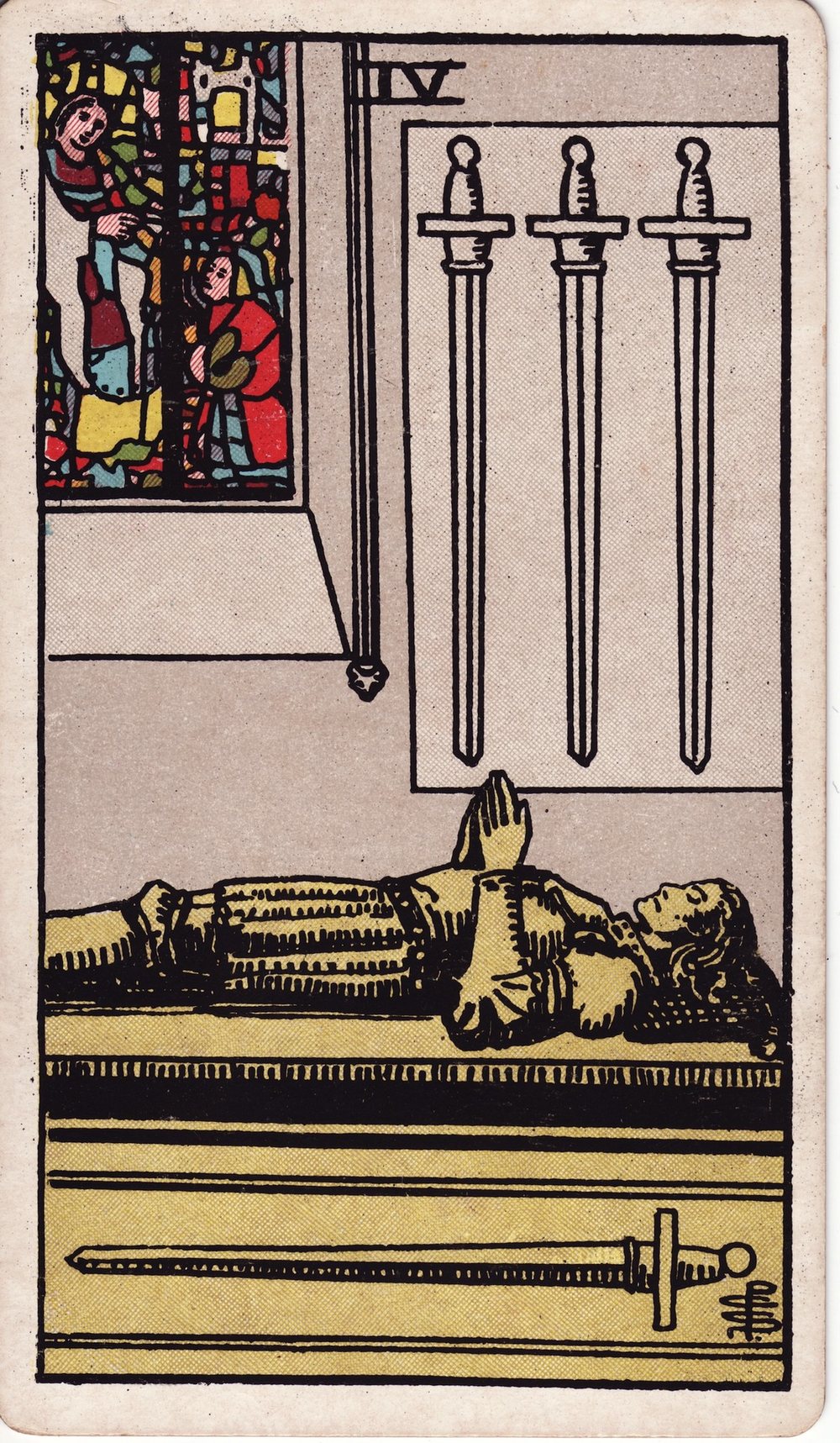

The Rider-Waite image is a sanctuary, not a battlefield. A knight lies carved in stone upon his tomb, armor on, hands pressed together in prayer, eyes closed in something that looks less like death than deep sleep. Three swords hang on the wall above him, points down, and a fourth rests along the base of the tomb, set aside rather than wielded. The three on the wall are the wounds already taken. The fourth, lowered, is the fight he has chosen, for now, not to pick up.
In the upper corner a stained glass window glows. A figure marked “Pax” (peace) watches over a smaller kneeling supplicant, that small mercy filtering in through colored light. The scene is a chapel, a field hospital, a monk’s cell. It is the room you retreat to when the mind has taken too many hits and needs the dark and the quiet to knit itself back together.
This is the card of the recovery ward and the meditation cushion. It does not promise that the war is over. It promises an interval, a sanctioned pause, the permission to stop swinging long enough to remember why you were fighting. The knight is not defeated. He is replenishing. When he rises, he rises whole.
The card reads differently depending on where it falls and what you carry into the reading.
What does the Four of Swords Tarot card mean?
Upright, the Four of Swords means rest, and it means it literally. Step back. Withdraw from the noise. Let the body and the overworked mind lie down in the dark and repair. This is not laziness or avoidance, it is the deliberate, strategic retreat a wise commander orders before the troops collapse on their own.
The card usually arrives after a stretch of strain: the worry of the Three of Swords, the overthinking that gives the suit its reputation. Something in you is running on fumes. The Four of Swords is the deck telling you, plainly, that you cannot think your way out of exhaustion. You have to rest your way out of it.
There is contemplation here too, not just sleep. The knight prays as he lies down. Stillness clears the silt from the water so you can finally see the bottom. Answers you have been chasing tend to surface on their own once you stop thrashing after them.
It can also signal convalescence in a real, physical sense, a recovery from illness, surgery, or burnout. If you have been ill or stretched thin, this is the season of getting your strength back, slowly and without guilt.
The key word is interval. The Four of Swords is a comma, not a period. You are not quitting. You are catching your breath before the next sentence.
Four of Swords Keywords:
- Rest
- Recovery
- Retreat
- Recuperation
- Contemplation
- Stillness
- Sanctuary
- Convalescence
- Pause
- Solitude
- Meditation
- Restoration
- Quiet
- Regrouping
What does the Four of Swords Tarot Card mean when Reversed?
Reversed, the knight stirs on his tomb. The Four of Swords inverted is the end of the rest, or the refusal of it, and which one depends on the cards around it.
At its most hopeful, the reversed card is awakening. The recovery is complete and you are ready to re-enter the world, to take up the lowered sword and rejoin life. The retreat served its purpose. The convalescence is over.
More often, though, it carries a warning. You are refusing the rest the upright card insisted on. You keep pushing, keep grinding, keep answering the messages at midnight, and your body and mind are starting to send the invoice. Burnout is no longer a risk, it is arriving.
It can also mean the opposite extreme: a rest that has curdled into stagnation. The retreat was meant to be temporary and you have made a home of it. The chapel has become a place to hide. The pause has outlasted its usefulness and become avoidance.
Either way, reversed asks you to check the clock on your stillness. Have you rested too little, or have you rested so long that you have forgotten how to stand?
Four of Swords Reversed Keywords:
- Burnout
- Restlessness
- Exhaustion
- Stagnation
- Re-entry
- Awakening
- Avoidance
- Overwork
- Forced rest
- Slow recovery
- Isolation
- Resistance to healing
The Four of Swords Tarot Card as How Someone (He/She) Sees You
When this card answers how someone sees you, they see a person who is currently withdrawn, and they read it as need rather than rejection. To them you look tired, quiet, a little remote, like someone recovering from something they may not fully understand.
They may see you as calm and self-contained, a still presence in a loud room. There is dignity in the knight at rest, and people often respect the one who knows when to stop. You strike them as someone who guards their own peace.
But they might also worry that you have pulled too far inside yourself. They notice you declining invitations, going dark, keeping your own counsel. The card suggests they are giving you space, sometimes more than you want, because they sense you are not ready to be reached.
If this is about a connection, they see you as someone who needs gentleness right now, not pressure. They are unlikely to push.
The Four of Swords Reversed as How Someone (He/She) Sees You
Reversed, the picture they hold of you is restless, frayed, stretched past your limit. They see the burnout you have been hiding. The composure has slipped and the strain shows through, in the short answers, the tense shoulders, the way you cannot quite sit still.
They may see someone who badly needs to stop but will not, and that can read as either admirable stubbornness or worrying self-neglect. Some will admire your endurance. Others will quietly wish you would let yourself off the hook.
Alternatively, they see someone re-emerging, brighter than before, stepping back into the room with color in the face again. If you have been away healing, the reversed card can mean they are noticing your return and welcoming it.
Watch whether they see a person worn ragged or a person revived. The same card holds both.
What does the Four of Swords Tarot Card mean in Love?
In love, the Four of Swords asks for a pause, and that is not the same as a problem. Sometimes a relationship, or a single heart inside it, simply needs to rest. After conflict or a draining period, the card counsels a cooling of the temperature: time apart to think rather than another round of talking it to death.
For couples, this can mean a healthy breather. You step back, you stop picking at the same wound, you let the silence do some of the healing that words could not. A weekend of low expectations, separate evenings, a quiet stretch where nobody is auditing the relationship. Distance, used well, lets affection regather. If you want to see what each person actually needs from the relationship right now, a spread built around that question can give you more to work with than a single card.
For the single person, the Four of Swords is rarely a card of new romance. It is a card of recovery from old romance. If you have been hurt, this is the deck telling you to heal before you reach for someone new. The chapel is not a dating venue. Tend the wound first.
There is no drama in this card, which is its mercy. It does not predict a breakup or a betrayal. It predicts a needed stillness, and it asks both people to honor it without reading abandonment into a partner’s need for quiet.
What does the Four of Swords Reversed mean in Love?
Reversed in love, the rest is ending, for better or worse. On the good side, a couple that withdrew into separate corners is ready to come back together. The breather worked. You return to each other steadier than you left.
On the harder side, the reversed card warns that the pause has gone on too long. A relationship in suspended animation, two people coexisting without really meeting, the spark not extinguished so much as left unattended. Stagnation is the risk. Comfortable distance can quietly become permanent distance.
It can also signal someone refusing the rest the relationship needs, forcing conversations that should be left to settle, demanding resolution from a partner who is depleted. Pushing a tired heart rarely opens it.
For the single person, reversed can be the welcome end of a healing season, the moment you feel ready to be seen again. The mourning has run its course. You can step out of the chapel and back into the daylight.
What does the Four of Swords Tarot Card mean in Friendship?
Among friends, the Four of Swords speaks to the friendships that survive silence. Not every bond needs constant tending. This card blesses the friend you do not speak to for months and then meet as though no time has passed.
It can mean you, or a friend, are pulling back from the social world for a while. Someone in the circle is depleted and needs to go quiet. The card asks the group to read that withdrawal correctly, as recovery, not as a slight, and to leave the door open without crowding it.
This is also a card of restorative company, the friend whose house is a place you can simply rest, where you are not performing or entertaining, where you can sit in comfortable silence. Those friendships are rare and worth protecting.
If you have been overextending socially, saying yes to everything, the Four of Swords gently suggests fewer, deeper, quieter connections over a packed calendar that leaves you hollow.
What does the Four of Swords Reversed mean in Friendship?
Reversed, a friendship is waking back up, or it has gone too still for too long. A friend you lost touch with may resurface, ready to reconnect after a season away. The quiet between you is breaking in a good way.
The shadow reading is a friendship that drifted and never drifted back. The pause became the whole story. Nobody fought, nobody chose it, the texts just stopped and the months stacked up. Reversed warns that some bonds dissolve through neglect rather than conflict, and that this one may need a deliberate reaching out to save.
It can also flag a friend who is burning out and hiding it, masking exhaustion behind a busy front. You may be the one who notices and offers the quiet room they cannot ask for. Or you may be that friend, and the card is nudging you to finally accept the rest your people keep offering.
What does the Four of Swords Tarot Card mean in Career?
In work, the Four of Swords is the card that gives you permission to step back, and warns that you need to. It often surfaces in the middle of a grind (a punishing project, a sustained period of overwork) and its message is unambiguous: take the break before the break takes you.
This might mean a literal pause: a vacation overdue by months, a sick day you keep postponing, a sabbatical. It might mean a quieter strategic retreat, stepping out of the daily fray to think, plan, and recover perspective before the next push. Some of the best decisions are made by the person who left the room to breathe. A guidance spread can help you see whether this is a step-back moment or a push-through one.
It can also describe a deliberately fallow period in a career, a stretch between roles, a recovery after a setback, time spent regrouping rather than charging. The card does not see that as failure. The field rests so the next crop can grow.
If you have been ill or burned out, the Four of Swords confirms that healing comes first and ambition can wait. You are no use to any goal as a husk. Rest now, and return sharper.
What does the Four of Swords Reversed mean in Career?
Reversed in career, the rest is over and the work resumes, or the warning has come due. Hopefully it means re-entry, returning from leave with energy restored, picking up the projects you set down, ready again.
But the more common reversed message is burnout arriving in earnest. You ignored the upright card’s advice. You did not take the break, and now exhaustion is making the decisions for you, in the form of errors, short temper, a body that finally refuses. The deck is telling you this is not sustainable, and that forced rest is far worse than chosen rest.
It can also describe career stagnation, a role you have rested in too comfortably, growth that stalled while you were coasting. The pause meant to recharge you has become a rut. Reversed asks whether you are recovering or simply stuck, and pushes you to stand back up.
The Four of Swords Tarot Card as How Someone Thinks of You
As thoughts, the Four of Swords means you are on someone’s mind quietly, without urgency. They are not obsessing over you. They are thinking of you the way you think of a place where you felt at peace, with calm fondness rather than heat.
It can mean they are giving you mental space on purpose. They have decided not to pester you, to let their thoughts of you stay private and undemanding because they sense you need room. Their care shows as restraint.
Sometimes it means they are thinking of you while they themselves recover, turning you over in their mind during a quiet, reflective period of their own. You are part of what they contemplate when the noise dies down.
This is not the card of someone consumed by you. It is the card of someone at rest who holds you gently in their thoughts and feels no rush to act on it.
The Four of Swords Reversed as How Someone Thinks of You
Reversed, their thoughts of you grow restless. They may be done holding back, ready to break the silence and finally reach out after a period of quiet consideration. The waiting is ending.
It can also mean their thoughts of you are tinged with worry, that they sense you are worn down and they are concerned. You occupy an anxious corner of their mind rather than a peaceful one.
Less kindly, it can suggest they keep returning to you in a way that exhausts them, unable to put the matter to rest, circling the same thoughts without relief. Their mind will not let the subject go quiet, and that lack of peace says more about their unrest than about you.
What does the Four of Swords mean in Conflict?
In conflict, the Four of Swords is the card of strategic withdrawal. It does not tell you to win and it does not tell you to surrender. It tells you to disengage, step off the field, and stop fighting on empty.
The wisest move here is the timeout. Walk away from the argument before it does more damage. Sleep on it. Refuse to fire the next shot while you are this depleted, because nothing decided in exhaustion is decided well. The card counsels the dignity of the pause over the satisfaction of the last word.
This is also recovery from a fight already had. If the conflict has already cost you, the Four of Swords says tend your wounds before you re-engage. The three swords are on the wall. You do not need to add a fourth right now.
There is real strength in this retreat. It is not cowardice to refuse a battle your body cannot afford. The knight who rests is the knight who survives to stand again.
What does the Four of Swords Reversed mean in Conflict?
Reversed, the truce is breaking. The conflict you stepped back from is flaring up again, demanding to be dealt with rather than left to rest. The pause is over and the matter has resurfaced.
This can be necessary, finally addressing something you have avoided, ending an uneasy ceasefire that solved nothing. Some conflicts only fester in the silence, and reversed pushes you to break it.
But it can also warn of re-entering a fight before you have healed, swinging the sword with a body still bruised. Charging back in restless and raw, you risk a worse outcome than the first round. The reversed card cautions that there is a difference between being rested enough to resolve a thing and merely being too restless to leave it alone.
The Four of Swords Tarot Card as Feelings
As feelings, the Four of Swords is numb, quiet, and tired in a way that wants only stillness. This person feels emotionally spent. Not heartbroken in the acute, bleeding way of the Three of Swords, but the flat, drained calm that comes after the storm has passed.
They may feel a need to withdraw, to be left alone, to not have to feel anything intense for a while. This is the emotional equivalent of lying down in a dark room. It is not coldness toward you. It is a depleted heart conserving what little charge it has left.

There can be a quiet peace in it too, the relief of having stopped struggling, a fragile contentment found in solitude and rest. If they have been through something hard, this card says they are finally letting themselves recover instead of forcing a feeling they do not have.
Do not mistake this stillness for indifference. The knight is not gone. He is healing, and feeling will return when the strength does.
The Four of Swords Reversed as Feelings
Reversed, the numbness either lifts or curdles. At best, feeling is flowing back, the heart waking from its rest, ready to engage emotionally again after a protected pause.
At worst, the reversed card is restlessness and agitation, an inability to find any peace at all. The mind races, sleep will not come, the quiet the upright card promised is nowhere to be found. This is the emotional state of someone running on no reserves, wired and exhausted at once.
It can also be the discomfort of avoided feeling, emotions that were set aside for too long and have started to press against the door of the chapel. The rest became repression. Reversed asks whether you are at peace or merely hiding from a feeling you have not let yourself have.
The Four of Swords Tarot Card as a Situation
As a situation, the Four of Swords describes a lull, a held breath, a deliberate or imposed pause in the middle of events. Things are quiet, and the quiet is meaningful. Nothing is being decided right now because it is not time to decide.
This can be a recovery period after a difficult stretch, a convalescence, a season of low activity where the work is internal rather than external. Outwardly little happens. Inwardly, repair and regathering are underway.
It can also be a waiting room of a situation, a delay, a matter on hold, a process that has gone dormant while everyone catches their breath. The card asks you not to panic at the stillness. Some situations need to lie fallow before they can move.
The right posture here is patience. Use the pause. Do not fill it with anxious motion. The stillness is doing work you cannot see.
The Four of Swords Reversed as a Situation
Reversed, the dormant situation is reactivating. The hold is being released, the delayed process restarting, the waiting room finally calling your name. Things that were paused begin to move again.
This is often a relief, especially if you have been stuck. The reversed card can mean re-entry after a stall, momentum returning to something that had gone still.
The shadow side is a situation that should have moved long ago and has rotted in the standstill. The pause outstayed its welcome and became stagnation, a project no one will restart, a circumstance everyone keeps avoiding. Reversed warns that endless rest is not neutral. Left long enough, the still water grows stale, and someone has to disturb it before anything can flow.
The Four of Swords Tarot Card as Intentions / What Someone Wants
As intentions, the Four of Swords means someone wants space, peace, and time to recover. They are not plotting anything. They want quiet. Their intention, where you are concerned, may simply be to step back and breathe for a while.
This can mean they want a pause in the connection, not an ending. They are seeking rest, not exit. If they have gone quiet, the card suggests the silence is about their own depletion, not a verdict on you.
It can also mean they want healing above all else right now, that recovery is their priority and everything else, including the relationship or decision in question, is on hold until they feel whole again. Their stated want is rest, and it is sincere.
Take this card at face value. The intention is not hidden or sinister. It is a tired person wanting the room to recover. Honor it and do not read scheming into stillness.
The Four of Swords Reversed as Intentions / What Someone Wants
Reversed, their intention shifts toward re-engagement, or toward an unhealthy refusal of rest. On the good side, they want to come back, to end the pause, to act after a period of holding still. The intention to reconnect is forming.
On the harder side, the reversed card can describe someone who wants to keep pushing past their limit, driven by restlessness rather than purpose, unable to let themselves stop. Their want is action for its own sake, and it may burn them.
It can also reveal someone who wants to hide, whose intention is avoidance dressed up as rest. They are not recovering, they are retreating from something they should face. Reversed asks you to tell genuine need for quiet from a wish to disappear.
Is the Four of Swords a Yes or a No?
The Four of Swords is not a yes and not quite a no. It is a “not yet.”
The card’s whole nature is the pause, so it rarely greenlights immediate action. If you are asking whether to move now, push now, decide now, the Four of Swords answers wait. The timing is wrong because you, or the situation, are not yet recovered enough to proceed well.
That makes it a soft no on the question of now, but not a no on the outcome. The knight is not dead. After the rest comes the rising. If you can be patient, the eventual answer may well be yes, just not on the timeline you wanted.
For questions about rest, recovery, healing, or whether to take a break, it is a wholehearted yes. Yes, step back. Yes, you need it. Yes, the pause is the right call.
Reversed, the answer tilts. It can mean yes, the wait is over, proceed now, or it can mean the rest was skipped and the no still stands. Read it with what surrounds it. And if the card does not feel like it fits what you know to be true, it helps to understand why a tarot reading can miss the mark.
The Four of Swords Tarot Card as a Place
As a place, the Four of Swords is anywhere that holds silence. A chapel, a quiet bedroom with the curtains drawn, a library, a monastery, a hospital recovery ward, a retreat in the woods. The room in the card is a sanctuary, and that is the kind of place it points to.
Think of the spaces you go to when you cannot take any more noise. A still, dim room. A place of worship long after the service. A cabin far from the road. Somewhere the world cannot reach you and you are not expected to perform.
It can also indicate a place of literal recuperation, a clinic, a spa, a bed you have been confined to. Wherever bodies and minds go to mend.
If you are asking where, the Four of Swords says somewhere quiet, enclosed, and restful. Not a crowd. Not a thoroughfare. A still room with the door closed.
The Four of Swords Reversed as a Place
Reversed, the still place is being left behind, or it has become a place you are trapped in. It can mean leaving the recovery room, checking out of the retreat, returning from the quiet place to the busy world.
It can also describe a place that is meant to be restful but is not, a bedroom where you lie awake, a sanctuary that has stopped soothing you, a room you have stayed in too long. The hospital you cannot seem to leave. The retreat that became a hiding place.
If you are asking where, reversed can point to somewhere restless and loud, the opposite of the chapel, or to the threshold between the quiet place and the world, the doorway you are stepping back through.
The Four of Swords Tarot Card as an Obstacle / Challenge
As an obstacle, the Four of Swords usually means the thing in your way is exhaustion, your own depleted reserves. You cannot push forward because there is nothing left to push with. The barrier is not the world, it is your empty tank.
It can also mean that rest itself is what stands between you and the goal, that you keep trying to advance when the situation genuinely requires you to stop first. The obstacle is your refusal to pause. Until you rest, the way stays blocked.
Sometimes the challenge is a forced inactivity you resent, an enforced delay, a recovery that keeps you sidelined while you are itching to move. The card asks you to make peace with the pause rather than batter yourself against it.
The way through is counterintuitive. You do not overcome this obstacle by trying harder. You overcome it by stopping, recovering, and returning with strength you do not currently have.
The Four of Swords Reversed as an Obstacle / Challenge
Reversed, the obstacle is burnout that has gone critical, or a rest you cannot pull yourself out of. The challenge may be that you have run yourself so far down that exhaustion is now actively sabotaging everything you touch.
It can also describe the difficulty of re-entry, the awkward, draining effort of starting again after a long stop. Getting the wheel turning from a dead stop is its own challenge, and reversed names it.
The shadow obstacle is stagnation, a rest that has become a rut you cannot climb out of. You have been still so long that motion feels impossible. The challenge is no longer to rest but to rise, and the card warns that the longer you wait, the harder the standing gets.
The Four of Swords Tarot Card as Action
As an action, the Four of Swords advises you to stop, and to do so on purpose. The action is non-action, the disciplined choice to lie down, withdraw, and let yourself recover.
Take the rest. Cancel the thing. Go to bed early. Book the time off. Sit in silence for twenty minutes and let the mind settle. Meditate, pray, sleep, do nothing of consequence for a stretch. These are the moves the card endorses, and they are harder for most people than charging ahead.
If a decision is pressing, the action is to sleep on it rather than force it. Withdraw from the debate, give the question room, and let clarity come in the quiet instead of squeezing it out under pressure.
The Four of Swords is one of the few cards whose call to action is to put the sword down. The strong move here is restraint, and the brave one is the courage to be still while everything in you wants to keep swinging.
The Four of Swords Reversed as Action
Reversed, the action flips toward motion. It may be time to get up, take up the lowered sword, and re-enter the fray. The rest is done. The action is to return, to resume, to begin again with restored strength.
For someone who has been sidelined, this is the green light to move. Get back to work, reach back out, restart the thing you paused. The recovery has served its purpose and now action is required.
But read it carefully, because reversed can also be a warning against acting too soon, lurching back into motion out of restlessness rather than readiness. If you are moving only because you cannot bear to be still, the action may be premature. Make sure you are rising because you are healed, not because you are agitated.
The Four of Swords Tarot Card as Advice
As advice, the Four of Swords is blunt and kind: rest. Whatever the question, part of the answer is that you need to stop and recover before you do anything else. The deck is prescribing stillness like a doctor prescribing bed.
Protect your peace. Guard your energy as the scarce resource it is. Say no to one more demand. Withdraw from the situations that drain you and give your mind the dark, quiet room it has been begging for. You will solve nothing as a husk, and you owe yourself the recovery without earning it first.
The card also advises contemplation over action. Before you decide, be still. Let the silt settle. The answers you have been chasing tend to surface once you stop stirring the water, and the clarity that comes from rest is steadier than the clarity forced from strain.
Trust that stepping back is not falling behind. The knight who pauses to heal returns stronger than the one who fought until he dropped.
The Four of Swords Reversed as Advice
Reversed, the advice splits. If you have been resting, the counsel is that it is time to rise, to re-enter life, to stop hiding in the quiet and step back into the daylight. The recovery has done its work, and now staying down becomes the danger.
If you have been pushing, the reversed card sharpens the upright warning: you are courting burnout and you must stop now, before the choice is taken from you. The forced rest of collapse is far worse than the chosen rest you keep refusing.
And if your rest has slid into avoidance, the advice is honest self-examination. Ask whether you are genuinely recovering or merely hiding. One restores you. The other quietly wastes you. The Four of Swords reversed wants you to know the difference and act on it.
The Four of Swords Tarot Card as an Outcome
As an outcome, the Four of Swords promises rest and recovery at the end of the road. Whatever you have been through, the result is a period of peace, a chance to heal, the storm finally giving way to stillness.
This is a gentle, restorative ending rather than a triumphant one. You do not arrive at fireworks. You arrive at a quiet room where you can finally lie down. After a hard stretch, that is often the better gift.
It can also mean the matter resolves into a pause rather than a conclusion, a held breath, an interval before the next chapter. The outcome is not the end of the story, it is the rest between movements. Do not mistake the quiet for stagnation. It is the recovery you earned.
Expect calm, not climax. The Four of Swords closes the reading the way the chapel closes around the knight, with peace, and the promise of rising restored.
The Four of Swords Reversed as an Outcome
Reversed, the outcome is the end of the rest, an awakening, a return to activity after the pause. Things start moving again, and you re-enter the world with strength regathered.
At its best this is recovery complete, the convalescence over, life resuming. The knight rises from the tomb whole.
At its worst, the reversed outcome is burnout reached, or a stagnation that never broke. The rest was skipped and exhaustion is the result, or the pause stretched so long that the situation simply went stale. Which ending you get depends on whether you heeded the upright card’s advice along the way. The Four of Swords reversed shows the bill coming due, for the rest you took or the rest you refused.
The Four of Swords Tarot Card in the Future
In the future position, the Four of Swords foretells a coming period of rest, and it usually arrives as relief. A pause is ahead, a chance to step back, recover, and breathe after the present push. If you have been bracing for more strain, the card softens the forecast.
It can mean a recovery is coming, from illness, from overwork, from a draining season. The future holds a quiet room where you can finally mend. Knowing it is coming can make the present push more bearable.
There is a gentle instruction folded into the forecast: prepare to rest, and let yourself when the time comes. Do not reach the quiet stretch and fill it with noise out of habit. The future is offering you stillness. The wise thing is to accept it.
Whatever lies ahead, the Four of Swords says part of it is peace. The fight pauses. The knight lies down. And from that rest, you rise into whatever comes next.
The Four of Swords Reversed in the Future
Reversed, the future holds either an awakening or a reckoning. Hopefully it means the rest ahead will end well, that you will recover and re-enter life restored, the pause giving way to renewed motion.
But the reversed card can warn that burnout lies ahead if the present course holds, that you are heading toward a collapse the upright card would have you avoid. The future shows the cost of refusing to stop. Heed it now and you can change the forecast.
It can also predict a stagnation to come, a stretch where things stall and stay stalled, a rest that overstays and turns to rut. Read it as a nudge to build the pause in deliberately, so it does not arrive later as a breakdown or a dead end.
The Four of Swords Tarot Card as a Person
As a person, the Four of Swords is the recoverer, the one who has withdrawn to heal. This is someone in a quiet season: convalescing, resting, deliberately stepping out of the noise. They may be recovering from illness, grief, or sheer exhaustion, and they need gentleness.

It can describe a contemplative, inward type, someone meditative and calm, drawn to solitude and quiet rooms. A monk-like temperament, peaceful, self-contained, comfortable with silence. They restore others simply by being unhurried.
It can also be the person who badly needs rest and has finally allowed it, the friend who took the sabbatical, the colleague on leave, the loved one who went quiet to mend. Their stillness is not coldness. It is recovery.
Treat this person with patience. They are not avoiding you, they are healing, and the kindest thing you can offer is the room to do it.
The Four of Swords Reversed as a Person
Reversed, this person is either re-emerging or running on empty. At best they are someone returning to life, stepping out of their quiet season brighter and ready to engage again, the color back in their face.
At worst they are burning out and refusing to admit it, a person stretched past their limit who will not stop, masking exhaustion with motion. They are wired, restless, unable to find peace, and heading for a wall.
They can also be someone stuck in their retreat, who withdrew to heal and never came back, whose rest became a hiding place. Isolated longer than is good for them, they may need a gentle hand to coax them back into the world. Reversed asks you to tell the one who is rising from the one who is stalling, and to meet each accordingly.
What Zodiac Sign / Element is the Four of Swords?
The Four of Swords belongs to the element of Air, the element of the mind, of thought, language, and the restless reasoning that defines the whole suit of Swords. Air governs the intellect, and the Four is the moment that ceaseless mind finally goes quiet. In astrology the airy signs are Gemini, Libra, and Aquarius, the thinkers, the communicators, the ones who live in ideas.
Most specifically, the older tradition assigns the Four of Swords to Jupiter in Libra. Libra is the sign of balance, of the scales, of the search for equilibrium and peace, and Jupiter is the planet of expansion, mercy, and grace. Together they describe this card exactly, a generous, restorative peace, the mind seeking its balance point and being granted the room to find it.
Libra’s instinct for harmony is the soul of the Four of Swords. After the discord of the Three of Swords, the scales tilt back toward rest. Jupiter’s blessing is the stained glass mercy in the corner of the card, the larger benevolence that watches over the recovering knight and grants him the interval he needs.
If this card speaks of a person, lean toward an Air sign, and toward a Libran temperament in particular, someone who craves peace, recoils from conflict, and needs balance restored before they can move on.
Final Thoughts
The Four of Swords is the deck’s permission slip to stop. It does not ask you to win or to surrender, only to lie down long enough to heal, and to trust that the rest is part of the fight and not a retreat from it. The knight on the tomb is not finished. He is gathering himself for the rising. If this card found you in a hard season, sit with the suit’s harder neighbor in the Three of Swords tarot card, trace the arc forward to the Ace of Swords for where the mind lifts again after the silence, or study the cool clarity of the King of Swords tarot card meaning for the steadiness that returns once you are rested. When the swords go quiet, let them. The strength you set down today is the strength you stand up with tomorrow.