Eight of Swords Tarot Card Meaning
The Swords belong to the element of Air, the suit of the mind, of speech and argument and the cold edge of reason. Where Cups feel and Pentacles build, Swords think, and thinking is exactly what gets the figure on this card into trouble. In the old Golden Dawn attributions the Eight of Swords carries Jupiter in Gemini (the planet of expansion lodged in the most restless and self-questioning of the air signs), a combination that lets a single worry swell until it fills the whole sky.
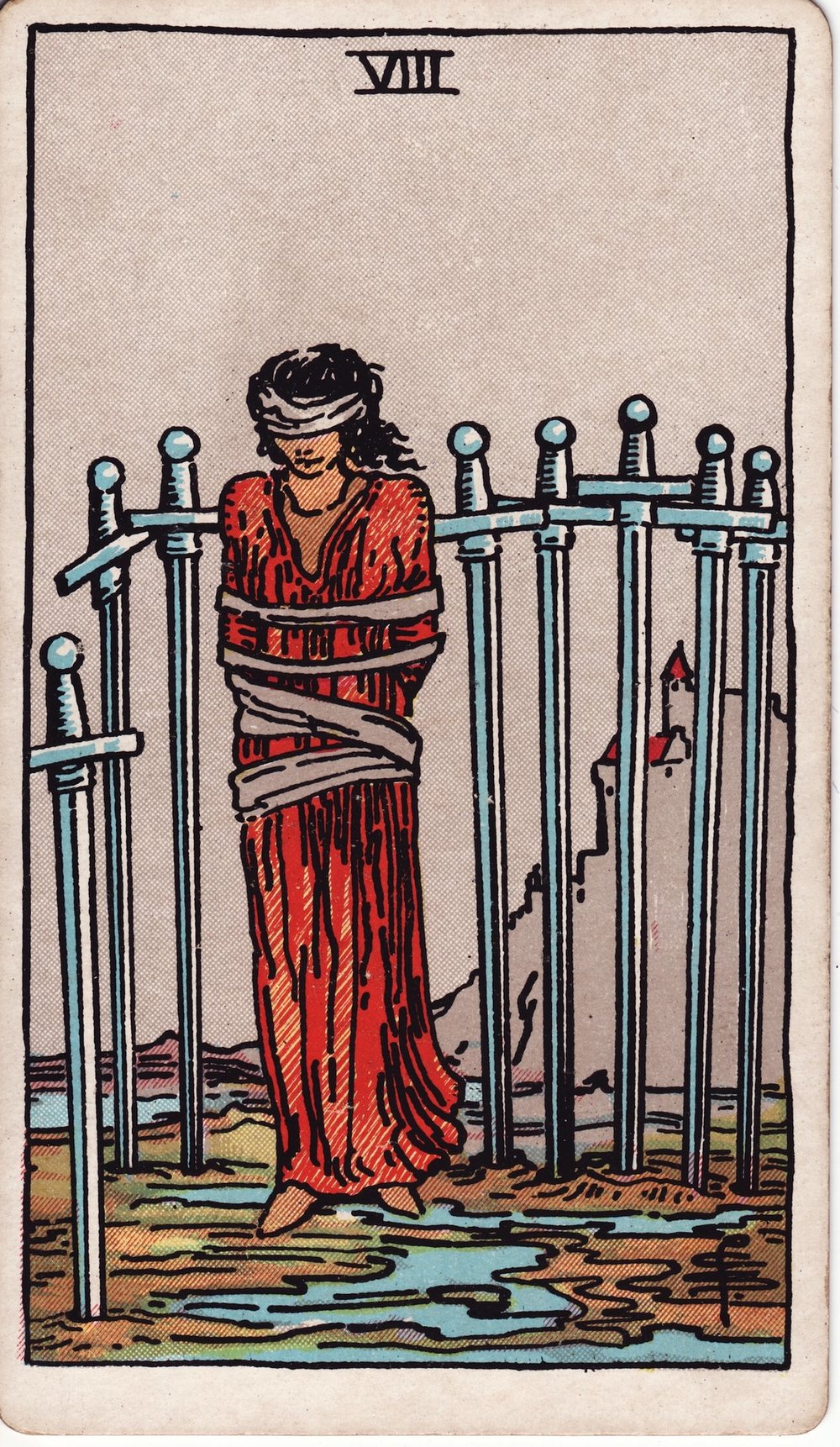
In the Rider-Waite image a woman stands alone in a marshy grey landscape, wrapped loosely in a red cloth and bound about the body with rope. A blindfold covers her eyes. Eight tall swords are driven into the wet ground around her, not forming a wall so much as a fence with wide gaps, and a castle sits high on a crag in the distance, remote and indifferent. The sky is colourless. The water at her feet has not quite reached her, and her own feet are free.
Look at the picture for more than a moment and its trick becomes plain. The swords do not enclose her. The blindfold is cloth, not iron. The ropes are wound but not knotted to anything. Everything that holds her in place is something she could undo, if only she would lift her hands or turn her head. The quiet horror of this card is also its mercy. The prison is real to the one inside it, and it is made of nothing.
This is the card of the trap you build for yourself and then forget you built. It rarely points to chains forged by other people. More often it shows the moment when fear has been mistaken for fact, when a story told often enough about what cannot be done has hardened into a wall. The Eight of Swords does not ask you to be braver than you are. It asks you, gently, to check whether the door was ever locked.
What does the Eight of Swords Tarot card mean?
Upright, the Eight of Swords describes a person stuck inside their own head. The seeker feels cornered, certain that every option leads nowhere, paralysed less by circumstance than by the way they are reading their circumstance. There is a powerful sense of helplessness here, of being a victim of forces too large to fight.
The catch is that the helplessness is largely manufactured. The card almost always appears when overthinking has replaced action, when the mind keeps circling the same fear and calling the circling progress. Each lap convinces the seeker a little more thoroughly that they are trapped.
What the card points to is not a hopeless situation but a misread one. Restriction feels total because the blindfold removes the wider view, and so the small free space that genuinely exists goes unnoticed. The work is not to force a dramatic escape. It is to stop, take off the blindfold, and look honestly at how much room there actually is to move.
Eight of Swords Keywords:
- Mental imprisonment
- Self-imposed restriction
- Feeling trapped
- Powerlessness
- Anxiety and overthinking
- Victim mentality
- Limiting beliefs
- Paralysis by fear
- A blindfold of one’s own making
- Isolation
What does the Eight of Swords Tarot Card mean when Reversed?
Reversed, the blindfold begins to slip. The Eight of Swords inverted is the moment the figure realises the ropes are loose and the swords have gaps, and that recognition is the turning point the upright card was waiting for. Something that felt like a cage is revealed as a choice, and the seeker starts to take responsibility for the part they played in their own confinement.
This can arrive as relief, the slow exhale of someone climbing out of a long anxiety. It can also arrive as a hard truth, the uncomfortable admission that the limits were self-set and could have come down sooner.
There is a shadow version too. Reversed, the card sometimes shows a person who clings to the blindfold, who has grown comfortable inside the story of being powerless because powerlessness asks nothing of them. The escape is offered and refused. Either way the reversal moves the focus inward, to the inner voice that has been narrating the limits, and asks whether the seeker is finally ready to stop obeying it.
Eight of Swords Reversed Keywords:
- Release and self-acceptance
- Freedom from limiting beliefs
- A loosening grip of fear
- Taking back control
- Facing the inner critic
- New clarity
- Refusing to escape
- Self-imposed isolation prolonged
- Owning your part
- A door opening
The Eight of Swords Tarot Card as How Someone (He/She) Sees You
When you ask how another person sees you and the Eight of Swords answers upright, they see someone who appears stuck. To their eyes you seem caught in a situation you keep describing as impossible, talking around a problem without ever moving on it. They may sense your anxiety and feel they cannot reach you through it.
This perception is not always unkind. Some will see you as genuinely hemmed in and want to help, frustrated that you cannot see the opening they can. Others read the same stillness as passivity and lose patience with it. The card warns that, from outside, a private mental knot can look a great deal like helplessness, and people respond to what they can see.
The Eight of Swords Reversed as How Someone (He/She) Sees You
Reversed in this position, the other person notices the change before you announce it. They see someone beginning to step out of an old corner, less consumed by worry, willing to look at things plainly again. The fog of anxiety that surrounded you has started to lift, and they find you easier to approach.
In its shadow reading the reversal is less flattering. They may see you as someone who enjoys the role of the trapped one, who turns down every rope thrown your way, and that can wear thin. Watch whether you are presenting yourself as someone moving toward freedom or someone settling more deeply into the chair.
What does the Eight of Swords Tarot Card mean in Love?
In a love reading the Eight of Swords upright is the card of staying in a situation your fear has convinced you that you cannot leave or change. Sometimes that means clinging to a relationship that no longer fits because the unknown beyond it feels worse. Sometimes it means a single person certain that love is simply not available to them, fenced off by old hurts they have stopped questioning.
The feeling of being trapped is intense and the sense of options is thin. Yet the card insists, as it always does, that the constraints are mostly internal. A conversation feels impossible, so it never happens. A boundary feels unsayable, so resentment grows instead. Sometimes a relationship spread can name the thing before the words exist to say it.

If the card describes you, the gentlest reading is this: you have more say in your love life than fear is letting you believe. The blindfold here is often the belief that speaking honestly will end everything, when speaking honestly is usually the only thing that can change anything.
What does the Eight of Swords Reversed mean in Love?
Reversed, the love reading brightens. The Eight of Swords inverted is the moment a partner finally says the thing they have been swallowing, or the single person who decides their past does not get to write their future. The walls that kept the relationship stuck are recognised as walls, and walls can be taken down.
For couples it can mean breaking a long silence, naming the fear that has been steering both people, and discovering the dread was larger than the reality. For someone seeking love it marks the end of self-imposed exile, a willingness to be seen again. The shadow note holds: if the reversal shows a refusal to leave a love that genuinely harms, the freedom on offer is being declined. Honour the version where you put the blindfold down.
What does the Eight of Swords Tarot Card mean in Friendship?
Among friends the upright Eight of Swords often points to someone who has quietly withdrawn. Convinced they are a burden, or that no one really wants them around, they stop reaching out and then read the resulting silence as proof. The isolation feels imposed from without when it has mostly been arranged from within.
The card can also describe a friendship that feels stifling, where you stay out of guilt or habit rather than choice, telling yourself there is no graceful way to create distance. In both cases the trap is a story about what is and is not allowed. A text could be sent. A plan could be made. The friend on the hilltop castle is not as far away as the wide grey field makes them seem.
What does the Eight of Swords Reversed mean in Friendship?
Reversed, the withdrawal ends. You reach back out, or a friend reaches you, and the imagined rejection turns out to have been imagined. The Eight of Swords inverted in friendship is the message you finally send, the door you assumed was closed and find merely shut.
It can also mark stepping out of a friendship that had become a quiet cage, doing it cleanly rather than vanishing. The reversal favours honesty over avoidance. If you have been hiding behind the belief that no one would notice your absence, this is the card that says they did, and they would welcome you back.
What does the Eight of Swords Tarot Card mean in Career?
In work the upright Eight of Swords is the feeling of being stuck in a role, a project, or a whole career with no visible way out. You may feel underqualified to move, trapped by money, or boxed in by a manager whose authority looms like that distant castle. The dominant emotion is powerlessness. You feel like the next move belongs to everyone but you.
As ever, the card asks you to separate the real limits from the assumed ones. Some constraints at work are genuine, a contract, a salary, a market. But a great many are the swords you have planted yourself: the belief that you cannot learn the new skill, cannot ask for the raise, cannot apply for the thing you are not yet sure you deserve. The Eight of Swords appears precisely when fear has been mistaken for the job description.
What does the Eight of Swords Reversed mean in Career?
Reversed, the career path reopens. You stop waiting to be rescued and take the small free step the blindfold was hiding, updating the resume, having the awkward conversation, naming what you actually want. The Eight of Swords inverted at work is the realisation that the corner you painted yourself into has a way out you walked past every day.
It can mean leaving a job you thought you were stuck in, or staying with new eyes, no longer reading your situation as a sentence. The shadow caution applies: if you keep insisting nothing can be done while refusing every option, the reversal is showing comfort in complaint. Choose the reading where you reclaim your own next move.
The Eight of Swords Tarot Card as How Someone Thinks of You
As a description of someone’s thoughts about you, the upright Eight of Swords shows a mind worrying. The person thinks about you anxiously, perhaps tangled in their own fears about where they stand with you, perhaps caught replaying a misunderstanding they cannot find their way out of. Their thoughts circle without landing.
It can also mean they think of you as someone hard to help, a person they want to support but cannot seem to free from a loop of worry. Their picture of you is coloured by the sense that you are holding yourself back, and they do not know how to say so.
The Eight of Swords Reversed as How Someone Thinks of You
Reversed, their thinking clears. They are letting go of an anxious story they had built around you, or coming to see you as someone finally moving forward rather than stuck. The mental knot they carried about you loosens, and their thoughts grow calmer and more generous.
In the shadow sense, the reversal can show someone who has decided to stop worrying about you altogether, having concluded you will not change. Read the surrounding cards to tell relief from resignation.
What does the Eight of Swords mean in Conflict?
In conflict the upright Eight of Swords is the fight you feel powerless to win, so you do not really fight at all. You go quiet, freeze, talk yourself out of the position you actually hold. The blindfold convinces you that you have no standing, no good argument, no allies, when in truth you have simply stopped looking for them.
The card warns against confusing intimidation with defeat. The other party may loom large, like the castle on the height, but distance and size are partly a trick of your own fear. You have more ground than you think. The swords are not yet at your throat. The task is to take off the blindfold and see the real shape of the disagreement before conceding it.
What does the Eight of Swords Reversed mean in Conflict?
Reversed, you find your footing. The Eight of Swords inverted in conflict is the moment you stop feeling cornered and recognise that you can speak, move, or simply walk away. The paralysis breaks. You see options you had ruled out, and the dispute that felt unwinnable turns negotiable.
It can also mean releasing a conflict you were keeping alive in your own head, an argument you kept rehearsing against someone who had long since moved on. Either way the reversal hands power back to you, and the way out of the standoff stops being someone else’s to grant.
The Eight of Swords Tarot Card as Feelings
As feelings, the upright Eight of Swords is anxiety, helplessness, and the particular exhaustion of feeling trapped. The person feels surrounded by problems with no exit, weighed down by worry that has stopped being useful and started being its own weather. There is fear here, and a creeping belief that things simply cannot improve.

Notice how isolating this feeling is. The blindfold not only hides the way out, it hides other people, so the seeker feels alone with the dread. These feelings are real and heavy, but they are feelings, not walls. Naming them as fear rather than fact is the first loosening of the rope.
The Eight of Swords Reversed as Feelings
Reversed, the emotional weather lifts. The fear that pressed in so hard begins to ease, and the person feels the first lightness of someone no longer wholly ruled by anxiety. There is relief, and often a wry recognition of how much of the dread was self-generated.
The shadow feeling is different: a reluctance to let the worry go, an odd safety in the familiar shape of being trapped. If that is the note, the reversal is asking why freedom feels more frightening than the cage. Most of the time, though, this is the breath after the panic, the sense that the mind is finally on your side again.
The Eight of Swords Tarot Card as a Situation
As a situation, the upright Eight of Swords describes circumstances that feel restrictive and confusing, where every direction seems blocked. The seeker is caught in a holding pattern, unable to act because the way forward is genuinely hard to see through the fear. The situation is sticky, and overthinking keeps it stuck.
The card’s counsel about situations is consistent. What looks like a sealed box almost always has an opening that fear has hidden. The situation may not be comfortable, and the free space may be small, but it is there. Stop trying to think your way out and instead look, plainly, for the gap between the swords.
The Eight of Swords Reversed as a Situation
Reversed, the situation begins to free up. A circumstance that felt locked starts to give, often because the seeker stops waiting and takes the one small action available. The Eight of Swords inverted as a situation is the jam breaking, the blockage clearing once the imagined part of it falls away.
It can also describe slowly realising that the bind was never as total as it felt, that the exit had been standing open. The shadow reading lingers only if the seeker insists on staying put. Where there is willingness to move, the reversal promises that movement is now possible.
The Eight of Swords Tarot Card as Intentions / What Someone Wants
As intentions, the upright Eight of Swords reveals someone who feels they have no real choice, acting from a place of fear rather than desire. Their wants are tangled with their anxieties. They may want out of something but feel powerless to leave, or want to act but be frozen by the dread of getting it wrong.
Do not read this as cunning. The figure here is not scheming, only stuck. What the person genuinely wants may be buried under what they think they are allowed to want. Their intention, at bottom, is often simply to escape a fear they have not yet learned to name.
The Eight of Swords Reversed as Intentions / What Someone Wants
Reversed, the intention clarifies and turns toward freedom. The person wants to break out of the pattern that has held them, and now they intend to act on it rather than just suffer it. The Eight of Swords inverted as intention is the quiet resolve of someone who has decided the blindfold comes off.
In its shadow form the reversed intention is to stay exactly where they are, to keep the role of the trapped one because it spares them the risk of trying. Read the company the card keeps to know which way the will is pointing.
Is the Eight of Swords a Yes or a No?
The Eight of Swords is a No, or at the very least a not yet. Its themes of restriction, fear, and stuckness weigh against forward motion, and as a straight yes-or-no answer it tells the seeker that conditions, especially internal ones, are not favourable right now.
But the No is conditional, which is rare and important. The card does not say the door is locked. It says you are standing in front of an open door with a blindfold on. If the question is whether something can change, the honest answer is yes, once you remove the obstacle you have placed in your own way.
Reversed, the answer warms toward a cautious yes. The blindfold is coming off, the fear is loosening, and movement is becoming possible. It remains a yes that depends on you being honest about what has truly been holding you back. Address that, and the No turns.
The Eight of Swords Tarot Card as a Place
As a place, the upright Eight of Swords is somewhere confining and grey, a setting that presses in on the mind. Think of a narrow room with the blinds drawn, a waiting area you cannot seem to leave, a town that feels like a dead end. The marshy ground of the card suggests a place that holds your feet, where every step feels heavier than it should.
More than any literal location, it is the atmosphere that matters: enclosed, anxious, low on light. If you are drawn to such a place, or feel pinned in one, the card asks whether the walls are brick or simply mood, and whether the exit you cannot find is being hidden by how the place makes you feel.
The Eight of Swords Reversed as a Place
Reversed, the place opens out. The narrow room gives onto a corridor, the dead-end town turns out to have a road leaving it. The Eight of Swords inverted as a place is the threshold, the step from somewhere confining into somewhere with air and horizon.
It can mark physically leaving a setting that had begun to feel like a trap, or seeing a familiar place with fresh eyes once the oppressive mood lifts. The reversal favours the doorway over the cell. If a location has felt like a cage, this is the card of walking out of it.
The Eight of Swords Tarot Card as an Obstacle / Challenge
As an obstacle, the Eight of Swords names the truest barrier on the card: your own mind. The challenge is not the situation but the fear, the limiting belief, the conviction that nothing can be done. That conviction is the wall. Only you can see it, and only you can bring it down.
This is a hard obstacle precisely because it disguises itself as realism. The seeker insists the limits are external and immovable, and the more reasonable that insistence sounds, the deeper the trap. To clear this challenge you must be willing to doubt your own certainty that you are stuck, which is a strange and uncomfortable thing to do, and the only thing that works.
The Eight of Swords Reversed as an Obstacle / Challenge
Reversed, the obstacle is in the act of coming down. The challenge of fear is being met, the limiting belief questioned, and what stood in the way is revealed as something you can move. The Eight of Swords inverted as an obstacle is the wall turning out to be a curtain.
The remaining difficulty is the temptation to keep the obstacle for comfort. If part of you would rather hold the familiar limit than face the open ground beyond it, that reluctance is the last knot to untie. Name it, and the challenge is effectively already solved.
The Eight of Swords Tarot Card as Action
As action, the upright Eight of Swords advises the smallest honest move rather than the grand escape. Do not try to slay every sword at once. Lift one hand. Take off the blindfold. Take a single step and discover the ground holds you. The card is wary of dramatic gestures born from panic, because panic plants new swords.
The deeper action it asks for is mental: catch the fearful story as it tells itself and refuse to take it as fact. Ask someone for an outside view, since the blindfold makes the seeker a poor judge of their own situation. The Four of Swords knows this territory: its lesson is that stillness can restore the sight that fear has taken. Action here begins not with the world but with the mind that has been misreading it.
The Eight of Swords Reversed as Action
Reversed, the action is to walk out. The reflection is over and it is time to use the freedom you have recognised, to take the step you had been ruling out. The Eight of Swords inverted as action is decisive in a way the upright card cannot be, because the blindfold is already off and the path is visible.
It urges you to move while the clarity lasts, before fear has time to re-tie the rope. Make the call, send the message, leave the room. The reversal rewards the person who acts on their new sight rather than admiring it.
The Eight of Swords Tarot Card as Advice
As advice, the upright Eight of Swords says this plainly: you are more free than you feel. Take off the blindfold. Question the belief that you have no options, because it is almost certainly false. Stop circling the problem in your mind and look at the actual room you have to move in, which is wider than your fear admits.
It also advises reaching for help. The figure stands alone, but she did not have to. An outside perspective can see the gaps between the swords that the blindfold hides from her, and a spread for guidance can do exactly that. Do not mistake your worry for wisdom. The kindest and most practical thing you can do is doubt the story that says you are trapped.
The Eight of Swords Reversed as Advice
Reversed, the advice sharpens into encouragement. You already sense the way out, so trust it and go. Stop waiting for permission or for the fear to vanish completely, because it will not vanish before you move, it vanishes because you move. The Eight of Swords inverted as advice tells you the rope is loose and your hands are free.
If the shadow note applies, the advice turns blunt: stop choosing the cage. Notice the comfort you take in calling yourself stuck and set it down. Either way, the counsel is the same direction, toward the open field and away from the planted swords.
The Eight of Swords Tarot Card as an Outcome
As an outcome, the upright Eight of Swords warns that, if nothing changes, the seeker ends up stuck, anxious, and feeling powerless. The situation closes in rather than opens out, not because fate is cruel but because the fearful pattern was allowed to run its course unchallenged. It is an outcome of paralysis.
Read it as a forecast rather than a sentence. The card is showing where the current road leads, precisely so the seeker can choose to leave it. An Eight of Swords outcome is the universe’s way of saying this only happens if you keep the blindfold on. The ending is not fixed.
The Eight of Swords Reversed as an Outcome
Reversed, the outcome is liberation. The seeker comes through the period of feeling trapped and out the other side, freer, clearer, and aware of how much of the prison was self-made. The Eight of Swords inverted as an outcome is the blindfold finally on the ground and the figure walking away across the marsh, heading toward the clean mental clarity the Ace of Swords promises.
It is a quietly hopeful result, hard-won rather than handed over. The shadow version, where the person stays bound by choice, only holds if every offered exit is refused. Where there is any willingness to move, the reversal points to escape and the lighter days that follow it.
The Eight of Swords Tarot Card in the Future
In the future position, the upright Eight of Swords signals a coming stretch where you may feel hemmed in or unsure of your options. A situation ahead will test your tendency to talk yourself into corners. Forewarned, you can meet it differently, refusing to plant the swords that this card is so good at planting.
It is less a warning of disaster than of mood. The future it shows is one where clarity is low and fear is loud, the kind of season that asks for patience and an outside perspective rather than frantic action. If you remember, when you get there, that the blindfold is yours to remove, the period passes far more quickly.
The Eight of Swords Reversed in the Future
Reversed, the future brightens into release. Ahead lies a moment when a long-standing sense of restriction lifts, when you step free of something that has bound you and breathe more easily. The Eight of Swords inverted in the future promises that the stuck feeling does not last, that an opening is coming.
It rewards the seeker who keeps a little faith through the narrow time, since the relief is real and on its way. Whatever has felt like a cage in your thinking is, the card says, due to give way. The road out is closer than it looks from inside the field.
The Eight of Swords Tarot Card as a Person
As a person, the upright Eight of Swords describes someone trapped in their own mind, anxious, indecisive, and prone to feeling like a victim of circumstances they actually have some power over. They may be genuinely going through a hard time, or they may have a habit of insisting nothing can be done. Often they are kind, sensitive, and far more capable than they believe.
Such a person needs patience rather than rescue. Solving their problems for them only reinforces the blindfold. What helps is steady company and the occasional gentle reminder that the door is open, offered without pressure. They will leave the field when they are ready to see it, and not a moment before.
The Eight of Swords Reversed as a Person
Reversed, the person is shedding the trap. They are someone climbing out of a long anxiety, taking back their power, learning to question the fears that ran them. There is a new steadiness about them, the look of someone who has recently realised the rope was never tied. They make encouraging company, proof that the cage can be left.
In the shadow reading, the reversed person is one who refuses to leave it, who has made an identity of being stuck and resists every hand offered. With them, honesty is kinder than enabling. Notice which version stands in front of you, the one walking out or the one settling in.
What Zodiac Sign / Element is the Eight of Swords?
The Eight of Swords belongs to the element of Air, the breath of the mind, of language, logic, and the endless commentary of thought. Air is what makes this card a story about the head rather than the heart or the hands, and it is why its prison is built of ideas. The air signs are Gemini, Libra, and Aquarius (the thinkers and talkers of the zodiac).
Within that family the card leans hardest on Gemini, carrying the old attribution of Jupiter in Gemini. Gemini is the mind in motion, quick, curious, and easily caught in its own loops, and Jupiter only magnifies whatever it touches. Put expansion behind Gemini’s restless thinking and you get exactly the Eight of Swords: a small doubt talked up into an inescapable wall. The remedy is the air sign’s own gift: the ability to think again, to reframe, to choose a different thought and open the door.
Final Thoughts
The Eight of Swords is the most patient teacher in the Swords suit. It does not free you. It simply waits, blindfold and rope and a fence full of gaps, until you decide to look. Almost every limit it shows is one you can lift the moment you stop believing you cannot. If this card spoke to you, it is worth sitting with the Nine of Swords and its midnight anxiety to see where unchecked worry leads, and with the calmer crossing of the Six of Swords to see what moving away from the trap can look like. The trickery of the Seven of Swords often sets the stage before the blindfold goes on, and the clear-eyed command of the Queen of Swords shows the mastered mind this card is quietly asking you to grow into. The swords were never the cage. The story you told yourself was, and stories can be rewritten.