Seven of Swords Tarot Card Meaning

The Seven of Swords belongs to the suit of Swords, the cards of Air, of thought, speech, and the swift movement of the mind. Where the suit of Cups feels and the suit of Pentacles builds, Swords think, and the Seven is where thinking turns tactical. Astrologically it carries the Moon in Aquarius: instinct slipping through the cool detachment of the water bearer, a private intelligence that prefers to work in the dark.
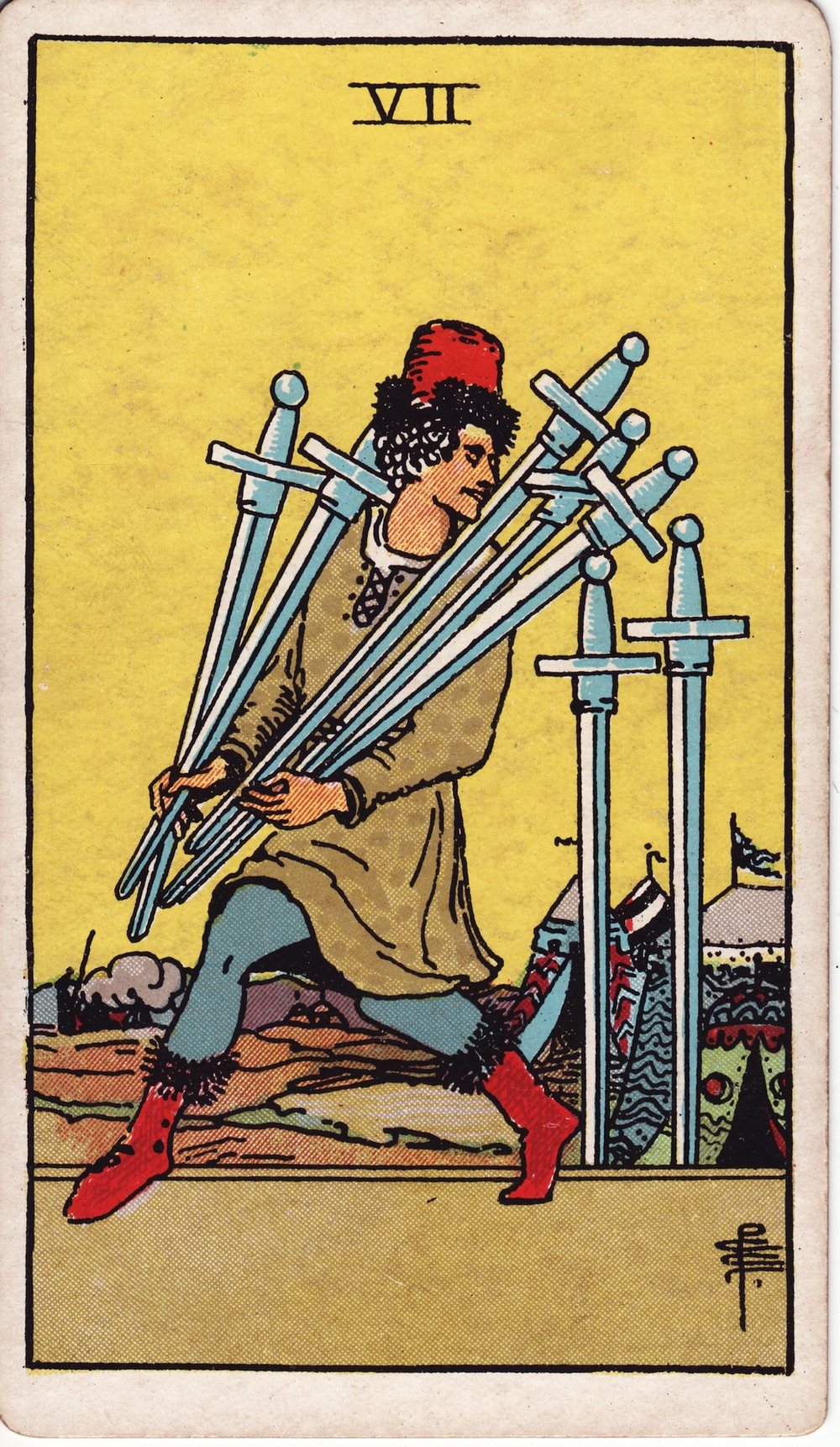
In the Rider-Waite image, a man creeps away from a military camp on the balls of his feet. He has gathered up five swords into his arms, holding them clumsily by the blades, and he glances back over his shoulder with a small, pleased smile. Two swords stay planted upright in the ground behind him. In the distance, tents stand in rows and a single figure raises a hand near a fire, too far away to stop what is happening.
Look closely and the theft is already half botched. He has the five swords but left the two that mattered, and he carries the lot by the sharp edges, which means he is going to bleed before he reaches the tree line. This is the heart of the card. The Seven of Swords is cleverness that admires itself a little too much. It is the plan that works right up until the part nobody planned for.
The card is not simply about lying or stealing, though it can be those things. It is about acting alone, slipping past the rules, and trusting your own wits over the group. Sometimes that is cowardice dressed as strategy. Sometimes it is the only honest move left in a situation where everyone else has the numbers. The smile on his face is the question the whole card asks of you. Are you being smart, or are you just getting away with it for now?
In this guide we follow that lone figure through every room of a reading, upright and reversed, to see where his cunning serves you and where it leaves you bleeding from your own grip.
What does the Seven of Swords mean?
Upright, the Seven of Swords points to strategy, stealth, and going your own way. You are operating on a plan that you have chosen not to share, either because you do not trust the people around you or because you believe you can move faster alone. There is intelligence here, real cunning, the kind that sizes up a situation and quietly takes what it needs.
The card often shows up when you are tempted to cut a corner. A small omission, a story told with a few details left out, a shortcut that saves you a difficult conversation. None of it feels like a crime in the moment. It feels efficient.
The Seven also speaks to self-reliance under pressure. When the group has failed you or the rules have stopped making sense, sometimes the sane response is to grab what you can and slip out the side door. The man in the card is not stupid. He read the camp, picked his moment, and moved.
What the card asks is whether you have read yourself as carefully as you read the room. Stolen advantage tends to come with a cost that arrives late. The swords he carries by the blade will cut his hands long before anyone catches him.
Seven of Swords Keywords:
- Stealth
- Strategy
- Cunning
- Deception
- Acting alone
- Getting away with something
- Self-interest
- Cutting corners
- Evasion
- Mental agility
- Secrecy
- Calculated risk
What does the Seven of Swords mean when Reversed?
Reversed, the Seven of Swords turns its cunning inward or brings the whole scheme to light. The plan that ran smoothly in the dark is now exposed, and the man who slipped out of camp finds someone waiting at the tree line.
In this position the card frequently signals a confession, a getting caught, or a guilty conscience that will no longer stay quiet. The deception has run its course. What was hidden is surfacing, whether you choose to reveal it or someone else does it for you.
Reversed can also mean the opposite of all that secrecy, a decision to come clean and do things openly. You are tired of carrying swords by the blade. You want to put them down and walk back to face whatever you were avoiding.
There is a third reading, quieter and turned against the self. Reversed, the Seven sometimes points to self-deception, the lies you tell yourself to keep a comfortable story intact. The reversal pulls the trick out of the shadows and into a light you cannot argue with.
Seven of Swords Reversed Keywords:
- Getting caught
- Confession
- Coming clean
- Exposure
- Guilt
- Self-deception
- Returning what was taken
- Conscience
- Owning up
- Releasing a secret
Seven of Swords as How Someone Sees You
When this card describes how another person sees you, they see someone they cannot fully read. You strike them as clever, independent, a step ahead, and they are not sure whether that excites them or makes them nervous. There is admiration in it, but it is wary admiration.
They sense that you keep something back. Not in a cruel way, necessarily, but they feel there is a version of you they do not have access to, a private calculation running behind your eyes. To some that is magnetic. You seem like a person with depths and plans.
To others it reads as slippery. They notice that your answers are smooth and complete and yet somehow leave them holding nothing solid. They may catch themselves wondering, after you have left the room, what you actually told them.
If you want this person to trust you, the card is asking you to give them one true, unguarded thing. The mystery is working. It is the openness that is missing.
Seven of Swords Reversed as How Someone Sees You
Reversed, the person has stopped wondering and started knowing. Whatever you were keeping from them, they have seen through it, and now they see you as someone who tried to pull a fast one and got found out.
This can be the moment a relationship cracks. The charm that read as mysterious now reads as evasive, and they are reinterpreting old conversations in a harsher light. Things you thought you had gotten past are being added up.
It is not always so grim. Reversed can also mean they see you finally being honest, dropping the act, showing up without the strategy. If you have made the choice to come clean, this card says they noticed, and the respect you feared losing may actually be returning.
The reversal is the unmasking either way. The only question is whether you removed the mask yourself or had it pulled off.
What does the Seven of Swords mean in Love?
In a love reading, the Seven of Swords is one of the cards that makes readers pause. It can point to a partner who is keeping something back, managing things from behind a screen and feeding you the version of events that keeps the peace rather than the one that is true.
This does not always mean a grand betrayal. Often it is the small architecture of avoidance. Plans made and not mentioned, feelings filed away rather than spoken, a habit of handling things alone instead of bringing them to the relationship. Intimacy thins out when one person is always operating in private.
If you are the one pulling the card, look honestly at your own hand. Are you protecting yourself by staying half-hidden? The Seven thrives on the belief that you can keep part of yourself in reserve and still be fully loved. It does not work that way for long.
For singles, the card can warn against someone who is not as available as they present, or against your own tendency to play games when you actually want closeness. Love asks you to walk back into camp and set the swords down where your partner can see them. If you want a spread designed to draw out what is being kept hidden in a partnership, the best tarot spreads for relationships offer better structure than a single-card pull.
What does the Seven of Swords Reversed mean in Love?
Reversed in love, the secret comes out. A confession lands, a hidden thing surfaces, or one partner finally chooses to tell the truth they have been managing around. This is uncomfortable, but it is also the end of the deception, and an end is a kind of mercy.
For couples willing to do the work, the reversed Seven can mark a turning point toward honesty. The relief of stopping the performance is real. You no longer have to remember which version of the story you told.
It can also show the painful aftermath of discovery, the rebuilding of trust that has to happen one plain conversation at a time. There is no clever route through this part. The card that was all strategy upright becomes, reversed, a long stretch of having no strategy left but the truth.
For singles, the reversal is often a clearing of self-deception, seeing a situationship for what it really is, or admitting what you actually want instead of pretending you are fine with less.
What does the Seven of Swords mean in Friendship?
Among friends, the Seven of Swords can flag someone who is looking out for themselves at the group’s expense. A friend who takes more than they give, who is friendly to your face and lighter on loyalty behind your back, or who treats the friendship as a resource rather than a bond.
It may also describe a moment when you are the one holding back, keeping a circle of friends at arm’s length, not letting any of them in completely. Sometimes that is healthy self-protection. Sometimes it quietly starves a friendship of the trust it needs to grow.
The card occasionally points to a friend who operates by their own rules, charming and unreliable in equal measure, the one who disappears when it is inconvenient and reappears when they need something. You can keep this person around, but the Seven advises you to know exactly what they are.
At its most constructive, the Seven in friendship is a nudge to be straight with the people you claim as friends. Loyalty that is never tested in the open is just a habit.
What does the Seven of Swords Reversed mean in Friendship?
Reversed, a friendship reaches its moment of honesty. Either you confront the friend who has been working an angle, or a tension that has been managed politely for months finally gets spoken aloud. The masks come off and you both find out what the friendship is actually made of.
This can heal things. A friend who has been pulling away or quietly competing may come clean, apologize, and meet you in the open. The reversed Seven is good at clearing the air, even when the air is unpleasant on the way out.
It can also mean the end of a connection that was never as solid as it looked. Once you see the pattern clearly, you cannot keep pretending. Some friendships only survive in the half-light, and the reversal turns the lights on.
If you have been the one keeping secrets from your friends, this card asks you to stop. The energy you spend managing perceptions is energy you could spend simply being known.
What does the Seven of Swords mean in Career?
In work, the Seven of Swords is the card of the clever operator. It can mean you are playing the long game, keeping your real intentions quiet, building an exit or an advantage while everyone else assumes you are content. There is genuine strategic skill in this. Not every plan should be announced.
It can also warn of dishonesty in your workplace, a colleague taking credit that is not theirs, information moving where it should not, a culture where people watch their own backs first. If the card appears around a deal or an agreement, read the fine print and notice who benefits from the parts that stay vague.
For your own conduct, the Seven asks where you are cutting corners. The report padded slightly, the process skipped because nobody checks, the small lie that keeps a project looking healthier than it is. These shortcuts compound. The man carries five swords now and bleeds for it later.
Used well, this is the card of the independent mover, the freelancer, the strategist, the person who succeeds by thinking sideways. Used badly, it is the card that gets you walked out of the building.
What does the Seven of Swords Reversed mean in Career?
Reversed, the corner you cut is discovered, or the workplace deception you sensed comes into the open. An audit, a question you cannot smoothly answer, a colleague whose story stops matching the facts. What was hidden in the office is surfacing.
If you have been the one operating in secret, the reversal often means it is time to come clean before someone else makes the choice for you. Getting ahead of an exposure costs far less than being caught by it.
More hopefully, reversed can mean you decide to do your work honestly and openly, dropping the politics and the maneuvering. There is a real career strength in being the person whose word can be taken at face value. It is slower than scheming and far more durable.
The card can also mark the unwinding of a plan that was too clever to last. The shortcut fails, the strategy collapses, and you are left to do the thing properly. Annoying, but cleaner.
Seven of Swords as How Someone Thinks of You
When the card describes another person’s thoughts about you, their mind keeps circling a question of trust. They are turning you over, trying to decide how much of what you show them is real. You occupy a suspicious, fascinated corner of their thinking.
They may be impressed by your independence and your sharp read on situations. They might think of you as someone who could not be easily fooled, someone always three moves into the game. That is a kind of respect, even if it comes with caution.
Underneath, though, they are not certain they have your full loyalty. They wonder whether you would put your own interests first if it came to it, and they are not entirely wrong to wonder, which is part of what unsettles them.
The fix, again, is a single act of plain honesty aimed at this person. The Seven of Swords cannot be argued out of someone’s mind. It can only be replaced by an experience of you being straight.
Seven of Swords Reversed as How Someone Thinks of You
Reversed, their suspicion has either hardened into a verdict or dissolved into relief. If something came to light, they now think of you as someone who deceived them, and that thought is loud and unflattering. They are not giving you the benefit of the doubt anymore.
But if you have changed your behavior, the reversal can show them revising their opinion in your favor. They think, with some surprise, that you have actually been honest with them lately, that the guarded version of you has stepped aside. Trust starts, tentatively, to grow back.
This card reversed is rarely neutral. The person has moved from wondering to deciding. Whichever way it has gone, the ambiguity that surrounded you in their mind is over.
If the verdict has gone against you, do not try to outmaneuver it. The only thing that touches a betrayal in someone’s mind is consistent, unglamorous honesty over time.
What does the Seven of Swords mean in Conflict?
In conflict, the Seven of Swords is the card of indirect tactics. This is not the open clash of crossed blades. It is the flanking move, the thing done quietly while the other side is looking elsewhere, the advantage taken before anyone realizes a fight had started.
You or your opponent may be fighting by stealth, gathering information, choosing not to declare your real position, planning to win without ever appearing to compete. There can be cleverage in this. The man took the swords before the camp knew they were gone.
But the card warns that quiet tactics curdle into underhandedness fast. There is a line between being strategic and being sneaky, and in the heat of a dispute it is easy to cross it while telling yourself you are just being smart.
The Seven advises you to ask what kind of victory you actually want. A win achieved by deception leaves you with the win and the deception, both. Some conflicts are better met head on, with your hand visible, even if it costs you the element of surprise.
What does the Seven of Swords Reversed mean in Conflict?
Reversed, the hidden tactics come into view. The flanking move is spotted, the quiet maneuver is named out loud, and the conflict that was being fought in the shadows moves into open ground. This can feel like a loss of advantage, and sometimes it is.
If you were the one moving quietly, the reversal often means you are caught, and now you must fight the original dispute plus the question of why you were sneaking. That second fight is usually the harder one.
It can also mean a healthier turn, a decision to stop the cold war and address things directly. Putting the swords down and saying what you actually want can end a conflict that stealth would have dragged out for months.
Where you suspected an opponent of underhanded play, the reversed Seven can be the moment you finally have proof. Use it carefully. Exposure is powerful, and power used in anger tends to overreach.
Seven of Swords as Feelings
As a feeling, the Seven of Swords is the particular unease of someone keeping a secret. There is a held-breath quality to it, a part of the heart kept off to the side, a wariness about being fully seen. The person may feel clever and in control, and also slightly alone in a way they cannot quite name.
If it describes how someone feels about you, they may feel guarded, unsure whether to commit their full trust. They could be holding back affection while they decide if you are safe, or protecting themselves out of an old habit that has nothing to do with you.
There can be a thread of guilt running under it. Carrying something hidden is heavier than it looks, and the Seven often shows a person more burdened by their own secrecy than they let on. The smile in the card is real, but so is the glance over the shoulder.
The feeling this card asks for is the relief of honesty. Whatever is being held in reserve wants, somewhere underneath, to be set down.
Seven of Swords Reversed as Feelings
Reversed, the held breath finally releases. The feeling is the lightness, or the exposure, of a secret that is no longer secret. For some that is enormous relief, the weight of pretending lifted at last. For others it is the raw, found-out feeling of having nowhere left to hide.
If it describes someone’s feelings about you, they may be feeling the urge to be honest with you, to drop a guard they have kept up too long. The reversal softens the wariness of the upright card into something more open and a little vulnerable.
It can also point to a person wrestling with guilt that has grown too loud to ignore. The conscience, reversed, has won. They are tired of the story they have been maintaining and they want to put it down even if it costs them.
Underneath the discomfort, this is usually a feeling moving toward truth, which is healthier than the polished concealment of the upright card, however exposed it feels in the moment.

Seven of Swords as a Situation
As a situation, the Seven of Swords describes circumstances where not everything is on the table. Information is being managed, motives are partly hidden, and the official version of events is not the whole story. You are operating with incomplete trust, and you may know it.
This is the situation that calls for discretion and a sharp eye. You may need to keep some things to yourself, watch how people behave when they think no one is looking, and avoid putting all your cards down at once. The environment rewards the careful and punishes the naive.
It can also be a situation you have entered by slipping past the proper channels, a shortcut taken, a permission not quite asked for. It is working for now. The card simply notes that it rests on something unspoken, and unspoken things have a way of being spoken later.
You are in a position where cleverness matters, but it has a shelf life. Plan for the day the hidden parts come out, because the Seven almost always implies that day exists.
Seven of Swords Reversed as a Situation
Reversed, the concealed situation breaks open. What was being managed quietly is now in plain view, and everyone involved has to deal with the actual facts instead of the convenient version. This can be chaotic at first and clarifying afterward.
If you were getting away with something, the reversal is the moment the structure gives way. The shortcut is found, the omission is noticed, and the situation demands honesty whether or not you feel ready for it.
More positively, the reversed Seven can describe a situation finally being conducted in the open, secrets resolved, the air cleared, the maneuvering done. Things become simpler once nobody is hiding anything, even if simpler is harder.
Either way, the era of strategy is closing. The situation is moving from what is hidden toward what is real, and the smartest thing you can do is stop defending the old story and start working with the truth.
Seven of Swords as Intentions / What Someone Wants
As intentions, the Seven of Swords reveals a person with a private agenda. They want something, they have a plan to get it, and they have decided not to tell you what it is. This is not automatically sinister, but it is deliberately concealed, and the concealment is the point.
They may want to slip away from a situation cleanly, to exit without a confrontation, to take what they value and avoid the mess of explaining themselves. The intention is escape as much as acquisition. They are looking for the side door.
In a relationship question, this can be an uncomfortable read. The person may want the benefits of closeness while keeping an escape route, or they may be pursuing their own interests in a way that does not fully include you. Their plan has a part you are not in.
The card asks you to notice the gap between what this person says and what they are arranging. Watch the feet, not the smile. Intentions kept this carefully hidden are worth understanding before you rely on them.
Seven of Swords Reversed as Intentions / What Someone Wants
Reversed, the hidden intention is surfacing. Either the person decides to be honest about what they actually want, or their concealed plan becomes visible despite their efforts. The agenda is no longer fully private.
This can be the moment someone owns up to what they have been after all along. The relief of stating an intention plainly, even an awkward one, can clear a great deal of fog. You finally know where you stand with them.
It can also mean their scheme is unraveling, the plan exposed before it could be completed, the side door found and locked. What they wanted is now known, and knowing it changes the game for everyone.
For your own intentions, the reversal asks whether it is time to stop strategizing and simply say what you want. The Seven reversed favors the person who chooses openness, even at the cost of the advantage that secrecy was buying.
Is the Seven of Swords a Yes or a No?
The Seven of Swords leans toward no, or at least toward not like this. It is a card of incomplete honesty and shaky foundations, and questions answered by it tend to involve a catch you have not seen yet. The path forward exists, but it runs through something underhanded or unstable.
When you ask a direct yes or no question and this card answers, the message is usually that the straightforward route is not available. You might be able to get what you want by slipping around the rules, but the card warns that the win would come with a cost arriving later.
It can occasionally read as a qualified yes for matters that genuinely call for strategy, discretion, or independent action, the situations where keeping your plans close is wisdom rather than deceit. Even then, the card asks you to be sure you are being clever and not just sneaky.
Reversed, the answer is muddier still, often a no wrapped around exposure. Whatever you were hoping to pull off is likely to come to light. Take it as a yes only to the question of whether the truth will come out. If yes/no questions consistently feel slippery with the tarot, five reasons tarot cards can be wrong explains why this card resists simple answers more than most.
Seven of Swords as a Place
As a place, the Seven of Swords points to somewhere you are not fully meant to be, or somewhere that asks you to keep your guard up. A border zone, a back route, a place you slipped into rather than entered through the front. There is a watchful, temporary quality to it.
It can describe environments built around discretion, a place where business is done quietly and not everyone is told everything. Somewhere you would lower your voice without being asked. The card carries the atmosphere of a camp at night, half asleep and not quite secure.
On a more ordinary level, it can mark a place you pass through rather than settle in, a transit point, a spot you are using for cover or convenience while your real destination lies elsewhere. You are here to get something and move on.
Wherever the card points, it advises you to keep your wits about you and your valuables close. This is not a place to relax completely or to assume the people around you have your interests at heart.
Seven of Swords Reversed as a Place
Reversed, the place is exposed or no longer safe to operate in quietly. The hideout is discovered, the back route is watched, the discreet environment has lost its discretion. Whatever cover this place offered is gone.
It can also describe returning to a place you left under cover, walking back into the camp you snuck out of, facing the location and the people you were avoiding. There is a confrontation built into the geography now.
In a gentler sense, the reversal can mean a place becoming honest, an environment where the hidden dealings have been cleared out and things are done openly again. The lights have come on in the room that used to run on whispers.
Either way, secrecy no longer holds in this place. If you have been counting on a location to keep something hidden, the reversed Seven says that arrangement is ending.
Seven of Swords as an Obstacle / Challenge
As an obstacle, the Seven of Swords is the problem of trust, your own and other people’s. Something in your path is not what it appears, and your challenge is to see through it without becoming paranoid or deceitful yourself in the process.
The card can mark a situation where you are tempted to take a shortcut that would solve the immediate problem and create a worse one. The obstacle is partly the situation and partly the appealing, dishonest way out of it. Resisting that pull is the real task.
It can also describe being blocked by someone else’s hidden agenda, a person working against you quietly, an arrangement that keeps failing for reasons that stay just out of view. You cannot fight what you cannot see, so the first job is to make the hidden thing visible.
The challenge, in short, is to meet a deceptive situation with clarity rather than counter-deception. The Seven tempts you to fight stealth with stealth. The harder and better move is usually to bring the whole thing into the open.
Seven of Swords Reversed as an Obstacle / Challenge
Reversed, the hidden obstacle is revealed, which is uncomfortable and useful at once. The thing that was tripping you up from the shadows now has a name and a face. You can finally deal with it directly because you can finally see it.
If your own deception was the obstacle, the reversal is the reckoning. The corner you cut comes due, the story you maintained collapses, and the challenge becomes cleaning up honestly. This is harder work than the cover-up but it actually ends.
The card can also signal the lifting of an obstacle through confession or disclosure. Once the secret is out, the blockage it created dissolves, and the path that was tangled becomes walkable. Truth, here, is the tool that clears the way.
The reversed Seven asks for courage rather than cunning. The obstacle yields not to a cleverer scheme but to the willingness to stop hiding and face what is real.
Seven of Swords as Action
As advice toward action, the upright Seven of Swords counsels strategy and discretion. Think before you move, keep some of your plans to yourself, and do not announce every intention to a room that has not earned your trust. There is a time to play your cards close, and the card says this might be it. If the Seven points to a moment of stealth, the Four of Swords is the preparation that comes before it: the still, private pause that makes the eventual move clean.
It can advise an independent approach, handling something yourself rather than waiting on a group, moving quietly while the conditions are right. The man read his moment well. Timing and a cool head can accomplish what force cannot.
But the card always carries its warning inside the advice. If the action you are considering requires deceiving someone, taking what is not yours, or slipping past a line you would not cross in daylight, the Seven is showing you the cost as much as the method. Act cleverly, not crookedly.
The cleanest version of this advice is to be strategic without being dishonest. Keep your counsel, pick your moment, move with intelligence, and make sure that when the swords are counted later, you can account for every one of them.
Seven of Swords Reversed as Action
Reversed, the action the card recommends is to stop, come clean, and do it openly. The time for maneuvering has passed. Whatever you have been handling in secret needs to be brought into the light, by your own choice, before circumstances force it.
This is the card advising confession, restitution, the return of the swords to the camp. It is rarely the comfortable choice, but it is the one that ends the slow bleed of keeping something hidden. Walk back in and say the true thing.
It can also advise abandoning a too-clever plan in favor of a straightforward one. Drop the strategy, do the work directly, take the slower honest road. The reversal favors plain action over the elaborate scheme that was about to fall apart anyway.
If you have been deceiving yourself, the action is the same in miniature. Tell yourself the truth you have been managing around. The Seven reversed cannot move forward until the hidden thing is set down.
Seven of Swords as Advice
As advice, the Seven of Swords tells you to be smart, stay alert, and protect your interests, while watching that you do not slide from shrewd into shady. Keep your plans discreet where discretion serves you. Do not hand your full hand to people who have not shown they can be trusted with it.
The card advises you to read situations carefully, to notice what is being left unsaid, and to plan a few moves ahead. Naivety is its own kind of danger, and the Seven respects a person who knows the room they are standing in.
At the same time it asks you to interrogate your own shortcuts. Every place you are tempted to cut a corner, ask what it will cost when it surfaces. The advice is not to be timid. It is to be clever in ways you would still be comfortable with if they were discovered.
The Seven’s deepest advice is to keep your integrity intact even while you keep your cards close. Strategy and honesty are not opposites. You can be both private and trustworthy, and that combination is far stronger than cunning alone.
Seven of Swords Reversed as Advice
Reversed, the advice is unambiguous. Come clean. Stop the scheming, drop the half-truths, and choose the honest path even though it is harder. Whatever you have been hiding has cost you more energy than the truth ever would.
The card counsels you to get ahead of exposure rather than wait to be caught. If something is going to come out, far better that it comes from you, on your terms, with whatever ownership you can offer. Confession chosen is gentler than confession forced.
It also advises an end to self-deception. Look squarely at the story you have been telling yourself and ask which parts are true. The reversed Seven has no patience for comfortable fictions, including the ones you only tell in private.
Put the swords down. Walk back into the open. The relief on the other side of honesty is worth more than any advantage secrecy was protecting, and the card is, at this point, simply pointing you toward the door marked truth.
Seven of Swords as an Outcome
As an outcome, the upright Seven of Swords suggests a result reached by clever, indirect means, a situation where you got what you were after but not entirely in the open. The win exists. So does the asterisk beside it.
It can indicate that you will succeed through strategy, wit, and a willingness to go your own way, slipping past obstacles that stopped more direct approaches. There is real accomplishment in that, the satisfaction of having outthought the problem.
But the card cautions that an outcome built on something hidden carries a delayed bill. The five swords are yours, but you are bleeding from the blades, and the two you left behind may matter more than you thought. Enjoy the result with your eyes open.
This is an outcome that asks you to make sure the foundation is sound. If the success rests on a deception, the Seven hints that the deception is the part of the story not yet finished. A clean win is better than a clever one.
Seven of Swords Reversed as an Outcome
Reversed, the outcome is exposure and its consequences. Whatever was hidden comes to light, and the result of the matter is shaped by that revelation rather than by the original plan. The scheme does not reach the tree line.
For situations where you were the one concealing, this outcome can sting, the getting-caught, the unraveling, the cost of the shortcut all arriving at once. It is not the ending you maneuvered toward, but it is, in its way, an honest one.
More hopefully, the reversed Seven as an outcome can mean a matter resolved through truth and disclosure, a clean slate earned by coming clean. The end of the story is honesty restored, trust slowly rebuilding, the slate wiped because you stopped hiding.
The outcome, in any case, leaves you with the truth in hand. That may not be the prize you were chasing, but it is the more durable possession, and the only one the Seven reversed will let you keep.
Seven of Swords in the Future
In the future position, the upright Seven of Swords suggests a coming time that will call for strategy, discretion, and a careful eye. You may need to keep your plans quiet, move independently, and watch for situations where not everyone is being straight with you.
It can foretell a circumstance where a shortcut or a clever maneuver presents itself, an opportunity to get ahead by going around rather than through. The card neither forbids nor endorses it. It tells you the choice is coming and asks you to be ready to make it with your integrity intact.
The future Seven can also warn of someone entering the picture who is not fully honest, a person with a private agenda you would do well to read carefully before you trust. Keep your valuables close in the weeks ahead, literal and otherwise.
Treat this as a heads-up rather than a prophecy of doom. The future it shows rewards the alert and the self-reliant. Walk into it clever, cautious, and clean, and the Seven becomes an asset rather than a trap.
Seven of Swords Reversed in the Future
Reversed, the future holds a revelation. Something currently hidden, by you or by someone near you, is on its way to the surface. The coming time is one of exposure, confession, and the clearing of secrets, whether you welcome it or not.
If you have been keeping something concealed, the reversed Seven advises you to use the time you have now to get ahead of it. The future it shows favors the person who chooses to come clean over the one who waits to be found out.
It can also promise relief. A burden of secrecy you have been carrying is going to be set down, and the future on the other side of that release is lighter and more honest than the present. The performance ends and you get to simply be known.
Expect the future to ask for courage rather than cunning. The reversed Seven is steering you, over the days ahead, away from the side door and back toward the open ground where the truth lives.
Seven of Swords as a Person
As a person, the upright Seven of Swords describes someone clever, independent, and hard to pin down. They are mentally quick, strategic, often charming, and they keep a private layer of themselves that even close people never quite reach. You are never entirely sure you have the whole of them.
This person tends to operate alone and on their own terms. They dislike being constrained by rules or committees, preferring to find their own route through any situation. At their best they are resourceful and self-reliant, the one who quietly solves the problem everyone else was stuck on.
At their less admirable, they can be evasive, slippery with the truth, and quicker to look after themselves than the group. They may bend facts to keep things smooth, or treat honesty as optional when it is inconvenient. The smile is genuine and so is the calculation behind it.
In a court-card sense the Seven leans Aquarian, cool, inventive, and a little detached, more comfortable with strategy than with vulnerability. Reading this person well means watching what they do, not just enjoying what they say.
Seven of Swords Reversed as a Person
Reversed, this is a person at the moment of being unmasked, or a person choosing at last to drop the act. The clever operator has either been found out or has decided, on their own, to stop operating in the shadows. Either way the private layer is opening.
If the reversal describes the unmasking, you are seeing someone whose deceptions have caught up with them, now exposed and dealing with the consequences. The charm no longer covers the gaps. What you get from them now is realer, if less polished.
If it describes the choosing, this is the same independent, sharp-minded person finally trading cunning for candor. They are tired of carrying swords by the blade. The version of them that comes clean is harder for them than any scheme, and worth respecting for that.
Met at this turning point, the person can become genuinely trustworthy in a way the upright Seven never quite manages. The intelligence is still there. It is just no longer pointed at keeping you in the dark.
What Zodiac Sign / Element is the Seven of Swords?
The Seven of Swords belongs to the element of Air, the territory of the mind, of language, logic, and the swift currents of thought. Air is where ideas move faster than feelings can follow, and the Seven is Air at its most tactical, thinking three steps ahead and keeping the plan to itself.
The Air signs are Gemini, Libra, and Aquarius, and the Seven of Swords sits most closely with Aquarius, carrying the specific attribution of the Moon in Aquarius. That pairing is telling. Aquarius is cool, inventive, and independent, the sign most comfortable standing apart from the crowd and solving things in unconventional ways.
Put the Moon’s instinct and secrecy inside Aquarius’s detachment and you get the heart of this card, a private intelligence that trusts its own judgment over the group’s, that would rather slip away and rethink than argue in the open. There is brilliance in it and isolation too, the gift and the cost of the lone strategist.
If the Seven of Swords describes a person, expect an Aquarian flavor, the clever loner, the original thinker, the one who plays by rules of their own design. Air gives them the wit. The Moon gives them the shadows they like to work in. For the suit’s undiluted starting point, the Ace of Swords shows this mental energy before strategy and secrecy have shaped it.
Final Thoughts
The Seven of Swords is the tarot’s great question about means and ends. It hands you cunning, independence, and the ability to slip past the obstacles that stop everyone else, then asks whether you can use those gifts without quietly betraying yourself or the people who trust you. The smile of the man leaving camp is the smile of someone who has not yet felt the blades cut his hands. If this card keeps appearing for you, the most useful thing you can do is look honestly at where you are being clever and where you are simply getting away with something. For more of the suit’s sharp and sometimes painful lessons, sit with the bruised aftermath of the Five of Swords tarot card and the clear-eyed authority of the Queen of Swords tarot card, and if you are still finding your footing with the numbered cards, this guide on how to read the Minor Arcana is a good place to steady yourself. Wherever the Seven of Swords turns up, it invites you to set the stolen swords down and walk back into the open, where cleverness and honesty can finally work the same side of the street.