Nine of Swords Tarot Card Meaning

The Swords belong to Air, the suit of thought, of language and judgement and the restless machinery of the mind. Air builds, sorts, names, and worries, and by the time we reach the Nine the worrying has taken over the whole house. In the old Golden Dawn attributions the Nine of Swords carries Mars in Gemini, the planet of aggression lodged in the most talkative and divided of the signs, so the violence here turns inward and becomes a quarrel the mind picks with itself at three in the morning.
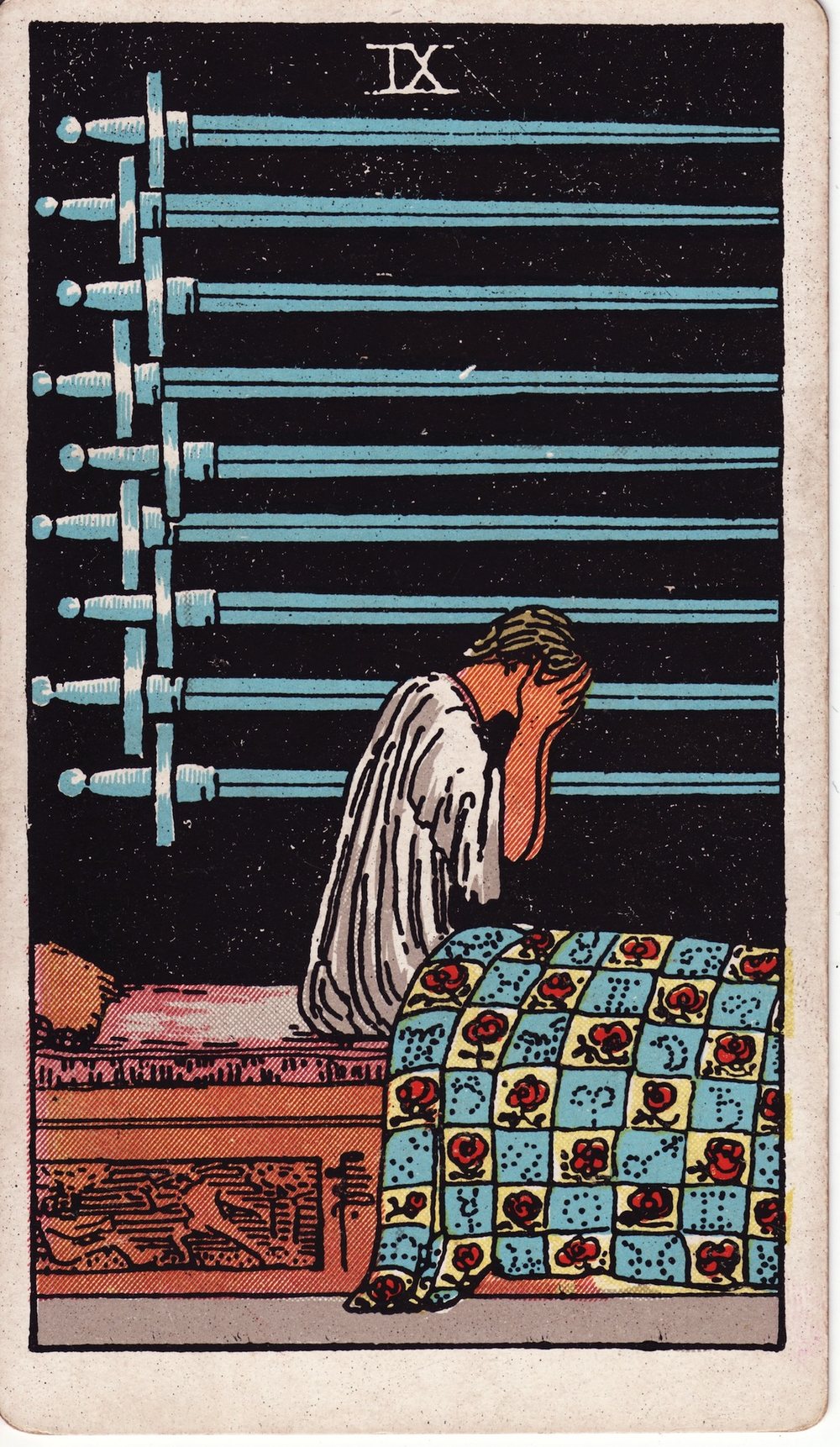
The Rider-Waite image is one of the most immediately human in the deck. A figure sits upright in bed, woken from sleep, face buried in both hands. Nine swords hang in horizontal rows on the black wall behind, not falling, not threatening, simply suspended there like the thoughts that will not leave. The bed is solid and carved, and the carving shows two figures, one defeating another, a small scene of conflict frozen in the woodwork. The quilt across the lap is sewn with red roses and the squares of the zodiac, signs of life and order, of beauty and meaning that still exist even now.
The detail that decides this card is the darkness. The swords do nothing. No one is struck, no blood is drawn, the room is quiet. All the suffering is happening behind the hands, in the private theatre of the mind, where the night magnifies everything and morning is still hours away. This is grief, yes, but more often it is anguish without an external cause equal to it, the dread that outruns the facts.
The Nine of Swords is the card of mental anguish, of guilt and insomnia and the long replaying of what cannot be changed. It rarely points to a fresh wound. More often it shows the wound being reopened nightly by a mind that has confused remembering with healing. Its mercy is hidden in the quilt: the roses and the zodiac are still there, the morning is real, and the swords on the wall were never going to fall.
What does the Nine of Swords Tarot card mean?
Upright, the Nine of Swords describes suffering that lives almost entirely in the head. The seeker lies awake, turning a fear or a regret over and over, convinced of the worst long before the worst has happened. There is anxiety here, often guilt, and the particular exhaustion of a mind that will not switch off.
What gives the card its weight is the gap between the feeling and the fact. The dread is genuine and physically real, the racing heart and the sour stomach and the hour that crawls. But the catastrophe being rehearsed has usually not arrived, and may never arrive. The mind is treating a possibility as if it were a verdict.
This is not a card that mocks the pain. It takes the anguish seriously and names it for what it is, then points quietly at the daylight. The work of the Nine of Swords is to step out of the loop, to put the fear into words and into the light where it can be measured, because almost nothing survives being looked at directly as well as it survives being imagined in the dark.
Nine of Swords Keywords:
- Anxiety
- Insomnia
- Nightmares
- Dread
- Guilt
- Mental anguish
- Worry and rumination
- Catastrophising
- Fear of the worst
- Isolation
- Sleepless nights
- Despair
What does the Nine of Swords mean when Reversed?
Reversed, the Nine of Swords usually turns in one of two directions, and the surrounding cards tell you which. At its better, the anguish is beginning to lift. The seeker has spoken the fear aloud, asked for help, or simply made it to morning enough times to know the night always ends. The swords are coming off the wall. Recovery is slow but it has started.
At its harder, the reversal deepens the trouble rather than easing it. The worry has gone underground, denied in daylight and left to fester, or it has hardened into despair that no longer even reaches for relief. Shame keeps the seeker from naming it, and what cannot be named cannot be set down.
In both versions the card points to the inner work of release. Where the upright is the worst of the night, the reversed is the question of whether dawn brings recovery or a numbness that only looks like peace. The honest move is the same: bring it into words, and let someone else help carry it.
Nine of Swords Reversed Keywords:
- Recovery from anxiety
- Releasing fear
- Hope returning
- Reaching out for help
- Or: hidden worry
- Denial
- Despair without relief
- Shame
- Refusing to face it
- Self-blame turned inward
- Healing beginning
- Letting the night end
The Nine of Swords as How Someone Sees You
When the Nine of Swords describes how another person sees you, it suggests they sense that you are not sleeping well. They notice the strain you think you are hiding, the worry that sits behind your eyes even when you smile. To them you seem burdened, carrying something heavy and private.
There can be tenderness in this reading. The person may see you as someone in pain and may want to reach you, unsure how to offer comfort without intruding on a struggle you keep behind your hands. They may worry about you more than they say.
It can also mean they see you as anxious, as quick to assume the worst, as someone who borrows tomorrow’s troubles tonight. They have watched you talk yourself into fear before. Whether that reads as fragility or as a habit they wish you would break depends on how close they stand to you.
The Nine of Swords Reversed as How Someone Sees You
Reversed, this card can mean the person sees you slowly surfacing from a hard stretch. They notice the colour returning, the relief of someone who has stopped bracing for a blow. To them you look like a person on the mend, lighter than you were.
Less kindly, it can mean they sense you are hiding how bad it still is. They catch the gap between the calm face and the tired ones underneath it, and they suspect you are minimising. They see denial where you intend composure.
Either way the reversed card hints that your inner state is more visible than you assume. The mind keeps its worst hours private, but the body and the silences give it away, and the person reading you has noticed more than you meant to show.
What does the Nine of Swords mean in Love?
In love the Nine of Swords speaks to the fears we carry into the relationship rather than the relationship itself. It often appears when one partner lies awake imagining betrayal, abandonment, or loss that the daylight relationship does not support. The anxiety is real, the threat usually is not.
For someone in a partnership, the card can mark a season of insecurity, of reading silence as rejection and lateness as proof of the worst. These fears, left in the dark, corrode the trust they are afraid of losing. Spoken plainly to a patient partner, they usually shrink to their true size.
For someone single, it can show a heart kept awake by old wounds, replaying a past hurt until it stands guard over every new chance. The card does not deny that love can hurt. It asks whether the dread is protecting you or simply keeping you up at night, alone, defending against a danger that is not in the room.
What does the Nine of Swords Reversed mean in Love?
Reversed, the Nine of Swords in love can be a genuine relief. The worst fears are being aired and disproved, a long anxiety is loosening, and two people are learning to talk in daylight about what used to haunt the night. Reassurance is doing its quiet work.
It can also warn that a fear is being swallowed rather than shared. One partner decides not to burden the other, and the unspoken worry curdles into distance. What is denied does not disappear, it just stops being something the two of you can solve together.
In the harder reading, the card points to anguish that has settled into the relationship as low, chronic unhappiness, a sadness no one names anymore. Here the reversal asks for honesty before resignation, for the hard conversation that breaks the silence rather than the slow agreement to stop trying.
What does the Nine of Swords mean in Friendship?
Among friends, the Nine of Swords often marks the one who is struggling silently. It can be you, lying awake and certain you are a burden, choosing isolation over the risk of leaning on someone. It can be a friend who has gone quiet, whose absence is not coldness but a private night you cannot see into.
The card asks for reaching across that gap. Anguish convinces people they are alone and unwelcome, and so it keeps them from the very company that would ease it. A friendship is one of the few things that genuinely turns down the volume on a frightened mind.
If a friend is the one suffering, the Nine of Swords counsels presence over solutions. You do not have to fix the fear. Sitting with them while the night passes, taking the worry seriously without feeding it, is most of what helps. The other half is simply checking that they are not facing it alone.
What does the Nine of Swords Reversed mean in Friendship?
Reversed, the card can show a friend coming back into the light, returning from a hard private stretch with relief and maybe a little embarrassment at having gone quiet. The friendship survives the silence, and the reaching out that ends it is the whole repair.
It can also flag a friend whose trouble is being hidden behind a brave face, or a worry of your own you keep deflecting with jokes. The reversal warns against the polished surface that keeps real help at arm’s length.
At its lowest the card points to a friendship strained by unspoken hurt, by resentment or guilt that festered in the dark instead of being said. The way through is the same as it ever was here: speak the thing, give the other person the chance to understand, and let daylight into what the night made enormous.
What does the Nine of Swords mean in Career?
In work the Nine of Swords is the card of the job that follows you home and keeps you up. It often appears with stress that has outgrown its cause, the looping dread about a mistake, a deadline, a conversation with a manager that you replay until it swells beyond all proportion.
It can mark genuine burnout, the point where worry about work has begun to cost you sleep and health. It can also mark anticipatory fear, the catastrophe rehearsed before the meeting that turns out, in the meeting, to be ordinary. Either way the suffering is real and the toll is physical.
The card’s counsel is to separate the workload from the dread about the workload, because they are rarely the same size. Write down what actually has to be done and by when. Most of what keeps you awake is not the task but the formless fear orbiting it, and that fear shrinks fast once it is named and put on paper.
What does the Nine of Swords Reversed mean in Career?
Reversed, the Nine of Swords at work often signals the pressure beginning to ease. A feared outcome did not come to pass, a problem got named and handled, and you are sleeping again. The crisis you braced for turned out smaller than the night made it.
It can also warn that stress is being buried rather than addressed, pushed down with overwork or a forced calm that will not hold. Denial keeps the machine running for a while and then it does not. The reversal asks you to deal with the cause before the body forces the issue.
In its darker sense the card can show despair about your work that you have stopped fighting, a quiet hopelessness about your situation. Here it is asking whether the problem is truly unsolvable or whether exhaustion has talked you out of options that still exist.
The Nine of Swords as How Someone Thinks of You
When this card describes someone’s thoughts about you, it often means you are on their mind in an anxious way. They worry about you, replay a conversation with you, or fret over where they stand with you. You occupy their late hours, not always comfortably.
It can mean they think of you with guilt, troubled by something they said or did, unable to set it down. The thought of you is tangled with their own self-reproach, and that knot keeps the memory of you sharp and uneasy.
Less heavily, it can simply mean they think of you when their own fears rise, as someone tied to a worry they carry. The card rarely shows light, easy thoughts. Whatever you are to this person, you are bound up with something that keeps them awake.
The Nine of Swords Reversed as How Someone Thinks of You
Reversed, the card can mean a worried preoccupation with you is finally easing. They have made peace with whatever kept them up, talked themselves down, or decided to let the fear go. You are becoming a calmer thought than you were.
It can also show that they are pushing the thought of you away, refusing to deal with feelings about you that still trouble them underneath. The calm is managed, not real, and what is buried keeps its hold.
In some readings it points to guilt they have not resolved and cannot quite face, a self-blame connected to you that they keep at the edge of awareness. The reversal hints at unfinished business in their mind, a reckoning postponed rather than completed.
What does the Nine of Swords mean in Conflict?
In conflict the Nine of Swords moves the battle inside. The real fight here is not with the other party but with your own dread about it, the sleepless rehearsal of every way it could go wrong. You are losing the argument in your head long before anyone speaks.
The card often shows a dispute magnified by the mind into something monstrous. The actual disagreement may be ordinary, but anxiety has wrapped it in catastrophe, and so you approach it braced for ruin. That bracing tends to make you either avoid the matter entirely or come in too hard, defending against a threat that is mostly imagined.
Its counsel is to bring the fear into daylight before the confrontation. Say plainly what you are actually afraid will happen. Most feared outcomes, once spoken, reveal themselves as unlikely, and the conflict you have been dreading turns out to be survivable, even small.
What does the Nine of Swords Reversed mean in Conflict?
Reversed, the card can mean the dread around a conflict is breaking. You have faced the conversation you feared, and the sky did not fall. The release is enormous precisely because the anticipation was so much worse than the event.
It can also warn that you are refusing to face a conflict at all, burying it to avoid the anxiety of dealing with it. The peace this buys is false, and the unaddressed matter keeps gnawing in the dark. Avoidance is not resolution, it is the worry stretched out longer.
In a harder reading the reversal shows a conflict that has left lasting anguish, guilt over what was said or grief over what broke. Here the work is no longer winning but healing, forgiving yourself or the other enough to finally sleep.
The Nine of Swords as Feelings
As feelings the Nine of Swords is unambiguous and heavy. The person feels anguish, dread, guilt, or grief, and feels it most at night when there is nothing to distract from it. This is the emotional low point of the suit, the place where thought turns on its owner.
It is important to read the card as feeling and not as fact. Someone feeling the Nine of Swords is convinced of the worst, but the conviction is the wound, not the evidence. They are suffering as if the catastrophe were certain, when it is only feared.
If the card describes your own feelings, it validates the pain while gently disputing the story. Yes, this hurts, and the sleeplessness is real. No, the thing you are dreading is not the certainty your mind has made it. The roses are still on the quilt. Morning is still coming.
The Nine of Swords Reversed as Feelings
Reversed, the card can mean the worst of the feeling is passing. Relief is seeping in, the dread is loosening, and the person is beginning to feel that the night will, in fact, end. Hope returns first as a small thing, the simple sense that this is survivable.
It can also mean the feeling has been suppressed, pushed down where it cannot be felt but cannot heal either. Numbness reads as calm from the outside, but it is anguish put on mute, not anguish resolved.
At its lowest the reversed Nine of Swords is despair that has stopped reaching out, sadness so settled it no longer expects relief. This is the reading that asks most urgently for another person, because a mind in this state rarely talks itself back alone.
The Nine of Swords as a Situation
As a situation the Nine of Swords describes circumstances soaked in worry, a stretch of life defined by sleepless nights and anxious days. Something has the seeker in its grip, and even if the outer events are manageable, the inner experience of them is not.
The card frequently appears when the dread has outgrown the facts. The situation may be difficult, but it is the rumination that has made it unbearable, the endless private rehearsal of disaster. The mind has built a prison out of what-ifs and locked itself inside.
Its guidance is to test the fear against reality. Name what is actually happening, what has actually been decided, what is actually likely. The situation is almost always more survivable than the version that keeps you awake, and seeing that clearly is the first real rest, the kind the Four of Swords calls for.
The Nine of Swords Reversed as a Situation
Reversed, the situation is usually turning a corner. The crisis that kept you awake is resolving, the dreaded thing has passed or proved smaller than feared, and the long anxious stretch is finally easing. You are starting to breathe again.
It can also describe a situation whose stress has been buried rather than handled, papered over with denial. The trouble has not gone, it has only gone quiet, and quiet trouble has a way of returning at full volume. The reversal asks you to face it while you still can choose the timing.
In some spreads it shows a situation that has left lasting marks, a hard chapter survived but not yet grieved. Here the work is recovery, giving yourself permission to heal from what the worry cost you instead of pretending it cost nothing.
The Nine of Swords as Intentions / What Someone Wants
As intentions the Nine of Swords is rarely about scheming and almost always about fear. What the person wants, underneath everything, is relief, an end to the worry that keeps them up. Their actions are driven less by desire than by dread.
It can mean someone wants reassurance they are too anxious to ask for directly, circling the thing they need to hear because requesting it feels too exposed. Their intention is muffled by the fear of the answer.
It can also point to guilt as the engine, someone wanting to make amends or to be forgiven, unable to set down what they did. What they want from you is release, the chance to stop punishing themselves. Read kindly, the card shows a person ruled by an anxious conscience rather than a hostile plan.
The Nine of Swords Reversed as Intentions / What Someone Wants
Reversed, the card can mean someone wants to move past a fear that has held them, to stop worrying and start trusting again. Their intention is recovery, the deliberate choice to let the night end and reach for something better.
It can also show someone who wants to avoid dealing with what troubles them, who would rather bury the worry than face it. The intention here is escape rather than resolution, and escape from this card tends to be temporary.
In a harder reading it points to someone too sunk in despair to want much of anything, whose intention has collapsed into simply getting through. The reversal asks for gentleness with such a person, and often for help they cannot bring themselves to request.
Is the Nine of Swords a Yes or a No?
The Nine of Swords is a no. It is one of the heavier negatives in the deck, weighted with anxiety, dread, and outcomes the mind has already decided will hurt. When it answers a question, it answers in the voice of fear.
But the reader should hold that no carefully. The card’s no is the verdict of a frightened mind, not always the verdict of reality. It says you expect the worst, you are losing sleep over this, you are braced for failure. It does not always say failure is certain.
So the honest reading is a no shadowed by a question. The path you are on is full of worry and likely to bring more, and that is reason enough to pause. Yet some of the dread is the card itself talking. Test the fear before you accept the no as final, because tarot cards can be wrong in exactly this way: the Nine of Swords lies awake imagining defeats that daylight does not deliver.
The Nine of Swords as a Place
As a place the Nine of Swords is the bedroom at the worst hour of the night, the room where you lie staring at the ceiling while the house sleeps. It is anywhere the mind goes to be alone with its fears, quiet on the outside and loud within.
It can point to a literal place tied to anxiety, a home where you do not sleep well, a room that holds bad memories, a building where dread waits for you. Some places press on us, and this card knows them.
More often it is an inner place, the private dark each of us carries. The counsel is the same in either case: do not stay there longer than you must. Turn on a light, open a door, find another room or another person. This place feels permanent at three in the morning and is not.
The Nine of Swords Reversed as a Place
Reversed, the card can mark leaving that dark place, the relief of stepping out of the room where you suffered into somewhere lighter. It is the bedroom with the curtains finally open, the house at dawn instead of midnight.
It can also describe a place whose oppressiveness you have learned to ignore, a setting that still weighs on you though you have stopped noticing. The reversal hints at a numbness to surroundings that quietly cost you something.
In some readings it points to a place of recovery, a refuge sought after a hard time, the quiet room where healing is allowed to happen slowly. Where the upright is the sleepless dark, the reversed is the long-awaited morning light reaching the floor.
The Nine of Swords as an Obstacle / Challenge
As an obstacle the Nine of Swords is fear itself, the anxiety standing between you and what you want. The thing in your way is not in the world. It is the dread that keeps you from sleeping, deciding, or acting, the catastrophising that turns every step into a cliff edge.
The card warns how convincing this obstacle is from the inside. The mind presents its worst-case stories as sober realism, and so you mistake worry for wisdom and call your paralysis caution. Meanwhile the actual path stays open and unwalked.
To clear it, you have to treat the fear as the problem rather than the messenger. Name the catastrophe you are bracing for, then ask how likely it truly is and what you would actually do if it came. Almost always the obstacle dissolves under that honest light, because it was made of imagination, not stone.
The Nine of Swords Reversed as an Obstacle / Challenge
Reversed, the obstacle of fear may be lifting. You are seeing through the worst-case stories, recognising the dread as dread rather than fact, and the paralysis is loosening its grip. The wall turns out to have been a shadow.
It can also warn that you are dodging the fear rather than facing it, that the obstacle remains because you keep avoiding the room where it lives. Denial leaves the challenge intact and adds the cost of pretending it is gone.
In a harder reading the reversed card shows anxiety that has hardened into a chronic block, a despair you have stopped trying to push through. Here the challenge is to reach for help, because some walls are not meant to be faced alone, and the reaching is itself the way past them.
The Nine of Swords as Action
As an action the Nine of Swords advises against acting from fear. The instinct this card produces is the wrong one to follow: the panicked decision, the message sent at midnight, the retreat made in dread. Action taken from the worst hour of the night tends to make the morning worse.
The truer action it points to is small and inward. Stop the loop. Put the fear into words, on paper or to a trusted person. Do the unglamorous things that interrupt rumination, the walk, the breath, the wait for daylight before deciding anything that matters.
If there is an outward move to make, it is the act of reaching out. Telling someone you are struggling is the single most effective action available under this card. It is also the hardest, because the Nine of Swords whispers that you are alone and a burden, and that whisper is exactly the thing the action proves wrong.
The Nine of Swords Reversed as Action
Reversed, the card calls for the deliberate act of release, the choice to set the worry down and let the night end. It is the action of asking for help, of speaking the fear aloud, of treating the anguish as something to move through rather than carry forever.
It can also warn against the action of burying, of pushing the trouble down and marching on as if nothing is wrong. That is motion, not progress, and the reversal flags it as a false fix.
At its best this is the first small step out of the dark: getting up, opening the curtains, making the call you have been avoiding. The reversed Nine of Swords asks you to act on the side of recovery, gently and soon, before despair talks you out of trying.
The Nine of Swords as Advice
As advice the Nine of Swords says: do not believe everything you think at night. Your mind is running a horror film and casting your future in it, and the film is not a forecast. Take the dread seriously as a feeling and skeptically as a prediction.
It counsels bringing the fear into the light. Name it, write it down, say it to someone, measure it against what is actually true. Anguish thrives in the dark and on silence, and it loses most of its power the moment it is spoken plainly and met with another person’s calm.
Above all the card advises against isolation. The voice telling you to suffer alone, that no one wants to hear it, that you are a burden, is the illness talking, not the truth. Reach out. The morning comes, the swords stay on the wall, and you do not have to wait for either by yourself.
The Nine of Swords Reversed as Advice
Reversed, the advice is to keep going with the recovery you have begun. The worst is passing, so let it pass. Accept the relief, keep talking, keep choosing daylight over the loop, and do not retreat back into the dark out of old habit.
If the reversal carries the harder meaning, the advice sharpens. Stop hiding how bad it is. The brave face is costing you the help you need, and the worry buried alive is not healing, it is waiting. Honesty with someone you trust is the way out.
Either way the counsel is the same in spirit: do not face this alone, and do not let shame guard the door. Whether you are mending or still sinking, the reversed Nine of Swords asks you to let another person in, because that is where the real turning happens.

The Nine of Swords as an Outcome
As an outcome the Nine of Swords is a difficult one to draw, pointing to a result steeped in worry, regret, or anguish. It suggests the situation ends with the seeker losing sleep over it, carrying guilt or fear into the aftermath rather than peace.
But read the card with its own caution in mind. The outcome it shows is partly the dread you are bringing to the question, the worst case your mind has already moved into. It tells you how you expect things to feel, which is not always how they will turn out.
If this is the outcome, treat it as a warning rather than a sentence. It says that on the current path you are headed for sleepless nights and a heavy heart. That is reason to change the path, to address the fear now, and to refuse the conclusion that this anguish is simply how the story has to end.
The Nine of Swords Reversed as an Outcome
Reversed, the outcome often improves. The dreaded ending does not arrive, the worry resolves, and the long anxious stretch closes with relief instead of ruin. The night you feared turns out to have a morning after all.
It can also show an outcome where the trouble was buried rather than resolved, a surface calm with the real matter still unsettled underneath. The reversal warns that such an ending is provisional, and the unfinished thing tends to return.
In its hopeful sense, though, the reversed Nine of Swords is genuine recovery, the slow lifting of a weight, the return of sleep and steadiness. It marks the end of a hard chapter and the beginning of healing, the swords coming down off the wall one by one.
The Nine of Swords in the Future
In the future position the Nine of Swords warns of a coming stretch of worry, a period when anxiety or guilt may weigh heavily and sleep may grow scarce. It asks you to be ready, not to dread, but to know the season and prepare for it.
The warning is also an invitation to disarm the fear early. If you can see the anxious time coming, you can build supports before it arrives, the people you will talk to, the habits that steady you, the spreads for guidance you pull while you are still calm, the reminders that the night always ends. Forewarned, the storm is far more survivable.
And as ever, treat the prediction lightly. The card shows a future colored by dread, much of which is the dread itself projecting forward. By facing your fears now and refusing to carry tomorrow’s troubles tonight, you can keep this future from hardening into fact.
The Nine of Swords Reversed in the Future
Reversed, the future looks like relief on the way. A current anxiety is set to ease, a feared thing to pass without the catastrophe, and a season of better sleep and lighter days to follow. The card promises that this hard stretch is not permanent.
It can also caution that a worry you are presently avoiding may surface later, the buried thing returning because it was never faced. The reversal suggests dealing with it now rather than letting it ambush a future you.
At its most hopeful the reversed Nine of Swords in the future is recovery arriving, the long-awaited morning after a hard night. It tells the seeker to hold on, because the weight is going to lift, and the version of you on the other side of it sleeps soundly again.
The Nine of Swords as a Person
As a person the Nine of Swords describes someone in the grip of worry, a sensitive soul prone to anxiety, guilt, and sleepless nights. They feel things deeply and tend to imagine the worst, carrying a private burden the world does not always see.
This is often a person of conscience, even of compassion, whose very depth of feeling turns against them in the dark. They lie awake replaying their faults, magnifying their failures, anticipating disasters that rarely come. Their suffering is real and largely self-administered.
Approached with kindness, such a person needs reassurance more than advice and presence more than solutions. They are not weak, they are overloaded, and the looping mind that torments them is also the one that cares too much to let things go. What helps them most is being heard without being judged for the size of their fears.
The Nine of Swords Reversed as a Person
Reversed, the person may be recovering, climbing out of an anxious stretch with relief and new resolve. They have begun to face the fears that ruled them, to ask for help, to trust the morning. You are meeting them as they mend.
Less happily, the reversal can show someone hiding their struggle behind a composed face, denying how much they suffer, refusing the help that would ease them. Their calm is a performance, and the worry runs on underneath it.
At the harder edge it describes a person sunk in despair, too far into the dark to reach for relief, in real need of support they cannot ask for. The reversed Nine of Swords asks you to look past the surface with such a person, because what they show is rarely the whole of what they carry.
What Zodiac Sign / Element is the Nine of Swords?
The Nine of Swords belongs to the element of Air, which governs mind, language, and thought across the whole suit of Swords. Air gives the card its character: this is suffering made of ideas, of the words we tell ourselves in the dark, of reasoning that has slipped its rails and turned on its owner. The anguish is mental before it is anything else.
Among the air signs (Gemini, Libra, and Aquarius), the Nine of Swords carries the specific stamp of Gemini, through the old attribution of Mars in Gemini. Gemini is the restless, dual-minded sign, quick and verbal and prone to talking itself in circles, and the Nine shows exactly what happens when that mental energy turns anxious and nocturnal. The same agility that makes Gemini sparkle in conversation can keep a mind racing at three in the morning, arguing both sides of a fear no one is debating.
This is the shadow of Air uncooled by perspective. Where the balanced mind sorts and decides, the Nine of Swords mind spins, and the swords on the wall are the thoughts it cannot put down. To answer this card is to bring an air remedy to an air problem: words spoken aloud, fears written down, the racing mind slowed by another person’s steadier one.
Final Thoughts
The Nine of Swords is the deck’s most honest portrait of mental suffering, and also one of its most merciful, because everything tormenting the figure in the bed is happening behind the hands rather than out in the room. The swords never fall, the roses stay on the quilt, and morning is always closer than the night will admit. Its work is to coax the fear out of the dark and into daylight, where it can be measured and almost always shrinks. If this card spoke to you, sit with the self-made prison of the Eight of Swords tarot card, where the blindfold is the only thing keeping the door shut, or the quiet stalemate of the Two of Swords tarot card meaning, where a choice waits to be faced. Wherever the Nine of Swords appears, it asks you to remember that the night ends, that you do not have to wait it out alone, and that the worst hour is rarely the truest one.