Ten of Swords Tarot Card Meaning
The Swords belong to Air, the suit of thought and speech, of judgement and the cutting clarity that names a thing for what it is. Air is the most useful and the most dangerous of the elements, because the mind it rules can build a cathedral or a guillotine out of the same materials. By the time the suit reaches its tenth and final number, the building is finished and lying in ruins. In the old Golden Dawn attributions the Ten of Swords carries the Sun in Gemini, the light of life fixed in the most mental and divided of the signs, and the result is a brightness that arrives only after the dark has done its worst.
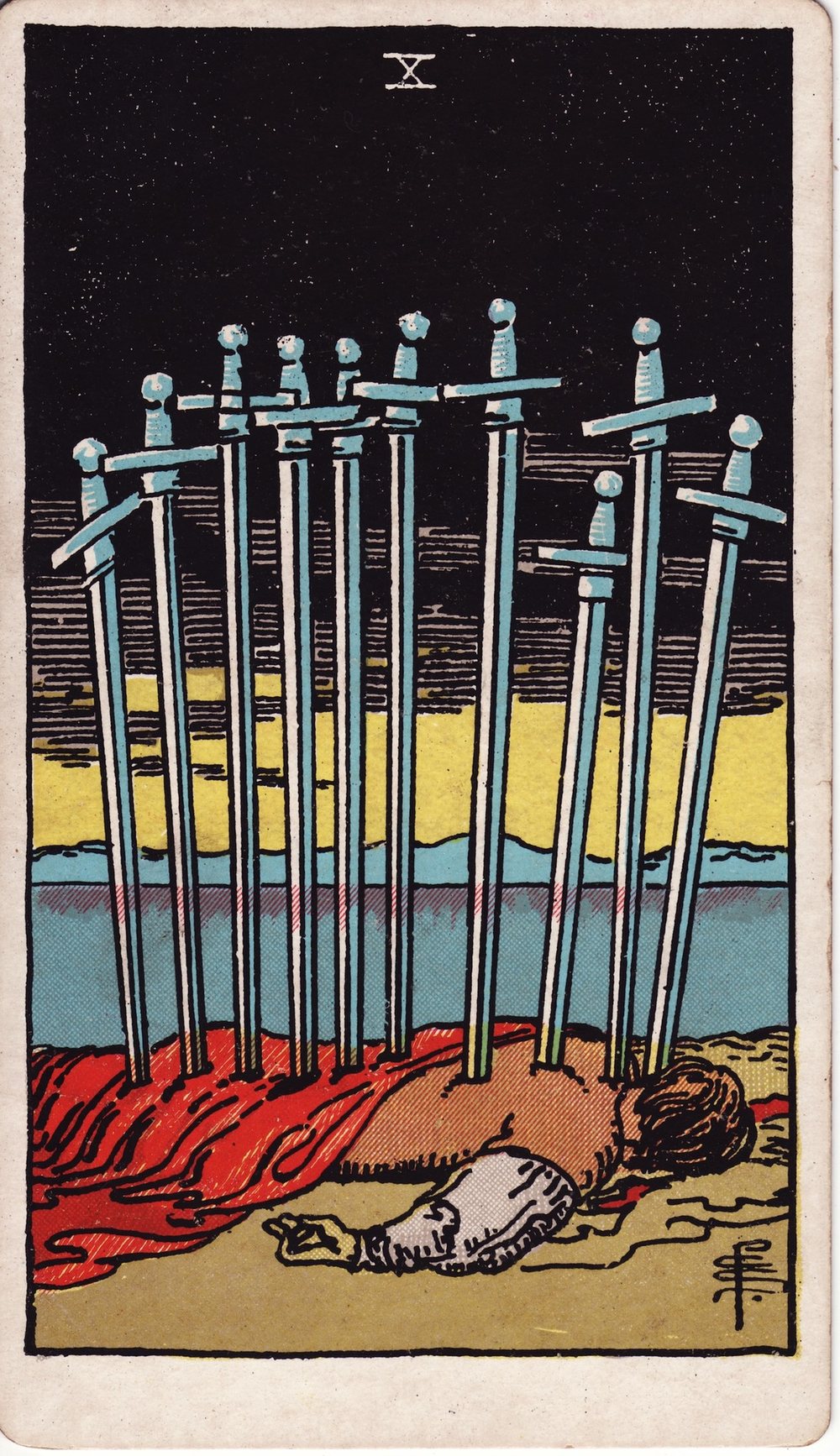
The Rider-Waite image is one of the most theatrical in the whole deck, and that is the point of it. A man lies face down on the ground at the edge of still water, and ten swords are driven into his back in a neat row, from shoulder to hip. The sky above him is black, the heaviest black in the deck. He is not wounded, he is finished, pinned to the earth by every blade the suit had to give. First-time readers sometimes wonder if a card this stark can predict death. It cannot.
But look at the detail that turns the card. You only need one sword to end a life. Ten is overkill, a wound past the point of meaning, and that excess is the card half-confessing that some of this catastrophe is melodrama, the mind stabbing a thing that was already dead. His right hand is curled into the sign of benediction, a blessing made even in defeat. And along the bottom of the sky, beneath all that black, runs a thin band of gold. The sun is rising. The night that did this to him is already ending.
The Ten of Swords is the card of rock bottom, of the painful ending fully arrived, of betrayal that lands in the back where you could not see it coming. It is ruin, collapse, the worst case made real. And it is, quietly, the most hopeful of the bad cards, because the disaster it shows is complete. There is nothing left to dread, no further to fall, and the only direction the suit has left is up toward the dawn already breaking over the water.
What does the Ten of Swords Tarot card mean?
Upright, the Ten of Swords describes an ending that has already happened. This is not the fear of ruin but the fact of it, the project collapsed, the relationship over, the betrayal landed. The seeker is past the moment of crisis and into the strange flat aftermath that follows it, lying in the wreckage and surveying the damage.
There is often betrayal in this card, the specific cruelty of being struck where you could not defend yourself. The swords are in the back. Someone you trusted, or a turn of events you never saw coming, has brought you down, and part of the pain is the shock of not having seen it.
What saves the card from pure despair is its finality. The worst has been done, which means the worst is also over. You cannot be stabbed an eleventh time. The Ten of Swords marks the absolute bottom of the suit’s long descent into the mind’s suffering, and from the bottom there is at last somewhere to go. Dawn is on the horizon precisely because the night has run completely out.
Ten of Swords Keywords:
- Rock bottom
- Painful endings
- Betrayal
- Defeat
- Collapse
- Ruin
- Hitting bottom
- The worst already done
- Martyrdom and melodrama
- Crisis passed
- Exhaustion
- Dawn after the dark
What does the Ten of Swords mean when Reversed?
Reversed, the Ten of Swords most often means recovery, the slow getting back up after the worst has passed. The swords are coming out of the back, the dawn that the upright only promised is now breaking in earnest, and the seeker is beginning the long, careful business of standing again. This is the most genuinely hopeful face the card has.
At its harder, the reversal warns of an ending resisted past its time. The collapse has come, but you will not accept it, clutching at something already dead, prolonging your own suffering because you cannot bring yourself to let go. The pain that upright was at least finished becomes, reversed, a wound you keep reopening.
It can also point to a fear of ruin so strong it freezes you, dread of a rock bottom that has not actually arrived. In all its versions the reversed Ten of Swords turns on the question of release: whether you are rising from the ground at last, or holding yourself down on it long after the swords could have come out.
Ten of Swords Reversed Keywords:
- Recovery
- Survival
- Getting back up
- The dawn arriving
- Resisting the inevitable
- Prolonging the pain
- Fear of ruin
- Relapse
- Slow regeneration
- Refusing to let go
- Lingering resentment
- Healing beginning
The Ten of Swords as How Someone Sees You
When the Ten of Swords describes how another person sees you, it usually means they see someone who has been through something brutal. They sense the defeat on you, the look of a person who took a heavy blow and is still absorbing it. To them you seem wounded, or recently wrecked, even if you are putting up a front.
There can be real sympathy in this, the way you might look on anyone who has clearly been knocked flat. They may see you as a survivor, as proof of how much a person can take, and there can be a kind of awe in that alongside the pity.
Less kindly, the card can mean they see you as a martyr, as someone who plays the wound a little louder than it needs playing. The ten swords are overkill, and if this is the reading, the person suspects you are dramatising your defeat, wearing the catastrophe like a costume long after the worst of it has passed.
The Ten of Swords Reversed as How Someone Sees You
Reversed, this card can mean the person sees you getting back on your feet. They notice the recovery, the colour returning, the way you are climbing out of a hole they watched you fall into. To them you look like someone on the mend, and they are quietly relieved.
It can also mean they sense you are stuck in the aftermath, still down long after they expected you to rise. They see you holding onto an ending, nursing a grievance or a defeat past the point of usefulness, and some of their sympathy is curdling into impatience.
Either way the reversed card suggests your recovery, or your refusal of it, is more visible than you think. People can tell the difference between a person healing and a person rehearsing their hurt, and this card hints that the one reading you has already made the distinction.
What does the Ten of Swords mean in Love?
In love the Ten of Swords is one of the heavier cards to draw, because it usually marks an ending that has already taken place. A relationship has hit bottom, the trust has been broken in a way that cannot be unbroken, and the seeker is in the wreckage of it. Often there is betrayal involved, the wound delivered from behind.
For someone in a partnership, the card rarely shows a rough patch. It shows the collapse: the affair discovered, the final cruel word said, the moment a thing both people half-knew was over made finally undeniable. The pain is sharp, and the back-of-the-neck shock of betrayal can make it sharper.
And yet even here the card carries its strange mercy. An ending this complete cannot be dragged out. There is a clean finality to the Ten of Swords that, once the grief passes, becomes a kind of freedom. For someone single, it can mark the true close of an old heartbreak, the day the worst of it is finally behind you and the sun starts to come up on a life after.
What does the Ten of Swords Reversed mean in Love?
Reversed, the Ten of Swords in love often means recovery from heartbreak. The worst of the pain is lifting, the betrayal is being slowly forgiven or at least set down, and the seeker is learning to trust the morning again. Where the upright was the collapse, the reversed is the careful rebuilding after it.
It can also warn of a relationship being kept alive past its death, both partners refusing to admit what is already over, prolonging the agony rather than allowing the clean break. This is the reading where letting go would hurt less than the holding on does.
In its kinder sense the reversed card is genuine healing, the heart relearning that it can survive what it survived and open again. The reversed Ten of Swords asks whether you are rising from this hurt or rehearsing it, because the same card that marks recovery also marks the refusal to let a finished love be finished.
What does the Ten of Swords mean in Friendship?
Among friends, the Ten of Swords usually points to a friendship that has been badly damaged, often by betrayal. A confidence broken, a loyalty that failed at the moment it was needed, a falling-out that went too far to undo. The card shows the aftermath, the friendship lying flat with the swords still in it.
It can describe being on either end of the wound. You may be the one stabbed in the back, reeling from a friend’s disloyalty, or you may be quietly aware that you were the one who delivered the blow. The card does not flinch from how much friends can hurt each other when trust gives way.
Its only comfort is the completeness of the break. Some friendships are genuinely over, and the Ten of Swords gives you permission to stop fighting for what has died. The work then is grief rather than repair, and the slow recognition that an ending, even a painful one, can clear the ground for friendships that do not stab.
What does the Ten of Swords Reversed mean in Friendship?
Reversed, the card can show a damaged friendship slowly mending, the betrayal worked through, the trust rebuilt brick by careful brick. It is not the same as it was, but it is alive again, and the recovery is real. Some friendships do survive their worst hour.
It can also warn against clinging to a friendship that ended for good reason, refusing to accept that someone showed you who they were. The reversal here is the long resentment, the grudge carried so long it weighs you down more than the original wound did.
At its best this card marks the moment you stop bleeding over an old betrayal and start trusting people again. The reversed Ten of Swords asks you to let the swords come out, to grieve the friendship that failed without letting it poison the ones still standing.
What does the Ten of Swords mean in Career?
In work the Ten of Swords is the card of the project that collapsed, the job that ended badly, the professional plan that fell apart at the worst moment. It frequently appears around redundancy, a failed venture, or being undercut by a colleague (the office betrayal that leaves you blindsided).
This is a low point, and the card does not pretend otherwise. Something you built or counted on has come down, and you are standing in the rubble of it wondering how it went so wrong. Often there is a sense of being wronged, of effort betrayed by circumstance or by someone you trusted to have your back.
But the Ten of Swords at work also marks the bottom of a cycle, and bottoms are where new things start. The failed venture teaches what the successful one never would. The ending you did not choose frees you from a path that was quietly killing you. The sun on the horizon is the next chapter, and it cannot begin until this one has fully ended.
What does the Ten of Swords Reversed mean in Career?
Reversed, the Ten of Swords at work usually signals recovery, the climb back after a professional disaster. The lost job leads to a better one, the failed project teaches the lesson that makes the next one work, and you are rebuilding with the dawn at your back. The worst is behind you.
It can also warn that you are refusing to let a dead situation die, hanging onto a role or a venture that has clearly failed, pouring effort into something the writing on the wall declared finished long ago. The reversal asks whether persistence has tipped over into denial.
In a harder reading it points to a fear of career ruin that is keeping you frozen, dread of a collapse that may never come. Either way the card’s counsel is to release what is finished and rise, because the energy spent holding yourself down in the wreckage is energy the recovery needs.
The Ten of Swords as How Someone Thinks of You
When this card describes someone’s thoughts about you, it often means they think of you in connection with an ending, perhaps one that involved the two of you. You may be tied in their mind to a painful conclusion, a relationship or arrangement that came down hard and left a mark.
It can mean they think of you with guilt, aware they wronged you, that the swords in your back were partly theirs to answer for. The thought of you is uncomfortable for them, weighted with what they did or failed to do when it counted.
It can also mean they think of you as someone defeated, written off, counted out. If so, the card carries a quiet challenge, because the Ten of Swords is the card of dawn after the worst, and the person who has decided you are finished may be about to watch you rise.
The Ten of Swords Reversed as How Someone Thinks of You
Reversed, the card can mean someone is revising their view of you, watching you recover and rethinking the conclusion they had drawn. They had you down as beaten, and now they see you standing, and the thought of you is shifting from pity toward respect.
It can also show that they are holding onto an old grievance against you, replaying a wrong long after it should have been let go. Their thoughts of you are stuck in the moment things broke, unable to move past it to who you are now.
In some readings it points to lingering guilt they have not resolved, a sense of having failed you that they keep at the edge of their mind. The reversal hints at an old ending between you that one of you, at least, has not yet finished grieving.
What does the Ten of Swords mean in Conflict?
In conflict the Ten of Swords usually means the fight is already lost, or already over, and not in your favour. This is not the heat of battle but the surrender after it, the white flag, the moment you realise there is nothing left to defend because the position has already fallen.
There is often betrayal in the dispute, an attack that came from an unexpected quarter, an ally who turned, a low blow you did not see coming. Part of the sting is that you were not braced for it, and the card knows the particular bitterness of being beaten by something underhanded.
Its hard counsel is to accept the defeat rather than die fighting a battle that is over. Continuing to struggle here only adds more swords to a back that already has ten. Sometimes the strongest move left is to lay the conflict down, grieve the loss honestly, and let the ending be an ending so that something new can begin.
What does the Ten of Swords Reversed mean in Conflict?
Reversed, the card can mean you are recovering from a defeat, getting back up after a conflict that knocked you flat, learning what the loss had to teach. The fight is over and you survived it, and now the rebuilding begins.
It can also warn that you are refusing to concede a battle that is plainly lost, dragging out a conflict past any hope of winning, wasting yourself on a position already fallen. The reversal here is the inability to admit defeat, which costs far more than the defeat itself.
In a kinder light it shows old hostilities finally laid to rest, a long feud allowed to die, the swords coming out of a wound both sides have carried too long. The reversed Ten of Swords asks you to let the war end, whether you won it or not.
The Ten of Swords as Feelings
As feelings the Ten of Swords is heavy and unmistakable. The person feels defeated, betrayed, wrung out, flattened by something that has gone badly wrong. This is the emotional rock bottom of the Swords, the place where the mind has finished doing its damage and there is only the wreckage left to feel.
There is often a sense of being a victim in this card, of having been wronged, and that feeling may be entirely justified. But the ten swords are a warning too, because the card sometimes shows a person who has begun to luxuriate in the role of the wounded one, feeling the defeat more loudly than it strictly warrants.
If the card describes your own feelings, it honours the pain and then points at the gold on the horizon. Yes, this is the bottom, and yes, it hurts as much as it looks. But the bottom is also the turning point, and the very completeness of the despair is the first quiet sign that it is almost ready to lift.
The Ten of Swords Reversed as Feelings
Reversed, the card usually means the worst of the feeling is passing. The numbness of defeat is thawing, hope is creeping back, and the person is beginning to feel that they will, after all, survive this. Recovery has the texture of relief here, the slow easing of a weight.
It can also mean the feeling is being held onto, the defeat clutched rather than released, a self-pity or resentment that the person is not ready to put down. The pain has become familiar, and familiar pain can be strangely hard to give up.
At its lowest the reversed Ten of Swords can mark a despair that refuses the dawn, a person who cannot believe the night is ending even as the light comes up. This is the reading that most needs another person nearby, someone to point at the horizon the sufferer has stopped being able to see.

The Ten of Swords as a Situation
As a situation the Ten of Swords describes circumstances that have hit bottom, a chapter of life that has collapsed completely. Something is over, something has failed, and the seeker is standing in the aftermath taking stock of the damage. There is usually a sense of finality, of a door not just closing but slamming.
The card often carries betrayal or a blindside, a situation made worse by the fact that no one saw it coming. A trusted arrangement fell apart, a sure thing failed, a person or a plan you leaned on gave way beneath you. The shock is part of the situation’s weight.
Its guidance is to treat the bottom as a foundation rather than a grave. The situation cannot get worse, which is its hidden gift. Every brutal ending clears ground, and the dawn in the card insists that this collapse, however total, is the close of one thing and not the close of everything.
The Ten of Swords Reversed as a Situation
Reversed, the situation is usually beginning to recover. The crisis has passed its peak, the worst has happened and been survived, and the slow work of rebuilding is underway. The light on the horizon has become actual daylight, and you are starting to move again.
It can also describe a situation whose ending is being resisted, a dead arrangement kept on life support, a collapse no one will officially declare. The reversal warns that prolonging it only prolongs the pain, and the kinder course is to let the finished thing be finished.
In some spreads it shows a situation slow to heal, a recovery dragging because old wounds keep being reopened. Here the card asks for patience and for release in equal measure, the willingness to let the swords come out so the ground can finally close over them.
The Ten of Swords as Intentions / What Someone Wants
As intentions the Ten of Swords is a complicated card, because the person’s deepest wish is often simply for the suffering to end. What they want, under everything, is release from a situation that has flattened them, an exit from a pain they can no longer carry.
It can mean someone wants to make a clean break, to let a dead thing die rather than keep dragging it forward. Their intention is the ending itself, the courage to call something finished and walk away from the wreckage of it.
Less happily, it can point to someone wallowing in defeat, whose intention has collapsed into the role of the victim, who wants their wound witnessed more than they want it healed. Read with care, the card shows a person at the bottom, wanting either to climb out or to be seen lying there, and the surrounding cards tell you which.
The Ten of Swords Reversed as Intentions / What Someone Wants
Reversed, the card can mean someone intends to recover, to rise from a hard fall and rebuild. Their will is set toward the dawn, toward survival and the deliberate choice to begin again rather than stay down in the dark.
It can also show someone who wants to keep an ending from happening, clinging to a person or a situation that is already gone, intent on resisting an inevitability everyone else can see. The intention here is denial dressed as hope.
In a harder reading it points to someone too defeated to want much at all, whose intention has shrunk to mere endurance. The reversed Ten of Swords asks for gentleness with such a person, and often for the kind of help they are too low to reach for themselves.
Is the Ten of Swords a Yes or a No?
The Ten of Swords is a no, and one of the more emphatic ones in the deck. It shares something with the Tower (that quality of complete undoing), though the Ten of Swords is less the strike of lightning than the morning after it. It is the card of collapse, defeat, and painful endings, and when it answers a question it answers in the language of the worst case. Whatever you were hoping for, this card says it has fallen through.
But the reader should hold that no with both hands. The Ten of Swords is the no that contains a beginning, because the bottom it marks is also a turning point. The thing you asked about may be finished, and yet the very finality of that ending clears the way for what comes next.
So the honest reading is a no with a sunrise in it. The present path has run into the ground, and there is no use pretending otherwise. But the dawn at the edge of the card insists this is the end of a cycle and not the end of the road, and the next question you ask may well draw a very different card.
The Ten of Swords as a Place
As a place the Ten of Swords is the scene of an aftermath, somewhere a disaster has already happened. A bleak after the storm, an emptied office, a home after the people have left it, any setting that holds the quiet of a thing that has ended. The drama is over and the stillness it left behind is the place.
It can point to a literal location tied to defeat or betrayal, a building where something went badly wrong for you, a spot your memory associates with collapse. Some places carry the weight of what happened in them, and this card knows those rooms.
But the water and the breaking dawn in the image soften it. The place is also a shore at first light, the bleak edge of something with the sun coming up over it. The counsel is not to stay in the wreckage longer than the grieving needs. Bottoms are for leaving, and the light at the horizon shows the way out.
The Ten of Swords Reversed as a Place
Reversed, the card can mark leaving the place of disaster, walking away from the site of a collapse into somewhere with more light in it. It is the room finally emptied of its bad memory, the shore left behind for higher ground.
It can also describe a place you cannot seem to leave though it has long since fallen, a setting whose ending you keep returning to, picking over the ruins. The reversal hints at a haunting, a refusal to let a place become past.
In a kinder reading it points to a place of recovery, a quiet spot sought out after a hard fall, the shelter where you let yourself heal. Where the upright is the field of swords, the reversed is the next morning’s road away from it.
The Ten of Swords as an Obstacle / Challenge
As an obstacle the Ten of Swords is usually a defeat that has not yet been accepted, an ending you keep tripping over because you will not let it be over. The thing in your way is the refusal to admit that something has already fallen, and that refusal pins you to the ground as surely as any sword.
The card also warns of a victim mentality as the barrier. When a person decides the worst has been done to them and settles into the wound, the wound itself becomes the obstacle, an identity built around defeat that keeps any recovery from starting. The ten swords are excessive on purpose, and the challenge is to stop adding more.
To clear it, you have to let the ending end. Grieve the loss honestly, then turn toward the dawn. The obstacle is not the collapse, which has already happened, but the part of you still lying in it long after the swords could have come out and the sun has begun to rise.
The Ten of Swords Reversed as an Obstacle / Challenge
Reversed, the obstacle of a stubborn ending may be lifting at last. You are accepting what happened, letting the dead thing die, and finding that once you stop fighting the defeat it loses its grip. The wall comes down when you stop leaning on it.
It can also warn that you are still clutching the wreckage, that the challenge persists because you will not release it, prolonging your own difficulty by refusing the ending. The reversal asks whether you are healing the obstacle or feeding it.
In a harder reading it shows a fear of collapse that blocks you before any collapse has come, a dread of rock bottom that keeps you frozen above it. Here the challenge is to stop bracing for ruin and start living, because the disaster you are guarding against may exist only in the worst-case theatre of an Air-suit mind.
The Ten of Swords as Action
As an action the Ten of Swords advises acceptance, the hard and unglamorous act of admitting that something is over. The move it points to is surrender, not as defeat but as the clear-eyed laying down of a fight that cannot be won. Stop pulling against the ending and let it finish.
This is also the card of cutting losses. There comes a point where the wise action is to walk away from the wreckage rather than rebuild on a foundation that has failed, to grieve, to close the book, and to turn toward the light coming up over the water.
What it warns against is the action of melodrama, the urge to make a performance of the defeat, to add the eleventh sword yourself. The truer action is quieter: tend the wound, accept the loss, and take the first small step away from the field. The dawn does not require anything of you except that you get up and walk toward it.
The Ten of Swords Reversed as Action
Reversed, the card calls for the deliberate act of rising, getting up off the ground and beginning the recovery in earnest. If the Four of Swords sits nearby in the spread, take it as permission to rest before that rising begins. It is the action of rebuilding after ruin, of choosing the dawn over the dark, of treating the bottom as a starting line rather than a resting place.
It can also warn against the action of clinging, of refusing to let go, of pouring effort into reviving something that has plainly died. That is not action so much as the avoidance of an ending, and the reversal flags it as wasted motion.
At its best this is the first real step of healing: standing, brushing off the dust, and walking toward whatever comes next. The reversed Ten of Swords asks you to act on the side of recovery, to let the swords come out and the wound begin, at last, to close.
The Ten of Swords as Advice
As advice the Ten of Swords says: accept that this is over, and let the very fact that it cannot get worse become your relief. You have hit the bottom, and the bottom is solid ground to push off from. Stop bracing for the next blow, because the suit has no more swords to give.
It counsels you to grieve honestly rather than perform your grief. Feel the defeat, name the betrayal, let the loss be as real as it is, and then resist the temptation to live there. The wound deserves your honesty, not your residence.
Above all the card advises you to look up. The black sky is real, but so is the band of gold beneath it, and the whole message of the Ten of Swords is that dawn comes after the darkest hour and not before it. The advice is to survive the night by remembering that it is, even now, ending.
The Ten of Swords Reversed as Advice
Reversed, the advice is to commit to the recovery you have started. The worst is behind you, so let it stay behind you. Keep rising, keep rebuilding, and do not crawl back into the wreckage out of habit or fear of what an open future asks of you.
If the reversal carries its harder meaning, the advice sharpens. Stop holding the ending hostage. The thing you are refusing to let die is taking more from you than its death ever would. Release it, grieve it, and let the swords finally come out.
Either way the counsel points the same direction: toward the dawn and away from the dark. Whether you are healing or still resisting, the reversed Ten of Swords asks you to choose the morning, deliberately and soon, before the night you survived convinces you it never really ended.
The Ten of Swords as an Outcome
As an outcome the Ten of Swords points to an ending, often a painful one, the matter closing in collapse rather than triumph. The situation you asked about comes down hard, and the result is a bottom rather than a peak. There is no softening this: the card shows a defeat.
But it is the outcome that carries its own turning. Because the Ten of Swords marks the absolute end of a cycle, its conclusion is also a clearing, the ground swept bare for something genuinely new. The worst-case result is real, and so is the dawn that follows it.
If this is the outcome, read it as the close of one chapter and not the close of the book. The ending will hurt, and it will also free you. The very completeness of the collapse is what makes the fresh start possible, and the sun on the horizon is the next thing already beginning to arrive.
The Ten of Swords Reversed as an Outcome
Reversed, the outcome usually improves into recovery. The disaster passes, the rebuilding succeeds, and the situation that hit bottom rises again into something workable. The card promises that the fall, however hard, was survivable, and the climb out is well underway.
It can also show an outcome where the ending is resisted rather than accepted, a result left messily unfinished because someone will not let the dead thing die. The reversal warns that such an ending stays provisional, and the unresolved collapse tends to return.
In its most hopeful sense the reversed Ten of Swords as outcome is regeneration, the clean dawn after a brutal night, the slow and certain return of strength. It marks the end of the suffering and the real beginning of the recovery, the swords drawn out one by one and the morning fully come.
The Ten of Swords in the Future
In the future position the Ten of Swords warns of an ending on the way, a collapse or defeat that the seeker would do well to prepare for rather than dread. Something is heading toward its conclusion, and the card asks you to meet it with open eyes instead of being blindsided by it.
The warning is also a strange reassurance. If a hard ending is coming, the Ten of Swords promises it will be complete, and completion is what makes recovery possible. The future it shows is a bottoming-out, yes, but bottoms are turning points, and the dawn is written into the card alongside the dark.
As ever, treat the prediction lightly. The card shows a future shadowed by an ending, and much of how that ending lands depends on whether you brace for the worst or prepare to rise from it. Forewarned, even a collapse can be the ground you choose to build the next thing on.
The Ten of Swords Reversed in the Future
Reversed, the future points to recovery on the horizon, a hard time passing and a slow return of strength to follow. A current collapse will resolve, a defeat will give way to rebuilding, and the morning the card promises will, in time, actually arrive.
It can also caution that an ending you are currently resisting will eventually force itself, that the dead thing you are clutching will have to be released later if not now. The reversal suggests letting go sooner rather than waiting for the future to pry your fingers loose.
At its most hopeful the reversed Ten of Swords in the future is the dawn fully come, the worst long behind you and a steadier life ahead. It tells the seeker to hold on through the dark, because the version of you on the far side of this has already begun to heal.
The Ten of Swords as a Person
As a person the Ten of Swords describes someone who has been through the wringer, a soul marked by defeat or betrayal, carrying the weight of a hard ending. They may be genuinely wounded, a survivor of something brutal, still finding their feet after a fall.
At their best such a person has the hard-won wisdom of the bottom, the unshakeable steadiness of someone who has already lost everything once and learned that they could survive it. There is nothing left to threaten them with, and that can make them strangely free.
At their more difficult, the card describes a martyr, a person who wears their suffering as identity, who has settled so deeply into the role of the victim that they no longer want out of it. The ten swords are theatrical on purpose, and this person has learned to play them. Approached with compassion, what they most need is to be helped up rather than pitied down.
The Ten of Swords Reversed as a Person
Reversed, the person is usually recovering, climbing out of a hard fall with new resilience and a clearer eye. They have hit bottom and chosen to rise, and you are meeting them in the dawn of that recovery, lighter than they were and quietly proud of having survived.
Less happily, the reversal can show someone who refuses to let an ending end, clinging to a dead situation or an old grievance, holding themselves down on a ground they could long since have left. Their recovery stalls because they will not release what is finished.
At the harder edge it describes a person sunk too deep in defeat to rise alone, in real need of support to find the dawn again. The reversed Ten of Swords asks you to look past the wreckage with such a person, because the strength to recover is usually still in them, waiting to be reached.
What Zodiac Sign / Element is the Ten of Swords?
The Ten of Swords belongs to the element of Air, the domain of mind and language and judgement that governs the whole suit of Swords. Air gives this card its particular flavour of catastrophe: the disaster here is mental as much as material, a collapse the mind insists on rehearsing, replaying, and sometimes exaggerating. The overkill of the ten blades is the Air mind’s signature, the way thought multiplies a single wound into a massacre.
Among the air signs (Gemini, Libra, and Aquarius), the Ten of Swords carries the stamp of Gemini, through the old attribution of the Sun in Gemini. Gemini is quick, verbal, and divided against itself, and the Sun in that sign lights up the mind’s endings as much as its beginnings. There is something very Gemini in the card’s mix of real ruin and theatrical despair, the same restless intelligence that can talk itself all the way to the bottom and then, just as suddenly, talk itself toward the dawn.
This is the final shadow of Air, the suit’s long mental descent reaching its floor. And like the Sun that rules the card, it does not stay in the dark. The light of Gemini’s sun is the band of gold under the black sky, the mind’s own capacity to wake, to reframe, to see that the worst is over. To answer this card is to bring an Air remedy to an Air collapse: accept what the mind made real, then let the same mind turn toward the morning.
Final Thoughts
The Ten of Swords is the deck’s portrait of rock bottom, and like the best of the hard cards it hides its mercy in plain sight. The man is pinned by every sword the suit could muster, the sky is the blackest in the deck, and along the horizon the sun is already coming up. Nothing worse can happen, which is exactly why the only direction left is upward. Its work is to let the ending be an ending, to grieve the defeat without moving into it, and to trust the dawn that the card insists is on its way. If this card found you, sit with the sleepless dread of the Nine of Swords tarot card, the worst hour of the night that comes just before this final fall, and then turn toward the clean new beginning of the Ace of Swords tarot card meaning, where the suit starts again with a single clear blade and a mind ready to think its way toward the light. Wherever the Ten of Swords appears, it asks you to remember that the bottom is solid ground, and that the morning always comes.