Relationship Birth Chart Compatibility Report, Do You Belong Together?

The most accurate astrological assessment of relationship compatibility goes beyond comparing Sun signs. While Sun sign compatibility offers a useful starting point, the real picture emerges when you stack two complete birth charts together and examine how the planets interact across both. This technique is called synastry, and it is the foundation of serious relationship astrology.
The short answer: A relationship birth chart compatibility report uses synastry to compare both partners’ planetary positions, revealing connections, tensions, and long-term patterns that basic Sun-sign matching cannot show.
What You Need to Build an Accurate Chart
An astrological birth chart requires three pieces of information: date of birth, time of birth, and city of birth. All three matter for accuracy. The date places the Sun, Mercury, Venus, Mars, Jupiter, Saturn, Uranus, Neptune, and Pluto. The time and city determine the Moon sign and the four angles, including the Ascendant (or Rising sign).
The Moon moves through all twelve signs in roughly 28 days, spending just over two days in each sign. Without the birth time, you risk assigning the wrong Moon sign entirely. The Ascendant changes every two hours, so that placement is also a guess without a confirmed time. The most important aspects of a natal chart explains why the Moon and angles carry as much interpretive weight as the Sun, and why getting an accurate birth time matters so much.
How Synastry Works
Synastry places two charts in concentric rings, with one person’s planets on the inner ring and the other’s arranged around them. The connections between planets across the two charts are called aspects, and the type of aspect tells you the quality of that connection.
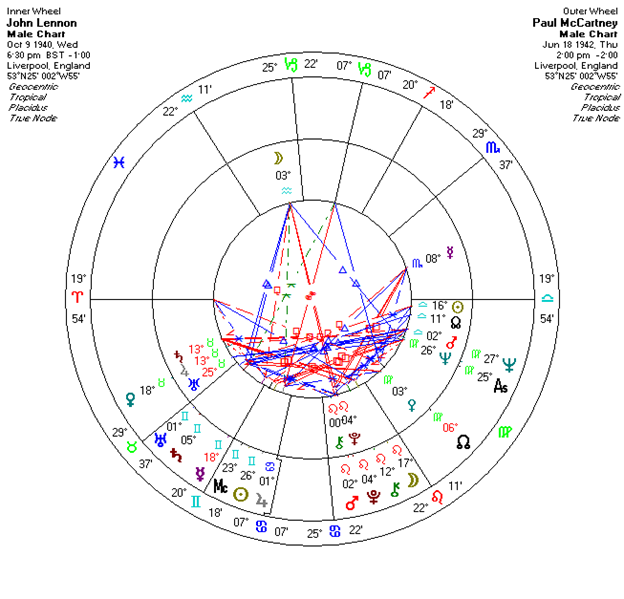
Harmonious aspects (trines and sextiles) indicate where the two charts flow together without friction. Challenging aspects (squares and oppositions) indicate tension and dynamic conflict. But significant challenging aspects are not automatically a problem in a synastry chart. Many long-lasting relationships carry real tension in the comparison, because that tension produces chemistry, motivation, and the kind of friction that keeps two people genuinely engaged over time.
Conjunctions, where two planets from different charts occupy nearly the same degree, tend to be the most powerful connections. When one person’s Sun falls closely on the other’s Moon or Venus, the resonance between them is difficult to ignore. When Mars from one chart aspects Venus in the other, physical attraction tends to be immediate and pronounced.
Key Placements to Compare First
When reviewing synastry for romantic compatibility, start with the connections between the inner planets of both charts: Sun, Moon, Mercury, Venus, and Mars. These move quickly enough to differ meaningfully between two people of similar age, unlike the outer planets, which can sit in the same sign for years at a time and therefore tell you more about generational overlap than personal compatibility.
Sun-Moon contacts between two charts carry particular weight. When one person’s Sun falls in the same sign or degree as the other’s Moon, there is often a natural ease of understanding, almost a sense that both people already know how to be around each other. Venus and Mars contacts speak to attraction and chemistry. Mercury connections reveal whether the two people actually communicate in compatible ways or regularly talk past each other. Capricorn Moon sign compatibility is a good example of how a single lunar placement shapes what someone needs emotionally before a partnership can feel secure.
Synastry Versus Composite Charts
A composite chart is a related but distinct technique. Rather than overlaying two individual charts, a composite chart creates a single chart by calculating the midpoints between each planet in both charts. Where synastry shows how two individuals interact, the composite chart describes the relationship itself as its own entity.
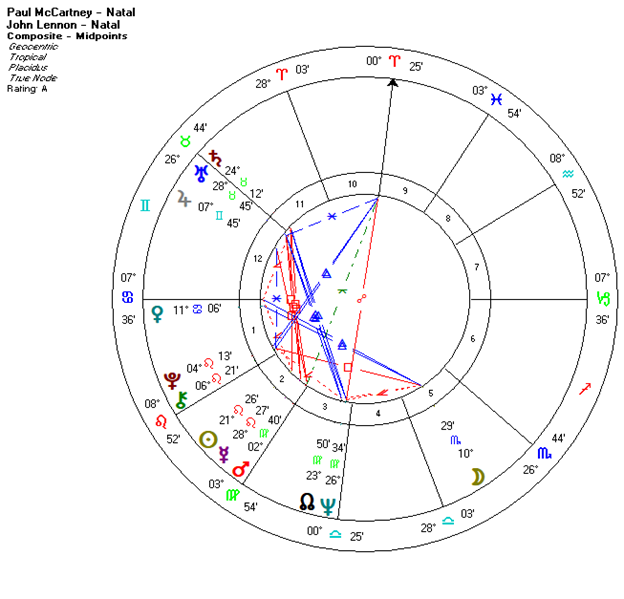
Both methods are worth using. Synastry is generally easier to interpret and most compatibility reports lead with it. Composite charts can reveal how the relationship functions as a unit in the world, what it brings out in both people that may not be visible when either person is operating alone, and whether the partnership has enough structure to sustain itself.
A single planet’s position can shift the entire compatibility picture, as who Venus in Pisces is compatible with shows, tracing how one Venus placement changes who someone draws to them and what they actually need in love.
What a Report Can and Cannot Tell You
A synastry report identifies patterns and potentials. It does not determine outcomes. Two people with difficult synastry can build something lasting through honesty and commitment. Two people with beautifully harmonious synastry can still fall apart through poor communication or incompatible life goals.
Use a relationship birth chart report as a tool for self-awareness rather than as a verdict. It helps explain why certain dynamics feel the way they do and points toward where both partners may need to grow. Sign-level overviews like Aries compatibility with each zodiac sign can orient you to the broad patterns before you dig into the full synastry. And Scorpio Moon sign compatibility shows how a single Moon placement structures a person’s entire emotional landscape in relationships.