Five of Wands Tarot Card Meaning
If the Four of Wands is the festival beneath the garland, the Five of Wands is the morning after, when the same fire that warmed the celebration starts throwing sparks. The suit of Wands is the element of Fire, the force of will, drive, and ambition, and a five always marks the place in a suit where the settled order of the four breaks open and conflict enters. Here that conflict is not a single duel but a crowd of it. In the Golden Dawn system the card is titled the Lord of Strife and assigned to Saturn in Leo, the planet of restriction and hard limits pressing down on the sign of the proud, performing lion. Five egos, each wanting the spotlight, each certain it should lead, and none of them willing to yield the floor.
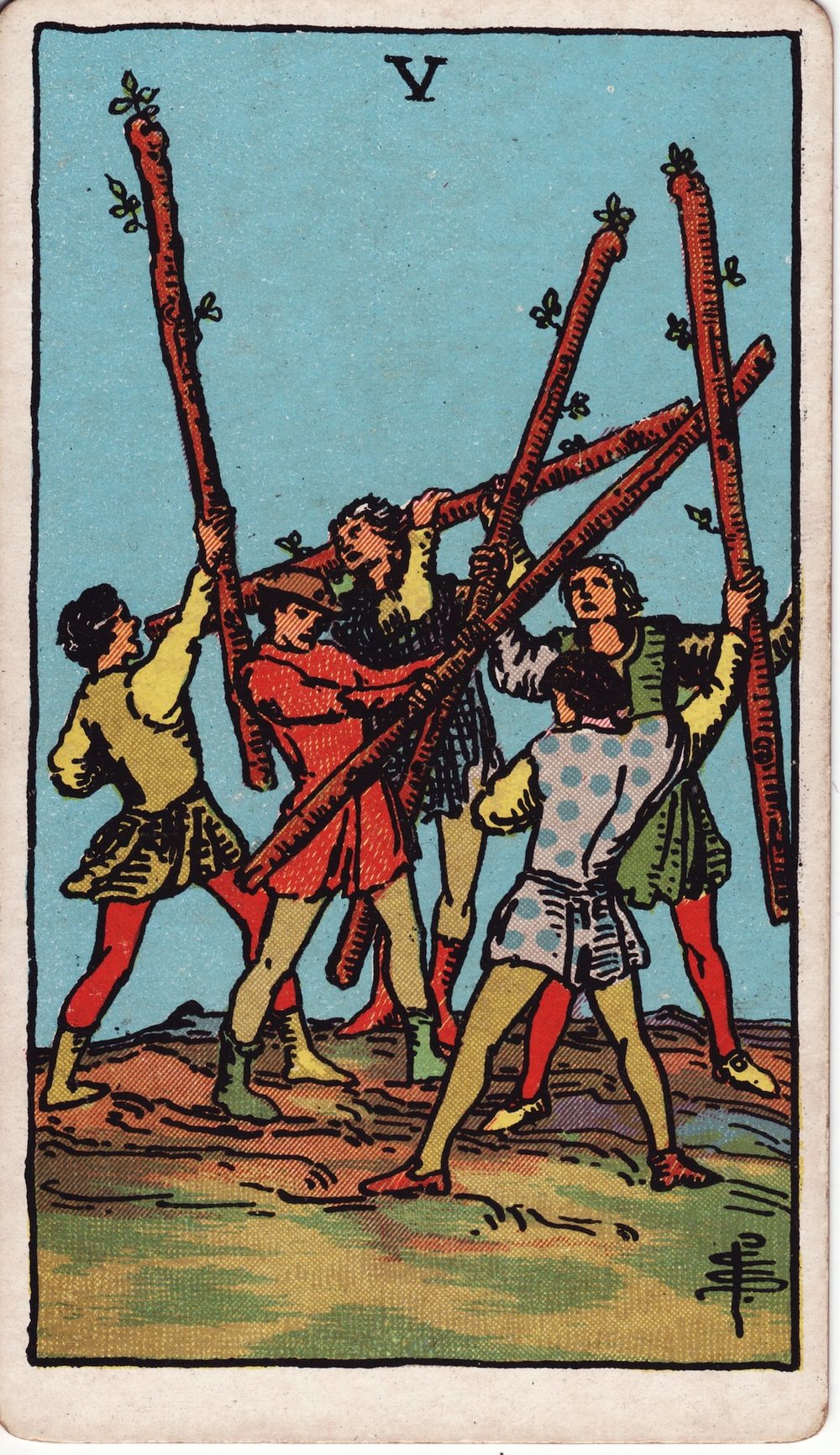
In the Rider-Waite image, five young men stand on open ground, each gripping a long flowering staff, raising and crossing them in what looks like a brawl. Their poses are energetic, even violent, yet nobody is bleeding and no real blow lands. The staves clash past each other rather than into anyone. The figures wear different clothes in different colors, and they seem not so much to be fighting as failing to coordinate, each swinging in his own direction. The ground is bare and the sky is plain. There is a great deal of motion and very little progress.
The wands are alive, topped with green leaves, full of growth and possibility, and yet they are being waved around in a scramble that builds nothing. The energy is real. The aim is missing. Five able people who could raise a structure together are instead knocking each other’s poles aside, and the longer it goes on, the more it looks like a game whose rules everyone forgot. Sometimes it is sport, the rough horseplay of people testing themselves against one another. Sometimes it is genuine discord, the petty grinding friction of a group that cannot agree.
This is the card of competition before it has found a winner, of debate before it has found a point, of effort before it has found a direction. It can be the gym, the boardroom, the group chat, the family table at the holidays. Wherever several strong wills push against each other at once, the Five of Wands is in the room.
What follows covers every face of this restless card, upright and reversed, across every kind of question a reading can raise.
Five of Wands Symbolism
The five staves dominate the card and they tell two stories at once. They are flowering, which is the signature of a healthy Wands suit, sap rising, vitality intact. But they are held like weapons and swung without coordination, so all that vitality cancels itself out. Saturn in Leo gives the scene its weight. Leo wants to shine and lead; Saturn blocks, delays, and demands discipline the lion would rather skip. The result is friction that feels personal even when it is only structural.
The five figures wear mismatched clothing, a quiet hint that the disorder comes from difference itself. Five backgrounds, five agendas, five definitions of winning. No one is the designated villain. The bare ground beneath them carries no harvest, because nothing grows while the energy is spent on jostling. The Five of Wands is what ambition looks like the moment before anyone agrees on the rules.
What does the Five of Wands Tarot card mean?
Upright, the Five of Wands means you have walked into a contest. Several forces are pulling at the same prize, the same airtime, the same patch of ground, and for now none of them is backing down. It can be open rivalry or just the everyday static of too many opinions in one space. Either way, you are not going to glide through this. You are going to have to push.
The good news folded into the card is that this friction is rarely dangerous. Nobody on the card is hurt. The Five of Wands is the bruise, not the wound, the heated argument that clears the air rather than the betrayal that ends the friendship. It often shows up when a group of capable people are still finding their pecking order, or when your own drive is meeting healthy resistance from the world.
The card asks one question above the noise. Is this a fight worth your fire? Some competition makes you sharper, faster, more sure of what you actually want. Some of it is just chaos you got swept into because everyone else was swinging. The Five of Wands marks the moment you decide whether to plant your staff and engage, or step back and let the scrum exhaust itself.
Five of Wands Keywords
- Competition
- Conflict
- Rivalry
- Friction
- Disagreement
- Scattered effort
- Tension
- Sparring
- Ambition meeting resistance
- Healthy struggle
- Clashing egos
- Lack of coordination
What does the Five of Wands Tarot card mean when Reversed?
Reversed, the Five of Wands usually means the fight is ending, going underground, or being deliberately avoided. The staves are lowering. Sometimes this is a relief, a sign that the squabbling has run its course and the group is finally ready to cooperate. The energy that was spent crossing swords can now go into the actual work.
But the reversal has a colder face too. It can mean conflict that has been pushed under the surface rather than resolved, the silent tension of people who have stopped arguing only because they have stopped trying. It can show someone who shrinks from every contest, dodging the kind of friction that would have helped them grow. Where the upright card risks too much pointless fighting, the reversed card risks too little honest struggle.
Read carefully, the reversed Five of Wands asks whether peace has actually arrived or merely been faked. Calm that comes from genuine agreement is a gift. Calm that comes from avoidance is just the storm waiting for a later date.
Five of Wands Reversed Keywords
- Avoiding conflict
- Inner tension
- End of strife
- Suppressed disagreement
- Cooperation returning
- Conflict resolution
- Backing down
- Withdrawal
- Releasing competition
- Hidden friction
- Fatigue
- Choosing your battles
Five of Wands as How Someone Sees You
When the Five of Wands describes how someone sees you, they see a competitor. You register to them as someone with fight in you, a person who pushes back, holds an opinion, and does not simply fold to keep the peace. That can read as exciting or as exhausting depending on who is looking. A rival respects you. A weary colleague may wish you would let one thing go.
There is energy in their view of you, and a touch of challenge. They might feel they have to bring their best around you, that conversations with you become contests they want to win. Some are drawn to that spark. Others feel sized up, as if you are always measuring yourself against them. The card says they do not see you as passive. They see someone worth squaring up to.
Five of Wands Reversed as How Someone Sees You
Reversed, the way they see you softens or goes murky. They may sense that you have stopped competing, that the fight has drained out of you, and read it as either maturity or surrender depending on the context. To some you finally seem easier to be around. To others you seem checked out, no longer in the game with them.
It can also mean they cannot quite read where you stand, because you are keeping your disagreements to yourself. They feel a tension they cannot name, the smile that does not match the eyes. If you have been swallowing your objections to keep things smooth, the reversed card suggests they sense it anyway, and it makes them uneasy rather than reassured.
What does the Five of Wands Tarot card mean in Love?
In love, the Five of Wands is the card of the couple that bickers. Not the couple in crisis, the couple that argues over the thermostat, the plans, the right way to load the dishwasher, and somehow stays together through all of it. There is friction here, but it is the friction of two people who both care enough to want it their way. Passion and squabbling come from the same fire.
For a new connection, the card can show competitive chemistry, the flirtation that runs on teasing and one-upmanship, two people circling and testing each other. It is lively and it is not boring. The risk is that the sparring never settles into trust, that you mistake the heat of an argument for the warmth of intimacy and keep picking fights to feel the spark.
The advice the card carries is to make sure you are on the same team. Disagreement is fine, even healthy, as long as you remember the relationship is the thing you are both fighting for, not the thing you are fighting over. When two people stop competing with each other and start competing against the problem, the Five of Wands becomes a strength.
What does the Five of Wands Reversed mean in Love?
Reversed in a love reading, the constant friction is either easing or being buried. At its best this is the moment the petty arguments stop mattering, the couple decides the bickering is not worth it, and a real peace settles in. The two of you stop scoring points and start cooperating. The relationship gets quieter in a good way.
The colder reading is avoidance. Nobody argues anymore because nobody believes it would change anything, so the real disagreements go unspoken and the resentment thickens underneath the calm. A relationship can look peaceful from the outside and be slowly hollowing out from this. The card asks whether your quiet is genuine accord or just two people who have given up on being heard. If it is the second, the kindest thing is to risk one honest argument before the silence becomes permanent. A spread built for relationships can often tell you which one you are actually in.
What does the Five of Wands Tarot card mean in Friendship?
Among friends, the Five of Wands is the rowdy group, the banter, the rivalry, the loud disagreement over where to eat that somehow takes an hour. There is real affection underneath it, but several strong personalities in one circle means the energy gets competitive. Who is funniest, who is right, who got the better story. Mostly it is play. Sometimes it tips into something that stings.
The card can also mark a friend group still working out its hierarchy, a few people quietly jockeying for the role of the one everyone listens to. It is the social equivalent of the five men crossing staves, lots of motion, no clear leader. Handled with good humor it bonds people. Handled with too much ego it splinters them.
The Five of Wands reminds you that competition between friends only works while everyone knows it is a game. The moment one person starts keeping score for real, the fun curdles. Keep it light, let others win sometimes, and the friction stays friendly.
What does the Five of Wands Reversed mean in Friendship?
Reversed, the friction in the friend group is dying down or being suppressed. The constant one-upmanship may finally be settling, the group finding its rhythm and choosing cooperation over competition. People stop needing to be the loudest voice and the circle relaxes.
The shadow reading is a group that has gone quiet because the conflict went underground. Nobody says what is bothering them, invitations get thinner, and a coldness replaces the old rowdy warmth. Someone may be withdrawing rather than naming the problem. If a friendship has lost its spark and you cannot quite say why, the reversed Five of Wands suggests an unspoken disagreement is sitting in the middle of it. Clearing the air, even awkwardly, beats letting it drift.
What does the Five of Wands Tarot card mean in Career?
In work, the Five of Wands is the competitive office, the crowded market, the project where five people all think they should be running it. It can mean a literal contest, a job you are up against other candidates for, a promotion several people want, a pitch against rival firms. It can also mean the daily friction of a team that argues its way to every decision. There is ambition everywhere and not enough coordination to channel it.
This is not a bad omen for your career. Competition sharpens you, and a workplace full of driven people can push you to do your best work. The card simply warns that energy is being spent on jostling that could be spent on building. Meetings that go in circles, turf wars, the same debate three weeks running. If the staves are all crossing and nothing is getting raised, the problem is not effort, it is direction.
The Five of Wands rewards the person who stops trying to win every exchange and starts trying to align the room. Whoever can turn five competing wills toward one shared goal becomes the natural leader, not by shouting loudest but by ending the brawl.
What does the Five of Wands Reversed mean in Career?
Reversed, the workplace friction is resolving or being avoided. The infighting may be cooling at last, a team that spent months at odds finally pulling together. A competition you were dreading might fizzle, or you might decide to step out of a rivalry that was costing more than it was worth. There is relief in this card reversed, a sense of energy freed up for real work.
But it can also flag conflict swept under the rug, the meeting where everyone nods and nothing is actually agreed, the resentment that festers because no one will raise it. It can show you shrinking from a competition you should enter, talking yourself out of the promotion or the pitch because the contest feels unpleasant. Sometimes the reversed Five of Wands is telling you to stop avoiding the fight that would have moved your career forward.
Five of Wands as How Someone Thinks of You
When this card shows how someone thinks of you, you are on their mind as a challenge. They think about you with a competitive edge, measuring themselves against you, perhaps a little impressed and a little provoked. You occupy the part of their thoughts reserved for rivals and worthy opponents, the people they want to keep up with.
This is not indifference. To think of someone as competition is to take them seriously. They may admire your drive while wishing they could outpace it, or they may be turning over a recent disagreement, replaying it, wanting another round. Either way you matter to them. You are not background. You are the person they have to reckon with.
Five of Wands Reversed as How Someone Thinks of You
Reversed, the competitive charge in their thoughts is fading. They may have stopped seeing you as a rival, either because the contest is settled in their mind or because they have decided it is not worth the energy. This can be peaceful, a former opponent who now thinks of you with simple respect rather than rivalry.
It can also mean they are sitting on unspoken frustration about you, thoughts they have not voiced. A disagreement they swallowed, an irritation they keep to themselves. They are not at war with you, but they are not entirely at ease either. If something has gone unsaid between you, the reversed card suggests it is still rattling around in their head, waiting for a moment that may never come unless one of you opens it.
What does the Five of Wands mean in Conflict?
This is the card’s home ground, so here it is at its most literal. The Five of Wands in a conflict reading describes messy, multi-sided friction, the kind where it is hard to say who started it and harder to say what it is even about anymore. Voices talk over each other. Everyone is defending, no one is listening. It is loud and it is tiring and it usually does less damage than it feels like it is doing.
The card’s quiet mercy is that this conflict is survivable. No one on the card is wounded. The staves clash and miss. Most Five of Wands disputes are about ego and airtime, not about anything that cannot be mended. The danger is exhaustion, not destruction. You wear each other down over things that will not matter in a month.
The way through is to stop swinging at everyone at once and find the single real disagreement underneath the noise. Five people arguing about five things will never resolve. Five people arguing about one thing might. Name the actual issue and most of the racket falls away.
What does the Five of Wands Reversed mean in Conflict?
Reversed, the conflict is either ending or being avoided, and the difference matters enormously. The hopeful reading is de-escalation, the staves lowering, tempers cooling, people ready to talk instead of clash. A genuine resolution may be close, the moment everyone is tired enough of fighting to actually compromise.
The harder reading is conflict that has gone silent without being settled. The argument stopped, but nothing was resolved, so the tension just moved underground and turned into cold distance. This is the dispute nobody mentions and everybody feels. The reversed Five of Wands warns that avoiding a fight is not the same as winning peace. If the issue still lives, dodging it only delays the reckoning and lets resentment compound in the meantime. If you do reach genuine de-escalation, watch for the Four of Swords nearby. It is the card of earned rest, and it signals the truce is real.
Five of Wands as Feelings
As feelings, the Five of Wands is restless, frustrated, and keyed up. The person feels challenged, maybe a little besieged, like they are constantly having to defend their ground or prove their worth. There is irritation in it, the chafe of too many demands and too much friction, the sense of being in a contest they did not entirely sign up for.
But there is fire in it too, not just frustration. Sometimes this card describes the feeling of being fully engaged, blood up, ready to compete, even enjoying the scrap. It is the emotion of the athlete before the match, the debater before the round, alive and combative. Whether it reads as stress or as excitement depends on whether the person feels they have a real shot or just feels surrounded.
What the card rarely describes is calm. Whoever holds these feelings is stirred up, pushing or being pushed, and the emotion will not settle until the contest finds an outcome.
Five of Wands Reversed as Feelings
Reversed, the heated feelings are draining away into either relief or fatigue. At best the person feels the tension finally easing, the fight going out of them in a good way, ready to make peace with whatever was stressing them. The constant friction lifts and they can breathe.
Sometimes they feel worn down instead, conflict-weary, too tired to argue and so swallowing what they feel. There can be a bottled frustration here, anger with nowhere to go, the quiet seething of someone who has decided it is not worth speaking up. They may also feel they are avoiding something they should face. The reversed Five of Wands as feelings is the exhale after a fight, which can be relief or can be the surrender of someone who simply gave up.
Five of Wands as a Situation
As a situation, the Five of Wands describes circumstances full of competition and crossed purposes. Several people or forces want the same thing and none has the upper hand yet. It is a crowded, contested, unsettled state of affairs, lots happening and little decided. Think of a hiring shortlist, a contested market, a household where everyone wants the schedule to bend their way.
The situation is dynamic, not stuck. Things are moving, just not in one direction. The Five of Wands often marks a transitional phase, the chaotic middle where the order of the Four of Wands has broken up and a new arrangement has not yet formed. It is uncomfortable but rarely dangerous, the kind of mess that sorts itself out once someone takes the lead or the rivals tire.
Your job in this situation is to keep your own aim clear while everyone else flails. The person who knows exactly what they want in the middle of a free-for-all has a decisive advantage over four people who are mostly just reacting.
Five of Wands Reversed as a Situation
Reversed, the contested situation is winding down. The competition may be resolving, the crowd thinning, a winner emerging or the rivals simply walking away. There is a settling quality to this card reversed, the chaos finding its floor. Often it is good news, the end of a stressful, jostling phase.
The cautionary version is a situation that only looks resolved. The fighting stopped but the underlying tension is still there, papered over rather than worked out. It can also describe circumstances where everyone is avoiding a necessary confrontation, a stalemate dressed up as peace. If the situation feels suspiciously quiet, the reversed Five of Wands hints that something unaddressed is still sitting in the room.
Five of Wands as Intentions / What Someone Wants
As intentions, the Five of Wands says someone wants to compete, to assert themselves, to come out on top. Their aim is to win, or at least not to lose, and they are prepared to push for it. This is not necessarily hostile. It can be the healthy ambition of someone who wants to prove what they can do, to test themselves against you or alongside you.
It can also mean they want to provoke, to stir things up, to get a rise out of you, sometimes just to see where they stand. Some people use friction to find out who is real. Their intention may be to clear the air through confrontation rather than to wound. Underneath the combative surface there is often a desire for engagement, a wish to be taken seriously and met head-on rather than humored or ignored.
Five of Wands Reversed as Intentions / What Someone Wants
Reversed, the will to compete is gone or hidden. They may want to avoid conflict altogether, to keep the peace even at the cost of saying what they really think. Their intention could be withdrawal, stepping back from a contest they no longer care to fight. This can be mature, a person who has decided the rivalry is beneath them.
It can also conceal something. They may want to disengage outwardly while still nursing the grievance privately, smoothing things over on the surface without actually letting go. Or they want resolution and an end to the friction, genuinely seeking common ground. Read the surrounding cards to tell the peacemaker from the avoider. One intends to mend, the other just intends to escape.
Is the Five of Wands a Yes or a No?
The Five of Wands is a maybe leaning toward not yet. It is the card of unresolved competition, so it rarely gives a clean yes. There is too much in flux, too many other hands reaching for the same thing. Whatever you are asking about, the answer is contested, and you will likely have to fight for it rather than receive it.
That said, the card is not a flat no. Fire is active and ambitious, and the Five of Wands favors those willing to compete. If you are prepared to push, to show up and engage, the outcome can swing your way. The card simply warns that it will not be handed to you and that others want it too. Before you treat a contested answer as final, it is also worth knowing the reasons tarot readings can be wrong, especially when timing is in the question.
Reversed, the reading tips further toward no, or toward a yes that comes only after you stop avoiding the necessary effort. The contest is fizzling out, which can mean the opportunity passes you by if you withdraw. If you want the yes, the reversed Five of Wands says do not duck the challenge that stands between you and it.
Five of Wands as a Place
As a place, the Five of Wands is anywhere crowded, competitive, and loud. A gym floor, a sports field, a busy market, a trading desk, a packed bar where everyone is talking at once. It is a space humming with rivalry and noise, full of energy and short on calm. The schoolyard, the courtroom, the comment section. Wherever people gather to contend, this is the room.
It can also be a place that simply feels chaotic, a household with too many strong personalities, an office mid-reorganization, anywhere the order keeps getting reshuffled by competing wills. These are not restful places, but they are alive. If you thrive on stimulation and a bit of friction, the Five of Wands locations energize you. If you crave peace, they will wear you out fast.
Five of Wands Reversed as a Place
Reversed, the place is one that has quieted down, for better or worse. It can be a space where a recent commotion has died away, a stadium after the match, an office after the layoffs settled, the calm that follows a busy stretch. The energy has drained out and the room feels still.
It can also describe a place with a strange, suppressed tension, somewhere people are being polite over an unspoken conflict, a dinner table where everyone is careful, a workplace where the friction went silent rather than away. The air feels managed rather than easy. If a location seems peaceful but leaves you tense, the reversed Five of Wands suggests the quiet is covering something rather than reflecting genuine calm.
Five of Wands as an Obstacle / Challenge
As an obstacle, the Five of Wands is the wall of competition and conflicting agendas standing between you and your goal. The thing blocking you is not a single enemy but a scrum, too many people pulling in too many directions, including possibly yourself. Your effort keeps getting tangled in other people’s effort, and the friction eats the progress.
The challenge is also internal. The card can mark scattered energy, the way ambition with no clear aim turns into spinning your wheels. You are working hard and getting nowhere because the work is not pointed anywhere. Five staves swinging, nothing built. The obstacle is the lack of coordination, in the group or in your own divided focus.
To get past it you have to do the one thing the figures on the card refuse to do. Stop, look up from the brawl, and pick a single direction. The Five of Wands as an obstacle dissolves the moment effort stops fighting itself.
Five of Wands Reversed as an Obstacle / Challenge
Reversed, the competitive obstacle is clearing, or your challenge is learning to stop avoiding it. On the hopeful side, the friction that was blocking you is easing, the rivals dispersing, the path opening as the conflict resolves. What stood in your way is losing its force.
On the harder side, the obstacle is your own avoidance. You may be sidestepping a confrontation that has to happen, ducking the competition you need to enter, and that dodge is the real barrier. The reversed Five of Wands can also warn of buried tension that quietly sabotages your progress while everyone pretends things are fine. Sometimes the bravest move is to walk back into the fight you have been avoiding and settle it for good.
Five of Wands as Action
As advice for action, the Five of Wands says engage, but engage on purpose. Do not shrink from the competition, and do not swing wildly at everyone in it either. Step up, make your case, defend your ground, and stay focused on what you actually want out of the contest. This is a moment to be assertive, not passive.
The card also counsels you to channel the friction rather than just endure it. Use the rivalry as fuel. Let the competition push you to sharpen your work, raise your game, prove what you can do. The energy swirling around you is real power if you aim it. Wasted, it is just noise.
Above all, the action the Five of Wands rewards is bringing order to chaos. If you are in a group pulling five ways at once, the most powerful thing you can do is help everyone agree on one. Be the person who ends the scrum, not the one who prolongs it.
Five of Wands Reversed as Action
Reversed, the action shifts toward resolution and away from pointless combat. The card may be telling you to step out of a fight that is not serving you, to lower your staff and refuse a contest that only drains you. Not every argument deserves your energy, and choosing your battles is its own kind of strength.
But check your motive, because the reversed card also warns against avoidance dressed as wisdom. If you are walking away from something you should face, the action it really wants is honesty, naming the buried tension and dealing with it. Make peace where peace is real, and risk the confrontation where the silence is fake. The reversed Five of Wands asks you to tell the difference between letting go and giving up.
Five of Wands as Advice
As advice, the Five of Wands tells you that some friction is the price of doing anything worth doing, so do not let competition scare you off. If you want the goal, expect to contend for it, and meet that contest with energy instead of dread. The card respects a fighter. It just wants the fight to be deliberate.
It also advises you to keep perspective on the conflicts you are already in. Most of them are smaller than they feel in the heat of the moment. Nobody on this card is actually hurt. Before you pour another day’s energy into a quarrel, ask whether it will matter next month, and whether it is even about what you think it is about.
And the card advises coordination over domination. You do not have to beat everyone. Often the better win is getting the competing parties, including the warring voices in your own head, to pull together. The Five of Wands at its wisest turns rivals into teammates.
Five of Wands Reversed as Advice
Reversed, the advice is to defuse rather than escalate, and to stop avoiding what needs saying. If a conflict has dragged on, this is your cue to seek resolution, to be the one who offers the olive branch and ends the cycle of jostling. Peace is available if someone is willing to reach for it first.
The flip side of the advice is a warning against false calm. Do not buy quiet by burying your real position, because suppressed conflict always resurfaces, usually larger. If you have been dodging a competition or a confrontation out of fear, the reversed Five of Wands gently tells you the avoidance is costing you more than the fight would. Face it, settle it, and free up the energy you have been spending to keep it hidden.
Five of Wands as an Outcome
As an outcome, the Five of Wands suggests a situation that ends in ongoing competition rather than clean resolution. The matter stays contested, the rivalry continues, the debate goes another round. This is not a defeat, but it is not a tidy victory either. You come out of it still in the ring, which can be invigorating if you have fight left or wearying if you do not.
For some questions this is a fine result. Competition keeps you sharp, and an outcome that keeps you engaged and striving beats one that leaves you idle. The card often points to a future where you are tested and have to keep earning your place, where nothing is handed over but the contest itself is making you stronger.
The Five of Wands as an outcome rarely closes the book. It leaves you mid-story, staff in hand, with the next round already forming. Whether that excites or exhausts you is the real answer the card is offering.
Five of Wands Reversed as an Outcome
Reversed, the outcome is the end of the conflict, one way or another. The competition resolves, the friction dies down, and a more settled state arrives. At its best this is a genuinely happy ending, the rivalry behind you, the energy freed for what comes next. The scrum breaks up and the field clears.
The shadow outcome is a resolution that is really just avoidance, a conflict that ended because everyone gave up rather than because anything got solved. The tension goes quiet but does not go away, and it may resurface later under a new disguise. As an outcome, the reversed Five of Wands asks you to notice whether the peace you arrived at was won or merely declared.
Five of Wands in the Future
In the future position, the Five of Wands warns of competition or friction on the horizon. A contest is coming, a clash of wills, a phase where you will have to assert yourself against others reaching for the same thing. It might be a job you will compete for, a debate you cannot dodge, a group whose energy is about to get combative. Whatever it is, the future holds a push.
This is a heads-up, not a doom. Forewarned, you can prepare to compete well, to enter the contest with a clear aim while others arrive scattered. The Five of Wands in the future favors the person who sees the friction coming and decides in advance what they actually want from it. Fire ahead means a chance to prove yourself, if you are ready to swing with purpose.
The card also hints that the coming friction is survivable and probably useful. The challenge sharpens you. Look at the future Five of Wands less as a threat and more as a training ground you are about to step onto.
Five of Wands Reversed in the Future
Reversed, the future holds the easing of conflict or the temptation to avoid it. A current rivalry may be heading toward resolution, the friction in your life winding down into something calmer ahead. After a contentious stretch, the reversed card can promise a quieter road.
But it can also foretell a future where you sidestep a contest you should enter, or where unresolved tension goes underground and waits. If you have been avoiding a confrontation, the reversed Five of Wands suggests that dodging it does not make it vanish, it only moves the reckoning further out. The kinder future comes from settling things now rather than carrying the buried friction forward into it.
Five of Wands as a Person
As a person, the Five of Wands describes someone competitive, energetic, and combative in temperament. This is the natural rival, the person who turns everything into a contest, who loves to spar, debate, and prove themselves. They are full of fire and rarely back down from a challenge. Around them the air feels charged, sometimes thrillingly, sometimes exhaustingly.
At their best they are stimulating company, a worthy opponent who pushes everyone to do better, a person who keeps you on your toes. Turn it around and they are quarrelsome, unable to let any disagreement go, picking fights to feel alive. They may struggle to cooperate, always needing to come out on top, always certain their direction is the right one. Often this is a young, scrappy energy, ambition that has not yet learned to coordinate with others.
The card can also point to someone caught in the middle of a chaotic group, not a villain but a participant in a clash with no clear leader. To know which, look at the company they keep on the rest of the table.
What Zodiac Sign / Element is the Five of Wands?
The Five of Wands belongs to the element of Fire, the element of passion, drive, ambition, and the will to act. Fire governs the three signs Aries, Leo, and Sagittarius, and all three carry some of this card’s restless, competitive charge. Aries brings the headlong rush to be first, Leo the need to shine and lead, Sagittarius the conviction that its way is the right way. Put any of them in a crowded room of equals and you get the friction the Five of Wands describes.
More specifically, the card is traditionally assigned to Saturn in Leo. Leo wants the spotlight and the crown; Saturn imposes limits, delays, and the hard discipline the lion would rather avoid. That tension is the engine of the card, proud ambition meeting resistance and refusing to yield gracefully. It is the energy of five Leos in one room, each sure the throne is theirs.
If the Five of Wands turns up around a person, look for fiery, competitive temperaments, the natural athletes, debaters, and leaders who come alive in contest. The card carries Fire’s gift and Fire’s flaw at once, tremendous drive with a tendency to clash when too much of it gathers in one place.
Final Thoughts
The Five of Wands is the noisy, scrappy heart of the Wands suit, the place where Fire’s ambition trips over itself and turns into competition. Its lesson is not to fear friction but to aim it, to know which contests sharpen you and which only waste you, and to be the person who can turn five crossed staves into one shared direction. If this card drew you in, trace the suit backward to the restless drive of the Ace of Wands and the watchful planning of the Three of Wands tarot card, and when reversals keep surfacing in your spreads, this guide to why your tarot cards keep coming up reversed is worth a read. To see how competitive energy plays out across a full layout, one of these tarot spreads for guidance can show you exactly what the Five of Wands is fighting for. Wherever it lands, the card asks the same question. Is this a fight worth your fire, or is it time to lower the staff and build something instead?