Six of Wands Tarot Card Meaning
If the Five of Wands is the scrambling brawl where nobody quite wins, the Six of Wands is the moment one rider emerges from it crowned. The suit of Wands is the element of Fire, the force of will, ambition, and the desire to make a mark on the world, and a six always brings a suit to a place of resolution after the friction of the five. Here the resolution is triumph. In the Golden Dawn system the card is titled the Lord of Victory and assigned to Jupiter in Leo, the planet of expansion and reward sitting in the proud, sun-ruled sign that loves to be seen. After the strife, the laurel.
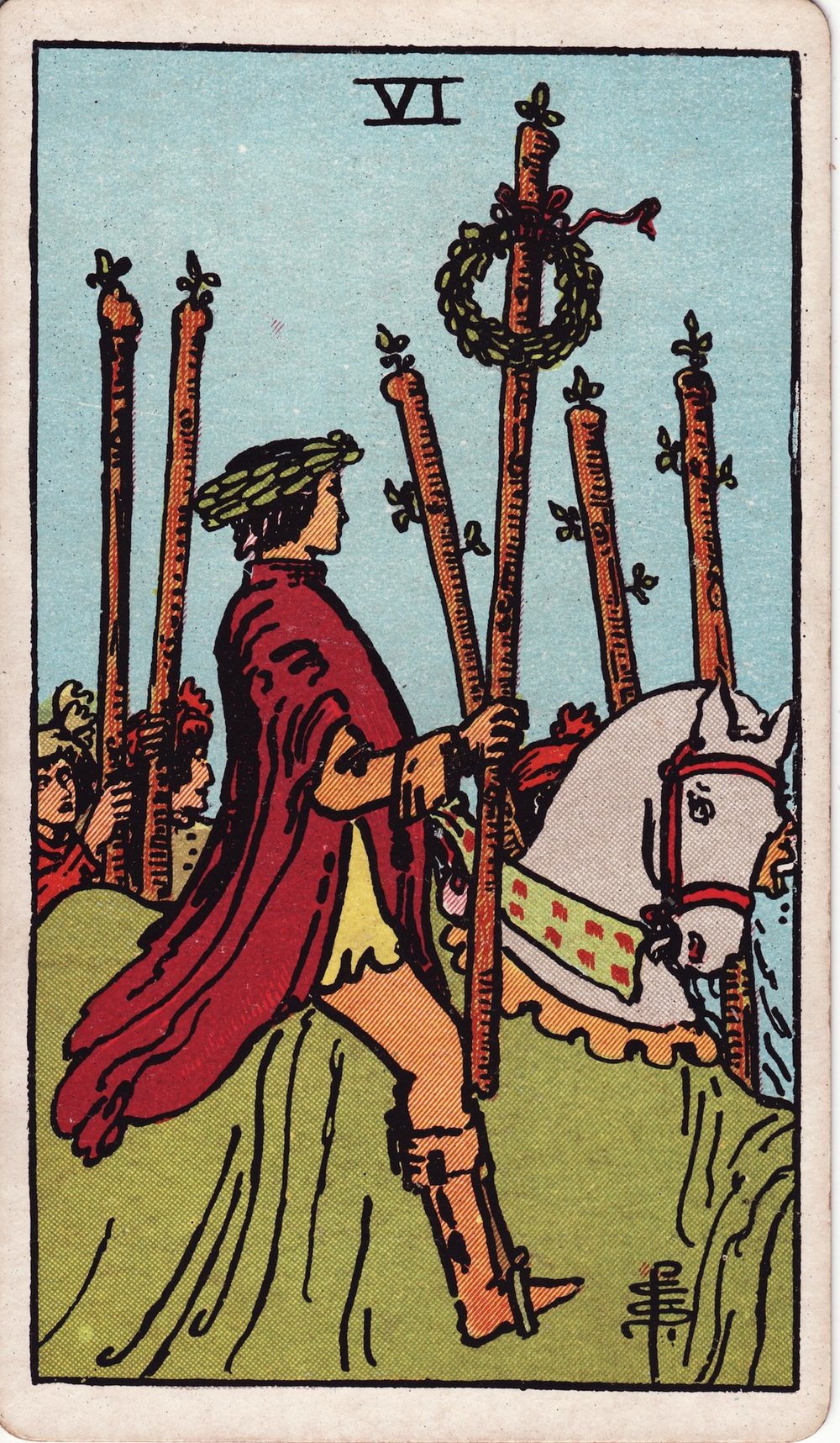
In the Rider-Waite image, a man rides a white horse through a crowd. He wears a victor’s laurel wreath on his head, and a second wreath is fixed near the top of the tall staff he carries upright like a standard. The horse is draped in a green cloth, calm and unhurried, picking its way forward at a walk rather than a gallop. Around and behind the rider press other figures, all of them holding their own staves raised, escorting him. It reads as a parade, a homecoming, the return of someone who went out and did the thing they said they would do.
The detail that gives the card its weight is the crowd. The victory is not private. There are witnesses, and their staves are lifted in salute, which means the success has been seen and acknowledged by other people. That public dimension is the heart of the Six of Wands, and also its quiet warning. A win that needs an audience is a win that depends on the audience staying. The same people lining the road to cheer were, a card ago, the rivals swinging their poles in the Five. Today they walk alongside. The horse, white and serene, suggests the rider has earned this through real effort rather than luck, but the procession is a moment, not a permanent state. The wreath will dry out. The crowd will disperse and go back to their own roads.
This is the card of recognition, reward, and well-deserved pride. It is the promotion announced in front of the whole office, the medal, the project that finally shipped and got noticed, the moment your name is read aloud. It carries genuine confidence, the kind that comes from having done the work and being vindicated by the result.
What does the Six of Wands mean?
Upright, the Six of Wands means victory, and specifically victory that other people can see. Something you worked toward has paid off, and the payoff comes with acknowledgment. Recognition, praise, a title, a result that settles an open question in your favor. The card tells you that the effort was worth it and that you may now ride the wave of it without apology.
It is one of the more straightforwardly good cards in the deck, but its goodness has a flavor. This is not the quiet inner peace of higher cups, nor the abundance of the pentacles. It is the public win, the head held high, the applause. You have proven something, to others and to yourself.
The card often appears when you have been doubting whether the struggle was getting you anywhere. The Six answers yes. The fight of the Five is behind you and you came out on top. People who watched you grind are now watching you succeed, and that shift in how you are seen is part of the gift.
There is a note of leadership in it as well. The rider is out front, the others follow. When this card shows up, you may be the one others are looking to, the one setting the pace. That carries a small responsibility folded inside the reward. You set the tone now. The way you carry the win teaches the people around you how to carry their own.
Enjoy it. Wins are meant to be enjoyed, and the Six of Wands gives you full permission to feel proud of yourself for once.
Six of Wands Keywords:
- Victory
- Public recognition
- Success
- Acclaim
- Pride
- Confidence
- Reward
- Vindication
- Leadership
- Triumph
- Progress
- Good news
- Being celebrated
- Riding high
What does the Six of Wands mean when Reversed?
Reversed, the Six of Wands turns the parade inside out. The applause goes quiet, or it never comes, or it comes and means nothing. This is the card of victory that fails to land. The win arrives but no one notices. The recognition you expected does not show up. Or the success is real but private, won in a room with no witnesses, leaving you proud and oddly unseen.
In its harsher reading, the reversed Six speaks to a fall from grace. The rider is unhorsed. A position of standing is lost, a reputation takes a hit, the thing you were celebrated for is suddenly in question. The higher the parade, the longer the drop.
It can also point at the ego trap on the other end. When the upright card’s confidence curdles, you get arrogance, the need to be admired, success that has gone to the head. The reversed Six can describe someone so attached to looking like a winner that they cannot tolerate an ordinary day.
Most often, in everyday readings, it is simply a stall. The promotion is delayed, the announcement gets pushed, the result you were sure of comes back uncertain. The card is not telling you the effort was wasted. It is telling you the reward is late, or that you have been chasing the applause instead of the work that earns it.
Six of Wands Reversed Keywords:
- Lack of recognition
- Fall from grace
- Private victory
- Delayed success
- Self-doubt
- Arrogance
- Ego
- Imposter feelings
- Anticlimax
- Reputation damage
- Empty acclaim
- Hollow pride
The Six of Wands as How Someone Sees You
When you ask how someone sees you and draw the Six of Wands, the answer is flattering. They see a winner. They see someone who carries themselves with the easy confidence of a person who has earned their place. You look successful to them. Competent, the sort of figure others naturally fall in behind.
There is admiration in it, and possibly a little awe. You may seem slightly elevated, up on the horse while they stand in the crowd. That gap can read as inspiring or as intimidating depending on the person. Some look at you and think, I want to follow that. Others look up and feel small by comparison.
They likely see you as someone who has been through something and come out vindicated. Not untested, but proven. There is respect for the road you walked to get where you are.
The one thing to hold lightly is that this is a view of your standing more than your soul. They see the laurel, the posture, the result. Make sure the people who matter also get to see the person underneath the victor, because the rider on the horse is impressive but a little hard to reach.
The Six of Wands Reversed as How Someone Sees You
Reversed, the view sours. They may see you as someone coasting on a reputation that has started to wobble, or as a person who talks more about past wins than present ones. The shine has come off in their eyes.
In a lighter reading, they simply do not see your success at all. The work you are proud of has gone unnoticed by this person, and to them you are not the triumphant rider, just another face. That can sting precisely because you know what you accomplished and they missed it.
In the harder reading, they read you as arrogant. The confidence that looks earned when the card is upright looks like swagger when it is reversed. They may feel you need too much credit, or that you carry yourself as if the applause is owed. If that lands as a fair criticism, it is worth a quiet look. If it does not, remember that some people resent a winner on principle and there is little you can do about that.
What does the Six of Wands mean in Love?
In love, the upright Six of Wands is warm and public. It points to a relationship you are proud of, the kind you are happy to be seen in. Things are going well enough that you want to show your partner off, walk into the room together, let people know. There is mutual pride here, a sense of being a team that others admire.
For an existing couple, it can mark a milestone reached together, a moment of being celebrated, an engagement announced, a hard patch survived and acknowledged by both of you. You came through something and you came through it as winners. The card affirms that the relationship is on solid, respected ground.
For someone seeking love, the Six of Wands is encouraging. It suggests you are entering this chapter from a place of confidence rather than need, and confidence is magnetic. You may attract someone who is drawn to the way you carry yourself, or you may find that recent success in another part of life spills over and makes you more open, more visible, easier to find.
The small caution is about who the love is for. A relationship that exists partly to be admired by others can lose track of the quiet, unwitnessed tenderness that actually sustains it. Make sure you would still want this person if the crowd were not watching.
What does the Six of Wands Reversed mean in Love?
Reversed in love, the Six suggests a relationship that looks better from the outside than it feels from within. The picture is good, the standing is good, but privately the warmth has thinned. You may be performing the happy couple while quietly knowing something is off.
It can point to one partner needing too much admiration, wanting the relationship to constantly affirm them, treating love as a source of applause rather than companionship. That hunger is exhausting for the person expected to keep clapping.
For singles, the reversed Six can describe disappointment after high hopes. Someone you were sure of cools off. A connection you thought was a sure thing does not progress. Or you realize you were more in love with the idea of being chosen than with the actual person.
It can also simply mean a relationship that is not getting the recognition it deserves, a love kept hidden, unacknowledged by family or friends, or one partner unwilling to make it public. The card asks whether the privacy is protective or whether it is a quiet form of not being fully claimed. A relationship spread can help clarify which of those situations you are actually in.
What does the Six of Wands mean in Friendship?
Among friends, the upright Six of Wands is the friend who shows up to cheer you on, and the joy of being that friend for someone else. It describes a circle where one person’s win is treated as everyone’s win, where success is celebrated rather than envied. When something good happens to you, these are the people lifting their staves.
It can mark a moment when a friend reaches something they worked hard for and you get to be part of the parade, or when you are the one being celebrated and your people show up for it. There is real generosity in this card: the kind of friendship that does not shrink at someone else’s good fortune.
It can also flag the friend who is a natural leader of the group, the one others follow, the one who sets the plans and sets the mood. If that is you, enjoy it but watch that the others still get a turn on the horse. If it is someone else, there is nothing wrong with following a friend whose confidence you trust.
The shadow to keep an eye on is the friendship that survives only on shared triumphs. Real friendship also has to hold the ordinary days and the losing ones, not just the victory laps.
What does the Six of Wands Reversed mean in Friendship?
Reversed, the Six of Wands among friends turns toward envy and comparison. Someone’s success has become a sore point. Maybe a friend won something you wanted and you are struggling to be glad for them, or maybe you achieved something and a friend could not muster the applause. The card exposes the gap between the friendship you hoped for and the one that showed up.
It can point to a friend who needs to be the center of attention, who turns every gathering into their own parade and bristles when the spotlight moves. Over time that wears a group down.
In a softer reading, it is the friend whose good news goes uncelebrated because everyone was distracted or busy, and the quiet hurt that leaves behind. If you sense you missed someone’s moment, it is not too late to circle back and acknowledge it. A late cheer still counts for something.
What does the Six of Wands mean in Career?
In career readings the Six of Wands is one of the cards you most want to see. It means recognition at work. A promotion, a raise, a public acknowledgment, a project that lands and gets your name attached to it. The effort has been seen by the people who decide things, and it is paying off.
It often shows up right when you have been wondering whether anyone notices how hard you have been working. The Six answers that they do. Your standing is rising. You may be moving into a more visible role, one where others look to you for direction, and the card supports you stepping into that leadership rather than shrinking from it.
It can also describe winning a competitive situation, landing the contract over rivals, getting the offer, beating out the field. The Five of Wands was the crowded contest. The Six is the moment you are named the one who got it.
The advice folded in is to accept the credit gracefully and remember who helped you get there. The crowd around the rider matters. A win celebrated alone is thinner than a win shared with the team who carried part of the load.
What does the Six of Wands Reversed mean in Career?
Reversed, the career Six points to recognition withheld or delayed. You did the work and someone else got the credit. The promotion went to a less deserving colleague. The announcement keeps getting pushed back. It is the specific frustration of having earned something and watching it not arrive, or arrive in someone else’s hands.
It can also warn against resting on a past success. A win from a while ago is no longer carrying you, and the reputation it built is starting to fade. If you have been coasting, the card is a nudge to produce again rather than to keep pointing at the trophy on the shelf.
In its ego reading, the reversed Six describes someone whose confidence at work has tipped into arrogance, who oversells their contributions, who needs the applause more than the results. If that critique fits, dialing it back will serve you. People forgive a quiet winner far longer than a loud one.
There is also the imposter version, where you did succeed but cannot believe you deserved it, and the fear of being found out follows you around. The card reminds you the win was real. You do not have to keep auditing it.
The Six of Wands as How Someone Thinks of You
When the Six of Wands describes how someone thinks of you, they think of you as a success, a winner, someone who has it together. You occupy a high place in their mind. They may hold you up as an example, point to you when they talk about what they want to become.
To a potential partner, you look like a catch, confident and accomplished. To a colleague, you look like someone going places, worth being aligned with. To a younger or less established person, you may look like a role model, proof that the road leads somewhere.
This is a generous opinion to hold, and mostly it is a gift. The only caution is the same as ever with the Six. They may be admiring the standing more than the substance. If you want this person to know you rather than just respect you, you will have to let them see past the parade, into the ordinary and unimpressive corners where actual closeness lives.
The Six of Wands Reversed as How Someone Thinks of You
Reversed, the thought turns skeptical. They may think your reputation is bigger than your results, that you have been believing your own press. Where the upright card is admiration, the reversed one is the raised eyebrow, the sense that the emperor’s parade is a little overdressed.
Alternatively, and more gently, they simply have not registered your accomplishments. In their mind you are not the impressive figure you are elsewhere, just an ordinary acquaintance, because the wins that define you to others never reached them.
In the harder reading, there may be resentment. Some people store up a quiet grudge against those they see as winners, especially if they feel they were passed over while you were celebrated. That thought is more about them than about you, but it is worth knowing it is in the room.
What does the Six of Wands mean in Conflict?
In conflict, the upright Six of Wands favors you. It is a card of winning the dispute, coming out vindicated, having your position acknowledged as the right one. If you are in the middle of a disagreement, a negotiation, or a contest of any kind, this card tilts the outcome your way.
The win here tends to be public. You are not just quietly correct, you are seen to be correct. The matter resolves with your standing intact or improved, and possibly with an apology or an acknowledgment from the other side.
The card asks you to win well. The rider does not trample the crowd, he rides through it. Victory in conflict is sweeter and far more durable when you do not humiliate the person you beat. Leave them their dignity. Today’s defeated rival is tomorrow’s escort, and how you treat them in the moment of winning decides which one they become.
What does the Six of Wands Reversed mean in Conflict?
Reversed, the Six in conflict warns that the win may not come, or that it will arrive without the recognition you wanted. You may be right and still not be vindicated. The dispute resolves quietly, unsatisfyingly, or in someone else’s favor despite your case.
It can also flag a conflict driven by ego rather than substance, a fight you are in mostly to protect your image or be proven the winner. That kind of conflict rarely ends cleanly, because the goal is applause rather than resolution, and applause is a moving target.
Sometimes the card describes a fall, a position of strength in an argument that suddenly collapses, an authority that turns out to be hollow. If you have been arguing from a perch that is shakier than it looks, the reversed Six suggests stepping down before you are pulled down. There is no victory worth defending past the point where it has stopped being true.
The Six of Wands as Feelings
As feelings, the upright Six of Wands is pride, confidence, and the warm glow of being appreciated. The person feels good about themselves and good about you, or feels that the situation reflects well on them. There is a buoyancy here, a head-up, chest-out sense of things going right.
If this is about how someone feels toward you, they feel proud to be associated with you. You make them feel like a winner, or they feel admiration that borders on looking up to you. It is an elevated, sunny feeling, not the soft intimacy of the cups but a genuine, energizing regard.
The feeling can carry a need for it to be witnessed. The person may want to feel admired, to be seen succeeding, to have their good feeling reflected back by others. That is not vanity exactly, it is the Leo warmth of the card, the simple human wish to shine and be seen shining.
If you are asking about your own feelings, the Six says you are or should be feeling proud of yourself. You earned this mood. Let it be.
The Six of Wands Reversed as Feelings
Reversed, the feeling is the comedown after the high, or the high that never arrived. Disappointment, deflation, the flatness of a win that did not feel like one. The person may feel unappreciated, overlooked, like their efforts went unseen and the recognition they craved did not come.
It can be the ache of bruised pride, a sense of having been knocked off a pedestal, of standing lower in someone’s eyes than before. That is a tender, exposed feeling, and the reversed Six does not hide it well.
On the ego side, it can be the anxious need for admiration that never feels satisfied, the person who fishes for praise because the inner supply has run dry. Underneath the wanting is usually a quiet fear that they are not actually enough without the applause. Naming that fear gently does more good than feeding the hunger.
The Six of Wands as a Situation
As a situation, the upright Six of Wands describes a moment of arrival. Something is being recognized, rewarded, celebrated. The circumstances are favorable and visible, a public win, a turning point where effort meets acknowledgment in front of an audience.
It is a situation with momentum. The rider is moving forward, the crowd is carrying the energy along. This is not a static reward but a peak in motion, a high point you are passing through on the way to whatever comes next. The card encourages you to ride it confidently rather than freezing up in the spotlight.
There is usually a backstory of struggle behind a Six of Wands situation. This victory was paid for. Whatever you are being celebrated for cost you something, and the card honors that by making the reward a public one. Take the win, and take a breath, because the parade does not last forever and the road continues past it.
The Six of Wands Reversed as a Situation
Reversed, the situation is an anticlimax or a reversal of fortune. The expected celebration falls flat. The win is delayed, downgraded, or quietly handed to someone else. The circumstances that looked triumphant turn out hollow.
It can describe a situation where status is slipping, where a position once secure is now in question. The ground that felt solid is moving. If you have been relying on past standing to carry a present situation, the reversed Six is the moment that stops working.
More gently, it is simply a situation lacking the recognition it deserves. Good work done in the dark, a quiet success no one clapped for. The card does not say the success is unreal, only unwitnessed. Whether that matters depends on whether you needed the witnesses or just the result.
The Six of Wands as Intentions / What Someone Wants
As intentions, the upright Six of Wands says someone wants to win, to succeed, and to be seen doing it. Their aim is recognition. They want to come out on top, to be acknowledged, to have their efforts crowned. This is ambition with an audience built into it.
In a relationship question, it can mean the person wants to be proud of you and proud of the partnership, wants something they can stand behind publicly. They are not interested in a hidden arrangement, they want the real, visible thing they can be celebrated for being part of.
It can also mean they want your admiration specifically, that part of what they are after is to impress you, to be the rider you cheer for. That is a flattering intention as long as it is matched by substance. Watch whether they want to actually be good for you or mainly to look good to you.
The Six of Wands Reversed as Intentions / What Someone Wants
Reversed, the intention gets murkier. The person may want recognition badly but lack a real basis for it, wanting the applause more than the achievement that should earn it. The desire is for status, image, the appearance of winning, even where the win is thin.
It can describe someone who wants to be admired by you while keeping the relationship private or unacknowledged, taking the ego boost without offering the public commitment. The wanting flows one way.
In a kinder reading, it is someone who privately wants to succeed but is held back by self-doubt, who wants the win but cannot quite believe they deserve to chase it openly. Their intention is real, just tangled in fear of failing in front of others. A little genuine encouragement may be exactly what unsticks them.
Is the Six of Wands a Yes or a No?
The Six of Wands is a clear yes. It is a card of victory, success, and reward, and there are few cards in the deck that answer a question more favorably. If you are asking whether something will work out, whether you will succeed, whether the effort will pay off, the Six says yes, and adds that others will see it happen.
It is an especially strong yes for questions about achievement, recognition, competition, and public outcomes. Will I get the job, win the case, be acknowledged, come out ahead? Yes. The rider crosses the finish line and the crowd is already cheering.
Reversed, the answer tips toward no, or toward not yet. The victory is delayed, the recognition withheld, the outcome less certain than you hoped. It is not always a hard no, more often a yes that has been postponed or a win that will not look the way you imagined. Take stock before counting on the result. It is also worth reading about why tarot cards sometimes miss before writing off a goal entirely.
The Six of Wands as a Place
As a place, the upright Six of Wands points to somewhere associated with triumph, celebration, and being seen. A stadium, a stage, an awards hall, a winner’s podium. Anywhere people gather to recognize achievement. The energy of the place is public, elevated, charged with attention.
It can also be a town or street during a parade or festival, the route lined with onlookers, the air full of noise and pride. Think of the places where homecomings happen, where someone returns to applause.
On a more personal scale, it is the room where you were once celebrated, the spot tied to a proud memory. A place that, when you stand in it, reminds you of a time you came out on top. If the reading is asking where, look for somewhere the spotlight has shone.
The Six of Wands Reversed as a Place
Reversed, the place loses its glow. It is the venue after everyone has gone home, the empty stage, the street the morning after the parade with the litter still in the gutters. Somewhere that was meant to host a triumph and instead feels deflated.
It can point to a place where you felt overlooked, passed over, or quietly humiliated, a room where the recognition you expected did not come. The location carries an anticlimax, a memory of arriving expecting applause and finding silence.
It may also simply be a place you have outgrown, where a past success no longer holds the meaning it did. Returning there reminds you the parade has moved on, and so should you.
The Six of Wands as an Obstacle / Challenge
As an obstacle, the Six of Wands flags the trap inside success itself. The challenge is the pressure of expectation, the difficulty of living up to a reputation, the weight of everyone watching and waiting to see if you can do it again. Past victories have become a standard you now have to keep meeting.
It can describe an over-attachment to recognition as the obstacle. You cannot move freely because you are too concerned with how it will look, too dependent on the applause to take a risk that might not earn any. The need to keep winning publicly has become a cage.
It can also be the challenge of a rival, a competitive situation where someone else holds the position you want and is being celebrated for it. To get your own parade, you first have to get past theirs. The card frames this as a real contest, not an insurmountable one. You have beaten a crowd before.
The Six of Wands Reversed as an Obstacle / Challenge
Reversed, the obstacle is the loss of standing or the failure of recognition. What blocks you is the absence of the credit you needed, the win that did not register, the reputation that has slipped. You are trying to move forward without the wind of acknowledgment at your back.
It can be self-doubt as the barrier, the imposter feeling that keeps you from claiming a victory that is rightfully yours. The challenge is internal, the inability to believe you have actually won, which keeps you from stepping up to receive the prize.
In its ego reading, the obstacle is arrogance, a confidence that has tipped into blindness. You may be so sure of your own triumph that you stop seeing the ground shifting under you. The card asks you to check whether the pedestal you are standing on is as solid as you assume.
The Six of Wands as Action
As an action, the upright Six of Wands tells you to step forward and claim your win. Take the credit, accept the recognition, lead from the front. This is not the time to be modest to the point of disappearing. You did the work, so let it be seen and let yourself be acknowledged.
It also counsels confident leadership. If others are looking to you, take the reins. Set the direction, ride out ahead, let the people who trust you fall in behind. The card supports decisive, visible action taken from a place of earned self-assurance.
The quieter instruction is to celebrate. Mark the victory. Too many people rush from one goal to the next without ever pausing to register that they arrived. The Six of Wands says stop, accept the laurel, let the parade happen. The next road will still be there tomorrow.
The Six of Wands Reversed as Action
Reversed, the action shifts inward. The card advises you to stop chasing applause and refocus on the work that actually earns it. If you have been performing success rather than building it, set the performance down and produce something real.
It can counsel humility, dialing back a confidence that has started to grate, sharing credit you have been hoarding, letting others have their turn on the horse. The reversed Six often appears when an ego correction would do you good.
It can also be a call to keep going without the reward you wanted. The recognition did not come, so the action is to carry on anyway, to do the work for its own value rather than for the parade. Sometimes the most useful thing you can do is win quietly and let the acknowledgment catch up later, if it ever does.
The Six of Wands as Advice
As advice, the Six of Wands says trust that your effort will be rewarded and carry yourself accordingly. Walk in like you belong, because you do. Confidence is not arrogance when it is backed by real work, and right now yours is. Let people see you succeed.
It advises you to accept recognition gracefully when it comes, neither deflecting it out of false modesty nor inflating it past what it is. Say thank you, mean it, and stay yourself. The rider who handles victory well becomes someone others want to keep following.
The deeper counsel is to share the win. The crowd around the rider is part of the picture. Acknowledge who helped you, bring your people along, let the success lift more than just you. A victory carried generously lasts far longer than one hoarded, and it builds the kind of standing no single setback can topple.
The Six of Wands Reversed as Advice
Reversed, the advice is to detach your worth from the applause. If you have been waiting on recognition that has not come, the card asks you to find the value of what you did inside yourself rather than in the reaction of the crowd. The work was good whether or not anyone clapped.
It cautions against arrogance and against resting on past wins. Do not let a previous triumph become the whole of your identity. Keep producing, keep growing, and hold your standing lightly enough that you could survive losing it.
If self-doubt is the issue, the advice flips to encouragement. Claim what you have earned. The reversed Six often appears for people who have genuinely succeeded but cannot bring themselves to believe it, and to them the card says the win is real and you are allowed to stand on it.
The Six of Wands as an Outcome
As an outcome, the upright Six of Wands is about as good as endings get. The situation resolves in victory. You come out recognized, rewarded, and vindicated, with your standing raised and an audience to witness it. Whatever you have been working toward arrives, and arrives publicly.
It promises that the effort was not wasted. The struggle that preceded this outcome paid off in something tangible and seen. You will not have to wonder whether anyone noticed, because the card makes the success visible by nature.
The one gentle note is that this is a peak, not a permanent plateau. The Six of Wands outcome is a triumphant moment to be enjoyed fully, after which life continues and new goals appear. Savor the parade, then look down the road. The win is real, and it is also the start of whatever you do next.
The Six of Wands Reversed as an Outcome
Reversed, the outcome disappoints. The expected victory does not materialize, or it arrives stripped of the recognition that would have made it satisfying. You succeed quietly, or you fall short, or someone else takes the credit you were owed. The parade you were riding toward turns out to be smaller than the picture in your head.
It can mark a fall from a high position, an outcome where standing is lost rather than gained. If you have been relying on reputation or past glory, this ending tests how much of it was real.
It is not always a defeat. Often it is simply an unwitnessed win, a result that is good in substance but lonely in form. The card asks whether the absence of applause actually changes the value of what you achieved. Frequently it does not, once the sting of being overlooked has passed.
The Six of Wands in the Future
In the future position, the upright Six of Wands is a promise of victory ahead. Whatever you are working on now is heading toward recognition and reward. There is a parade in your future, a moment when the effort pays off and people see it pay off. Keep going. The finish line is bright.
It suggests rising standing, a future where you are more visible, more respected, possibly in a position of leadership you do not yet hold. The trajectory is upward. The card encourages you to keep investing in the work, because the acknowledgment is coming.
It can also foretell good news, an announcement, a win in a pending contest or decision. If you have been waiting on a result, the future Six leans strongly toward a favorable one. Hold your nerve through the present uncertainty. The horse is already on its way back to town.
The Six of Wands Reversed in the Future
Reversed, the future Six warns that the victory you are counting on may be delayed or may not look as you imagine. The recognition could be slower in coming, smaller than hoped, or routed to someone else. Do not bank everything on an applause that has not been promised. For questions about direction and timing, a guidance spread can show you what is building rather than just what you are hoping for.
It can caution against a future fall, a warning that a position you are climbing toward may prove unstable, or that pride taken too far now could set up a humbling later. The card asks you to build the win on something solid so that it lasts.
More softly, it suggests a future success that stays private. You may achieve what you set out to without the public acknowledgment you wanted. The card invites you to decide now whether the result alone will be enough, so that if the crowd does not show, you are not left feeling the win was hollow.
The Six of Wands as a Person
As a person, the upright Six of Wands describes a confident, accomplished individual: a natural leader who carries themselves with earned self-assurance. This is the achiever, the one others look up to, the person who walks into a room and shifts its center of gravity toward them.
They are likely someone with a track record, a winner in some visible arena, admired and possibly a little envied for it. There is warmth in them, the Leo sun of the card, a generosity that comes from a full sense of self. At their best they lift others, sharing the spotlight and bringing people along on their rise.
They may also literally be a person in a high or public position, someone with status, a figure of recognition in their field. If the card is pointing at someone you know, look for the one out front, the one being celebrated, the one others are walking beside on the way into town.
The Six of Wands Reversed as a Person
Reversed, the person turns into one of two figures. One is the fallen champion, someone whose standing has slipped, who is struggling with lost recognition or a reputation that no longer carries them. There is often a wound here, a pride that has been bruised and not yet healed.
The other is the inflated ego, the person who needs constant admiration, who oversells their wins and cannot bear to go unnoticed. Their confidence is loud because underneath it is thin, and the demand for applause is really a demand for reassurance.
In a gentler reading, it is someone privately accomplished but plagued by self-doubt, a person who has actually earned recognition but cannot accept it, who deflects every compliment and quietly suspects they are a fraud. They do not need more praise so much as permission to believe the praise they already have.
What Zodiac Sign / Element is the Six of Wands?
The Six of Wands belongs to the element of Fire, and through its Golden Dawn attribution of Jupiter in Leo, it carries a strong Leo signature. Fire is the element of will, drive, passion, and the urge to express and be seen, and the fire signs are Aries, Leo, and Sagittarius.
Leo, the sign most at home in this card, is the natural performer of the zodiac. Ruled by the Sun, Leo is drawn to recognition and warmed by genuine appreciation. The Six of Wands is Leo in its finest hour, the lion crowned and applauded, generous in victory and radiant in the spotlight. The same pairing also explains the card’s shadow, the Leo who needs the applause too much and deflates without it.
Jupiter’s presence brings expansion, luck, and reward (the planet that makes things grow and grants the win). Laid over Leo’s love of being seen, you get a card of large, visible, well-earned success. If a Fire sign appears in your life around this card, expect someone confident, ambitious, and made for the moment when the road is lined with people calling their name.
Final Thoughts
The Six of Wands is the deck’s victory lap, the homecoming of someone who set out, fought through the noise, and rode back to applause. Its real lesson is in how you carry the win, whether you let it make you generous or merely vain, and whether you can hold your standing lightly enough to survive the day the crowd moves on. If the Six drew you in, trace the story backward through the clamor of the Five of Wands tarot card and the celebration of the Four of Wands tarot card meaning, or see how the suit’s whole fire begins in the spark of the Ace of Wands. However it appears, the Six of Wands reminds you that a victory truly worth having is one you can be proud of long after the parade has emptied the street.