How to Read a Synastry Chart! The Big Questions Answered
Synastry is the practice of overlaying two birth charts to see how they interact. It is one of the most widely used tools in relationship astrology, and for good reason. It can reveal a great deal about why two people feel the way they do around each other.
The short answer: Synastry shows connections between two charts through aspects, which are angular relationships between planets. Harmonious aspects like trines and sextiles tend to ease a relationship, while squares and oppositions introduce tension, but tension is not always a bad thing.
Synastry basics: what the chart actually shows
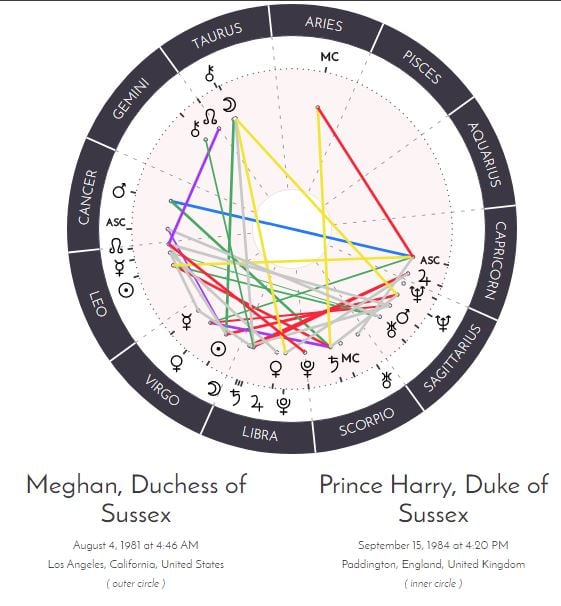
A synastry chart places two natal charts side by side, usually with one person’s chart in the inner ring and the other’s in the outer ring. The aspects that form between the two charts (where one person’s planet sits in relation to the other’s) are the main things to read. For a solid foundation in the underlying elements, the most important aspects of a natal chart covers everything from planets to houses to the nodes.
In a synastry chart, the colored lines indicate the aspect type. Squares are typically coded red and carry tension. Oppositions are coded blue and show polarity between two people. Sextiles appear in purple and trines in green; both are generally harmonious. Yellow lines indicate the quincunx, an awkward, adjusting energy. Grey lines mark minor aspects used by more advanced practitioners.
Where to start: the key points in order
The most useful place to begin reading a synastry chart is with the Sun, Moon, and Ascendant of each person, then work through the personal planets: Mercury, Venus, and Mars. These points describe the core of each person’s character and desires. Aspects between them tell you the most about day-to-day compatibility and attraction.

After the personal planets, move to Jupiter and Saturn. Jupiter connections can describe where a relationship brings expansion, optimism, or status shifts. Saturn connections, though they carry a reputation for limitation, are actually some of the most stabilizing aspects in synastry. They hold people together through difficulty and are commonly found in long-lasting relationships. The most important aspects of a synastry chart goes into each of these in detail.
Twin flames and mirror connections
The twin flame concept (popularized in spiritual circles) holds that certain people are two halves of the same soul. Astrology cannot prove or disprove this, but it can identify the kind of mirroring that twin flame relationships are said to describe. Pay attention to oppositions between Sun signs, Moon signs, or Ascendants. Opposite signs share the same axis and tend to look at the same fundamental issues from opposite directions: Aries and Libra both deal with self and relationship; Cancer and Capricorn both navigate home and career. The dynamic is energizing but requires real understanding on both sides.
Soulmate aspects: what to look for
If a relationship feels fated or unusually significant, the Moon’s nodes are often involved. The North and South Nodes are two points in each chart that sit exactly opposite each other. When one person has a planet closely conjunct the other person’s North or South Node, the relationship tends to feel important in a way that goes beyond ordinary attraction. For a real-world example of how this kind of contact plays out, what astrology has to say about Taylor Swift and Joe Alwyn is worth reading alongside this.
A planet conjunct someone’s South Node can feel immediately comfortable, even familiar, as though the two people have known each other before. The risk is that this comfort becomes stagnation, with the North Node person feeling held back from their growth. A planet conjunct someone’s North Node feels more challenging, even fated, and tends to push the person whose North Node is activated toward their own development.
Are squares in synastry always a problem?
Squares in synastry show that two charts are connected in a way that creates friction. Whether that friction is destructive or energizing depends on which planets are involved and on both people’s capacity for growth.
A square between Venus and Jupiter is unlikely to cause serious harm. The worst case is usually that the two people overindulge together or are too optimistic about finances. A square between Mars and Saturn, or between Mars and Pluto, is a heavier dynamic, carrying the potential for control issues or chronic frustration if the two people do not have the tools to work through it.
In a sexual relationship, a Venus-Mars square can actually intensify physical chemistry. Some people with many natal squares in their own charts need the stimulation of friction to feel fully engaged, and they find relationships with no squares flat rather than peaceful. The signs someone wants you sexually can often trace back to exactly this kind of tense planetary contact.
How to read overall compatibility
Overall compatibility depends on what you are actually hoping for from the relationship. For a light, pleasurable connection, look for Venus aspects between the charts, especially from one person’s Venus to the other’s Sun, Moon, or Ascendant. For a long-term commitment, Saturn connections matter most, particularly from one person’s Saturn to the other’s Sun, Moon, or Ascendant. Saturn gets a bad reputation, but in synastry it is often what holds a relationship together when attraction alone would not be enough. Trines and sextiles between Mercury and the other person’s key points help with day-to-day communication. Mars connections show whether the two of you can move toward the same goals without constantly working against each other. If you want to understand what commitment looks like in practice beyond the chart, 5 ways to make a woman commit to you covers the behavioral side that astrology alone cannot predict.
No chart is entirely harmonious, and no chart is entirely difficult. Reading synastry well means holding all the pieces together. Both the ease and the friction in a relationship shape what it becomes.