Four of Pentacles Tarot Card Meaning
After the steady craft and earned recognition of the Three of Pentacles, the suit of Earth does something very human with what it has built: it closes its hands around it. The Four of Pentacles is the card of the grip. It belongs to the suit governed by the material world, the body, money, and the home, and in the old astrological scheme it carries the Sun in Capricorn, vitality poured into the most cautious and consolidating of signs, the warmth of the Sun made to sit still and guard a gate.
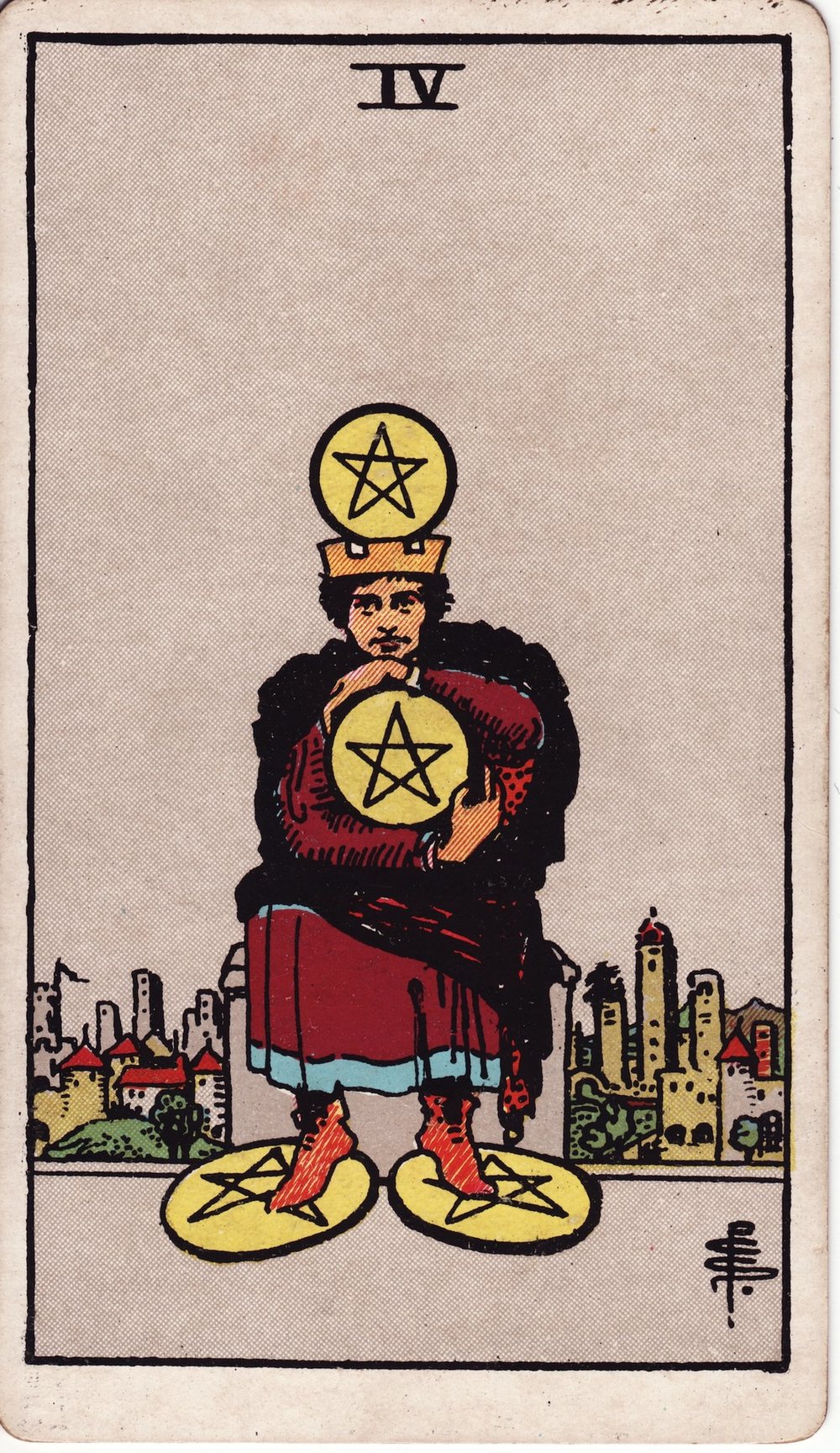
In the Rider-Waite deck a man sits alone on a low stool at the edge of a grey city. He wears a crown, and balanced on the very top of that crown is a single golden pentacle. He clutches a second coin against his chest with both arms wrapped tight around it, the way a person holds the one thing they cannot bear to lose. Two more pentacles are pinned beneath his feet, pressed to the ground so they cannot roll away. He has covered every exit. Head, heart, and both soles, each one occupied with keeping.
Behind him the town rises in the distance, full of life he is turned away from. He has his back to it. The wealth is real and the posture is rigid. Nothing about the image suggests he is enjoying any of it. He is not counting his coins or spending them or sharing them. He is simply holding, and the holding has become a full time occupation that leaves no hand free for anything else.
This is the stillness that comes after accumulation, when the question stops being how do I get more and becomes how do I keep what I have. There is a kind of safety in it. There is also a wall. The same arms that protect the coin shut out the warmth of the people who might want to sit beside him. Security and isolation wear the same coat here, and the card rarely tells you which one you are looking at until you loosen your grip enough to find out.
That grip follows the card into every corner of a reading.
What does the Four of Pentacles mean?
The Four of Pentacles is the card of holding on. It speaks of security, control, and the very natural urge to protect what you have worked for. Money saved, boundaries set, a position defended. At its healthiest, it is the discipline that builds a reserve and refuses to gamble it away on a whim.
There is stability in this card, the solid kind that comes from knowing exactly where you stand and refusing to be moved. After a stretch of uncertainty, that can feel like a relief. You have something now, and you mean to keep it.
But the grip is the whole image, and a grip that never opens turns into a cage. The Four often points to clutching too hard, to a fear of loss that has quietly outgrown the thing being lost. Saving becomes hoarding, caution becomes rigidity, and the wall built to keep trouble out starts keeping everything else out too.
The difference between owning your possessions and being owned by them is the quiet question underneath the card. The man on the stool has plenty. He is also stuck. When the Four appears, it usually means it is time to look at what your tight grip is costing you somewhere else.
Four of Pentacles Keywords:
- Security
- Holding on
- Control
- Saving and conservation
- Stability
- Possessiveness
- Scarcity mindset
- Boundaries
- Self-protection
- Caution with money
- Fear of loss
- Stubbornness
What does the Four of Pentacles mean when Reversed?
Reversed, the Four of Pentacles is the grip coming loose, for better or for worse. The fingers that were locked around the coin finally open. Sometimes that is release and generosity, learning to let money flow and trust move freely. Sometimes it is the opposite, a collapse of the controls that were holding things together.
At its best, the reversed card is the man finally setting the coins down. He gives, he spends on something that matters, he lets a person past the wall. The energy that went into guarding gets freed for living. This is the healthier face of the reversal, and it often arrives as a quiet relief.
At its worst, the reversal swings to extremes in both directions. It can show greed and materialism running unchecked, the grip tightened past the point of sense. Or it can show the opposite leak, reckless spending, financial chaos, a person who let go of all caution and now has nothing pinned down.
Either way, the reversed Four of Pentacles disturbs a stuck equilibrium. The wall is no longer holding. Whether that feels like liberation or loss depends entirely on what you were holding the wall up against.
Four of Pentacles Reversed Keywords:
- Letting go
- Generosity
- Release of control
- Financial insecurity
- Reckless spending
- Greed taken to excess
- Loosening boundaries
- Instability
- Opening up
- Learning to trust
- Loss of what was hoarded
The Four of Pentacles as How Someone Sees You
When the Four of Pentacles describes how someone sees you, they see a person who is hard to move. You come across as self-contained, careful, and firmly in possession of yourself and your things. There is a guardedness to the impression, the sense of someone who has drawn their lines and does not intend to redraw them for anyone.
To some that reads as admirable. You seem stable, dependable, not easily swayed or talked into things. People who value security recognize a fellow keeper. They trust that what you have, you will protect, and that you do not throw your resources or your loyalties around carelessly.
To others the same posture reads as closed. They feel the wall before they feel the warmth. You may seem unwilling to share, slow to let people in, more interested in what you are holding than in who is standing at the door. They sense the arms wrapped around the coin and wonder whether there is room for them.
The honest read is that you have made yourself difficult to reach, and people respond to the difficulty more than to anything you have actually said. They are reacting to a closed hand.
The Four of Pentacles Reversed as How Someone Sees You
Reversed, the impression shifts depending on which way your grip has slipped. If you have been opening up, they see someone becoming more generous and approachable, a person who is finally lowering the guard they once kept so high. The relief of that is visible. You seem warmer, less braced against the world.
If the slip has gone the other way, they may see someone who has lost their footing. The composure that used to define you looks shaken. Where you once seemed unshakeably in control, you now seem to be either grasping more desperately or letting things fall through your fingers, and neither is reassuring to watch.
There can be a sense that your relationship with security has become the loud thing about you. People notice when money or control stops being a quiet background fact and becomes a visible struggle. They may not name it, but they feel the change in pressure.
How you want that loosening to read is worth deciding. The same open hand can look like trust or like surrender, and the difference is mostly in how steady you are while you let go.
What does the Four of Pentacles mean in Love?
In love, the Four of Pentacles is a card of holding tight, and that can cut two ways. At its warmest, it is commitment that takes its security seriously, a partner who is loyal, steady, and in this for the long stretch. There is no wandering eye here. What they have, they keep, and being kept by such a person can feel deeply safe.
But the same grip turns possessive without much warning. The Four can describe a relationship where love has quietly curdled into ownership, where one person holds on so hard that the other can barely breathe. Jealousy, control, the constant need to know where the other person is: all of it can hide behind the language of devotion.
For someone single, the card often points to walls. You may be protecting your heart so thoroughly that no one can get near it. The arms wrapped around the coin are the arms that never reach out. Safety has become the whole strategy, and a closed heart, however well defended, stays empty.
The medicine is the same in every version. Love asks for an open hand, and an open hand cannot also be a fist. The Four invites you to notice where you are gripping out of fear and to test, gently, what happens when you loosen.
What does the Four of Pentacles Reversed mean in Love?
Reversed, the Four of Pentacles in love is the loosening of a hold, and in a relationship that has grown too tight, that is good news. The possessive grip relaxes. There is more room to breathe, more trust, a willingness to let your partner be their own person without checking on them. Walls that kept you separate start to come down.
For a guarded single person, the reversal is the heart finally opening. You stop defending against connection and let someone close enough to matter. The risk that the upright card refused to take starts to look worth taking. This is the reversal at its most hopeful.
But the loosening can also mean a bond coming apart. Reversed, the Four can show security slipping out of a relationship, the financial or emotional stability that held it together giving way. What once felt solid now feels precarious, and the worry shows.
Read the surrounding cards for which it is. The same image of an opening hand can mean a couple learning to trust or a couple losing their grip on each other. Honesty about money, control, and fear will tell you which way yours is turning. A tarot spread for relationships can help you read that dynamic more clearly.
What does the Four of Pentacles mean in Friendship?
Among friends, the Four of Pentacles describes the reliable one who is also a little closed off. You are the friend people count on to be steady, to not flake, to hold a confidence and keep a promise. There is real value in that. In a world of people who drift, you stay put.
But the card also notes a reluctance to give freely. Maybe you keep score on who paid last time. Maybe you are guarded about your real life, sharing the surface and protecting the depths. Friendships need a certain open-handedness, and the Four can mark where yours has tightened into something more cautious than warm.
It can also point to a friendship organized around security rather than joy. You may stick with the familiar circle because it is safe, not because it still feeds you, holding onto old bonds the way the man holds his coins, out of fear of having nothing rather than love of what you have.
Spend a little of yourself. Friendship is one of the few investments that grows when you give it away, and a guarded friend, however dependable, leaves the other person doing all the reaching.
What does the Four of Pentacles Reversed mean in Friendship?
Reversed, the Four of Pentacles loosens the grip you have kept on a friendship. At its best, this is you becoming more open and generous with the people you care about, sharing more of yourself, picking up the tab without keeping count, letting friends into the parts of your life you usually guard. The relationship gets warmer for it.
It can also mean releasing a friendship you have outgrown. You finally stop clutching a bond that ran on habit rather than affection. Letting it go frees both of you, even if the upright caution made it hard to admit the friendship had run its course.
On the harder side, the reversal can show a friendship destabilized, often by money or trust. A loan that soured, a sense that someone took more than they gave, a balance that tipped and never recovered. The careful boundaries that kept things even have come undone.
Honesty about give and take is what gets you somewhere. Some friendships need you to open your hand wider, and some need you to admit the well has gone dry. The reversal sits at exactly that fork.
What does the Four of Pentacles mean in Career?
In career and money, the Four of Pentacles is the saver, the consolidator, the one who builds a reserve and guards it. This is excellent for financial discipline. You live within your means, you keep something back for trouble, and you do not bet the house on a long shot. If a reading asks about security, this card delivers it.
It often marks a stable position you are reluctant to leave. You have a job, an income, a setup that works, and the thought of risking it for something better fills you with dread. The Four can be the golden handcuffs, comfortable enough to stay, too cautious to grow.
The shadow is rigidity. Held too tightly, the Four becomes the worker who will not delegate, will not invest, will not adapt because every change feels like a threat to what they have. Opportunities pass by because taking them would mean opening a hand that has forgotten how. Hoarding resources you never deploy is its own kind of poverty.
At some point caution tips into stagnation, and the difference is worth finding. A reserve is wise. A fortress with the drawbridge welded shut is just a slow way of going nowhere.
What does the Four of Pentacles Reversed mean in Career?
Reversed, the Four of Pentacles in career loosens a financial or professional grip. At its best, you start putting your resources to work, investing in growth, spending on the training or the tool or the risk that finally moves you forward. The fear that kept the money locked up gives way to sensible action.
It can also mean releasing the safe job that was holding you back. You let go of the position you clung to and step toward something with more room in it. The upright card could not bring itself to leave. The reversal can.
But the reversal also warns of money getting away from you. Reckless spending, a budget abandoned, a reserve drained faster than it can be refilled. Where the upright card hoarded, the reversed one can leak, and the result is the very insecurity the saving was meant to prevent.
The line to watch is between freeing your resources and losing control of them. One funds your future. The other empties it. The reversed Four can deliver either, and the difference is whether your spending has a plan behind it.
The Four of Pentacles as How Someone Thinks of You
When the Four of Pentacles shows how someone thinks of you in their private estimation, they think of you as solid and self-sufficient, but also as someone who keeps the gate. In their mind you are the person who has things together, who is careful, who does not need much from anyone. There is respect in that, and a little distance.
They may believe you are hard to get close to. Not cold exactly, but reserved, holding something back. They sense that there is more to you than you let out, and they are not sure they will ever be trusted with it. You come across, in their thoughts, as a locked room with the light on.
There can also be a sense that you guard what is yours, including, perhaps, them. If this is a partner or close friend, they may feel held tightly, valued the way a possession is valued. Whether that flatters them or unsettles them depends on the person, but they feel the grip either way.
The thought underneath it all is that you are someone with a wall, and they spend a fair amount of energy wondering what is on the other side of it.
The Four of Pentacles Reversed as How Someone Thinks of You
Reversed, the wall in their mind is coming down, one way or another. If you have been opening up, they think of you as someone who has grown warmer and more trusting, a person who is finally sharing what they used to hoard. The change reads as a softening, and they tend to welcome it.
If your grip has slipped the wrong way, they may think of you as someone struggling to keep things together. The unshakeable image has cracked. Where they once saw control, they now see worry, grasping, or a person scattering what they should be keeping.
There can be a thought that you have become preoccupied with security or its loss, that the subject of money or control has started to dominate how you move through the world. They notice when a quiet competence turns into an anxious one.
The reversed card suggests their picture of you is in flux. The fixed, self-contained figure is becoming something more open or more precarious, and they are recalibrating their sense of who you are.
What does the Four of Pentacles mean in Conflict?
In conflict, the Four of Pentacles is the immovable object. You dig in, plant your feet, and refuse to give ground. There is strength in this. You cannot be bullied out of your position, and someone who knows what they will and will not concede is hard to push around. Boundaries, firmly held, are a legitimate form of power.
But the same rigidity makes resolution nearly impossible. The man on the stool will not stand up, will not put down his coins, will not turn around to face the city behind him. A conflict where one side has welded itself to its position cannot move toward a settlement. It can only harden.
The fight is often about possession in some form. Money, property, who owns what, who controls the outcome. The Four turns disagreements into matters of holding versus losing, which raises the stakes and lowers the chance of compromise. Nobody wants to be the one who opened their hand first.
Whether winning is worth the rigidity it requires is the honest question. You may keep every coin and still lose the room, the relationship, the warmth that flexibility would have preserved. Standing your ground is wise. Becoming a wall is not.
What does the Four of Pentacles Reversed mean in Conflict?
Reversed, the Four of Pentacles in conflict is the stalemate breaking. At its best, this is someone finally willing to loosen their grip, to compromise, to let the matter go rather than guard it to the death. The rigid position relaxes, and a fight that seemed frozen suddenly has movement in it.
It can mark the wise surrender of something not worth the cost of holding. You stop clutching the point, the money, the need to win, and you find that letting go costs you far less than the endless defense was costing you. The relief is real.
But the reversal can also show control slipping in a fight, a position you can no longer defend, ground giving way under you. What you were holding gets pried loose, and not on your terms. This is the loss the upright card was bracing against, arriving anyway.
The first is grace. The second is defeat. In conflict, the difference is usually a matter of timing, and the reversed Four rewards those who let go before they are made to.
The Four of Pentacles as Feelings
As feelings, the Four of Pentacles describes an emotional grip, a person holding their heart the way the man holds his coin. There is attachment here, often deep, but it is attachment braced against loss rather than open to joy. They feel for you, and they are terrified of what feeling for you might cost them.
It can mean someone who feels secure with you and wants to keep things exactly as they are. They are not restless or wandering. They have what they want and they are clinging to it, which is flattering until you realize the clinging leaves little room to grow.
It can also mean guardedness, an emotion held so tightly it never quite gets expressed. They may care a great deal and show almost none of it, protecting the feeling instead of sharing it, afraid that to open up is to become vulnerable to hurt. The wall keeps the pain out and the love in, where it does no one any good.
Underneath, this is usually fear wearing the mask of stability. The Four feels safest when nothing changes, and so it holds on, sometimes long past the point where holding on still serves the heart.
The Four of Pentacles Reversed as Feelings
Reversed, the Four of Pentacles loosens the emotional grip. At its best, this is someone finally letting their guard down, allowing themselves to feel and to show it, opening the heart they kept so carefully closed. The relief of stopping the constant defense can flood through everything. They are choosing to be vulnerable, and it suits them.
It can also describe feelings becoming unsteady. The emotional security they relied on has slipped, leaving them anxious, ungrounded, unsure of where they stand with you or with themselves. The wall came down and the weather got in.
On the harder edge, the reversal can show possessiveness intensifying rather than easing, a grip tightening into something jealous and consuming, fear of loss turned all the way up. Not every reversal is a release. Some are a clench.
Read it by the company it keeps. The reversed Four can mean a heart bravely opening or a heart desperately grasping, and only the surrounding cards will tell you whether the hand is unfolding or closing harder.
The Four of Pentacles as a Situation
As a situation, the Four of Pentacles describes circumstances that are stable but stuck. The stillness here is not the deliberate withdrawal of the Four of Swords, which retreats to recover. This one holds position to prevent loss. Nothing is falling apart, but nothing is moving either. You have reached a kind of plateau where the energy goes entirely into maintaining what is, with none left over for what could be.
It often marks a situation defined by holding on, to money, to a position, to the way things have always been. There is a defensiveness in the air, a sense of guarding against loss. The status quo is being protected, perhaps fiercely, and change is treated as the enemy.
The card can also point to a situation of accumulation without enjoyment. The resources are there, the security is real, and yet no one is actually living. Everything is being saved for a someday that the careful saving keeps pushing further off.
What the holding is actually for is worth asking. A situation can be perfectly secure and still slowly suffocating, and this card often appears precisely when the safety has become the problem.
The Four of Pentacles Reversed as a Situation
Reversed, the Four of Pentacles unfreezes a stuck situation. At its best, the holding pattern breaks open. Resources start to move, controls relax, and circumstances that were locked in place finally begin to shift. After a long plateau, things start happening again.
It can mean a deliberate release, a choosing to let go of what was being hoarded so that life can flow. The situation opens up because someone finally loosened their grip on it, and the room that grip was taking up becomes available for something new.
But the reversal can also describe security coming undone. The stable situation destabilizes, the reserve runs short, the wall that kept trouble out develops a breach. What felt solid reveals itself to have been only held together by force.
Both look like movement after a long stillness, but a thaw and a crack are different things. One leads somewhere better, the other leads somewhere harder, and the surrounding cards usually point to which.
The Four of Pentacles as Intentions / What Someone Wants
As intentions, the Four of Pentacles shows someone who wants security and means to hold onto it. They want stability, control, a sure thing they can count on, and where you fit into their plans, they want to keep you in place. Their intentions are not adventurous. They are protective.
It can mean someone whose chief aim is to not lose what they have. They are playing defense. The goal is preservation, not expansion, and every move they make is calculated to guard the position rather than improve it. Safety is the whole ambition.
In a relationship question, this often reads as someone who wants to keep you, possibly in the possessive sense. They intend to hold on tightly, to secure the bond against any threat, to make sure you are theirs and stay theirs. Whether that intent feels devoted or controlling depends on how much air it leaves you.
Notice that holding is the whole intention here. This person is not trying to grow something with you. They are trying to keep something, and there is a real difference between being cherished and being kept.
The Four of Pentacles Reversed as Intentions / What Someone Wants
Reversed, the intention behind the Four of Pentacles shifts toward release. At its best, someone wants to let go, to be more generous, to stop guarding and start sharing. They intend to open the hand they have kept closed, whether with money, with trust, or with you.
It can mean someone ready to take a risk they previously refused, to invest, to spend, to commit resources they had been hoarding. The defensive crouch is straightening up. They want to put what they have to use rather than simply sit on it.
On the other side, the reversal can show intentions slipping into either extreme. Someone who wants to grasp harder, to control more tightly, fear driving them deeper into the grip. Or someone whose wants have grown reckless, ready to throw away the security they spent so long building.
Which loosening this is matters considerably. A person opening their hand to give is very different from a person whose grip has simply failed, and the reversed Four can carry either intention.
Is the Four of Pentacles a Yes or a No?
The Four of Pentacles leans toward no, or more precisely, toward not yet. It is a card of holding still, not of moving forward, and most questions that hope for change, growth, or release run into its closed hand. If you are asking whether something new will happen, the Four tends to say things are staying put.
For questions about security and keeping what you have, though, it flips to yes. Will the money hold? Will the position stay safe? Will the thing you are protecting remain protected? Here the Four is reassuring. It is very good at keeping. It is only bad at letting go.
The card resists yes-or-no readings the way it resists everything else, by digging in. Its instinct is to maintain, to conserve, to refuse the risk that any real yes requires. If your question needs an open hand to come true, the Four is reluctant to provide one.
When it appears reversed in a yes-or-no reading, the answer loosens. A loosening grip can become a hesitant yes if it means release and generosity, or a clearer no if it means loss and instability. Read it alongside the cards around it.
The Four of Pentacles as a Place
As a place, the Four of Pentacles points to somewhere closed, controlled, and securely held. A locked office, a vault, a gated property, a home with the doors bolted and the valuables put away. It is a place built to keep things in and people out, and it carries the particular stillness of a space that prioritizes safety over welcome.
It can describe a bank, a safe deposit room, a storage unit, anywhere wealth or possessions are kept under guard. The whole atmosphere is one of preservation. Nothing here is meant to move or change. It is meant to stay exactly as it was left.
On a subtler level, the Four can mark a place that feels emotionally shut, a household where everyone guards their own corner, an environment thick with the sense that you must not touch, must not take, must not ask. The walls are not all physical.
A fortress and a cage have the same architecture, and the Four sits in the room where it is hard to tell the difference.
The Four of Pentacles Reversed as a Place
Reversed, the Four of Pentacles describes a place where the controls have loosened. At its best, this is somewhere opening up, doors unbolted, a space that was closed becoming accessible again. The vault is being emptied for a good reason, the gate is standing open, the room is finally letting people in.
It can mean a place of release, somewhere you go to let go rather than to hold, a setting where the usual guarding falls away. After the tight enclosure of the upright card, the reversed version can feel like air moving through a house that was shut up too long.
But the reversal can also point to a place that has lost its security. A property no longer protected, a home whose stability has slipped, somewhere the safety has drained out and left a kind of exposure. The walls that kept things in have failed.
An unlocked door can mean hospitality or a breach. Whether the opening is welcome or not is the whole story, and the reversed Four describes the place at the moment its locks gave way.
The Four of Pentacles as an Obstacle / Challenge
As an obstacle, the Four of Pentacles is your own grip standing in your way. The thing blocking you is your unwillingness to let go, to spend, to risk, to change. You are so busy protecting what you have that you cannot reach for what you need, and the closed hand has become the whole problem.
It often shows up as fear of loss disguised as prudence. You tell yourself you are being careful, but the caution has hardened into paralysis. Opportunities require an open hand, and yours is clenched. The wall you built for safety is now the wall you cannot get past.
The challenge can also be someone else’s rigidity, a person or institution that will not budge, will not share, will not loosen the controls that are holding you back. You are pushing against an immovable object, and no amount of force will make it open. It has decided to hold.
Whatever you are clutching so hard, the price of clutching it may be the very thing you actually wanted. The obstacle dissolves the moment the hand opens. Getting there is the hardest thing.
The Four of Pentacles Reversed as an Obstacle / Challenge
Reversed, the obstacle of the Four of Pentacles is the grip loosening at the wrong time, or in the wrong way. The challenge may be that security you relied on is slipping just when you needed it, the reserve running low, the controls failing. What was supposed to hold is letting go.
It can mean the difficulty of learning to release. Opening your hand after years of holding is its own ordeal, and the reversed Four can mark the awkward, frightening stretch where you are trying to be generous or trusting and it does not yet feel safe. The challenge is the unclenching itself.
On the other edge, the obstacle can be a swing into excess, spending or grasping that has gotten out of control and is now creating the very instability you feared. The reversal warns that overcorrecting is its own trap. Letting go too fast can be as costly as never letting go at all.
The challenge is to release with intention rather than by collapse, to open the grip on purpose before circumstances pry it open for you.
The Four of Pentacles as Action
As an action, the Four of Pentacles counsels holding, conserving, and protecting. The move it endorses is to save rather than spend, to keep rather than risk, to secure what you have before reaching for more. Build the reserve. Set the boundary. Guard the position. In its right season, this is sound and necessary action.
It can mean consolidating, pulling your resources in close and making sure they are safe before you make any further move. Sometimes the wisest action is no action at all, simply maintaining what works and refusing to be pushed into a risk you are not ready for.
But the Four as action carries a warning inside the advice. The instinct to hold can override the moment when you should let go. If the card describes what you are about to do, ask whether you are protecting something or just refusing to move out of fear.
The action that serves you here is deliberate keeping, not anxious clutching. Hold what genuinely needs holding. Be honest about the rest.
The Four of Pentacles Reversed as Action
Reversed, the Four of Pentacles calls for the opposite move: open your hand. The action it endorses is to let go, to spend on what matters, to give, to release the grip and let things flow. After a long stretch of holding, the healthy reversed action is generosity, investment, and trust.
It can mean taking the risk you have been refusing, putting your saved resources to work, committing what you have been guarding to a purpose worth committing it to. The reserve does no good buried in the ground. The reversed Four says use it.
But the card also warns against the reckless version of the action. Letting go is not the same as throwing away. If the reversal is pushing you toward spending you cannot afford or surrendering ground you needed, the right action is restraint, not release.
The move that serves you is intentional loosening. Open the hand on purpose, give where giving heals, and keep enough sense about you that the release does not become a fall.
The Four of Pentacles as Advice
As advice, the Four of Pentacles tells you to take your security seriously, but to watch the grip. Save something. Protect what you have built. Set the boundaries that keep you safe. There is real wisdom in not gambling away your stability for the sake of every passing temptation.
At the same time, the card asks you to examine where you are holding on out of fear. Look honestly at the things you cannot bear to lose and ask whether the fear of losing them is running your life. A grip that never opens does not keep you safe. It keeps you stuck.
The Four advises a middle path between the spendthrift and the miser. Have a reserve, but do not let the reserve become a wall between you and the world. Money, control, and possessions are good servants and terrible masters, and the card appears when the relationship is tipping toward the second.
Above all, notice the cost of your holding. Whatever you are clutching, check that the clutching is not quietly costing you something you value more. The advice is not to let go of everything. It is to make sure your grip is a choice and not a compulsion.
The Four of Pentacles Reversed as Advice
Reversed, the Four of Pentacles advises you to loosen your hold. Whatever you have been gripping too tightly, money, control, a person, a position, it is time to open the hand and let some of it move. Generosity, trust, and a willingness to risk will serve you better now than another season of guarding.
The card encourages you to invest in your own life. Spend on the thing that matters, share what you have been hoarding, take the chance that requires you to let go of the sure thing. The security you built was never meant to be a tomb. Put it to use.
But the reversed advice comes with a caution against the swing too far. If you have been losing control of your spending or surrendering boundaries you needed, the counsel reverses: tighten up, steady yourself, reclaim the grip you let slip. Balance is the whole point.
The advice, in either direction, is to find the right tension. Hold what needs holding, release what needs releasing, and stop confusing the two. The reversed Four appears when your grip and your good are no longer pointing the same way.
The Four of Pentacles as an Outcome
As an outcome, the Four of Pentacles points to security achieved and held. You end up with stability, with the thing protected, with your position secure and your reserves intact. If safety was the goal, this is a successful ending. You kept what you set out to keep.
But the outcome carries the card’s characteristic ambivalence. You may arrive at security and find it lonelier or more static than you imagined. The walls held, and so did everything they shut out. The ending is safe, and it may also be stuck, a plateau rather than a peak.
It can mean a situation that settles into a holding pattern, neither improving nor collapsing, simply maintained. Things stay as they are. For some questions that is exactly the relief you wanted. For others it is the disappointment of nothing changing.
The Four delivers stability reliably. Whether that stability feels like a home or a cage depends on what you had to close your hand around to get it.
The Four of Pentacles Reversed as an Outcome
Reversed, the Four of Pentacles as an outcome is the grip giving way. At its best, the ending is release, a loosening that frees you from a holding pattern, money flowing again, walls coming down, a stuck situation finally moving. You let go and the letting go turns out to be the better outcome.
It can mean arriving at generosity and openness, a resolution where you stop guarding and start sharing, and find the relief of it worth far more than the security you released. The hand opens and something better moves into the space the grip was occupying.
On the harder side, the reversal can deliver loss. The security you held comes undone, the reserve is spent, the stability slips through your fingers. The ending is the very thing the upright card was bracing against, and it arrives despite all the holding.
A grip released on purpose leads somewhere freer. A grip that simply failed leads somewhere harder. The surrounding cards will tell you which outcome the reversed Four is pointing toward.
The Four of Pentacles in the Future
In the future position, the Four of Pentacles suggests a coming time of holding and securing. Stability is on the way, a period where you consolidate what you have, build a reserve, and settle into something solid. After uncertainty, this can be a welcome stretch of knowing exactly where you stand.
It can mean a future shaped by the need to protect, to guard your resources or your position against a threat you see coming. You will be playing defense, keeping rather than expanding, and the card advises you to make sure your caution stays in proportion to the actual risk.
The warning inside the forecast is that the future may also be a plateau. Things hold, and they also stop moving. If you do not want to find yourself secure but stuck, the Four asks you to keep a hand free for growth even as you protect what you have.
Enter that coming stability without gripping it to death. Build the reserve, set the boundaries, and remember to actually live inside the security you are working to create.
The Four of Pentacles Reversed in the Future
Reversed, the Four of Pentacles in the future points to a coming loosening of the grip. At its best, you are heading toward release, a time when you let go of what you have been holding, open up to generosity and risk, and find the freedom that the tight grip was denying you. The future has more room in it than the present does.
It can mean a future where you put your resources to work, invest in growth, spend on what matters, and stop hoarding against a someday that never comes. The reserve gets used, and the using turns out to be the point.
But the reversal can also forecast a future where security slips. The stability you counted on may loosen, the controls may fail, and you will need to adapt to having less pinned down than you are used to. Forewarned, you can prepare for the loosening rather than be caught by it.
Meet that coming change with a steady hand. Whether the future loosens by your choice or against your will, you will fare best if you decide in advance which things are worth keeping a grip on and which are ready to be set down.
The Four of Pentacles as a Person
As a person, the Four of Pentacles describes someone careful, controlled, and self-protective, a person who holds tightly to what is theirs. They are often financially disciplined, security-minded, and steady, the sort you can rely on never to do anything rash. There is solidity in them, and a certain hard-won calm.
They can be guarded to the point of being hard to reach. The arms wrapped around the coin are the arms that do not easily reach out, and people close to them often sense a wall, a part of themselves they keep behind a locked door. They protect their heart and their resources with equal vigilance.
At the shadow end, this is the possessive person, the miser, the one who clutches money, control, or people too tightly and mistakes the clutching for love or wisdom. Their fear of loss can quietly run everything, narrowing a life that has every material reason to be wide.
At their best, though, they are the steady keeper, the one who builds something solid and guards it faithfully, who can be trusted with what matters because they understand the value of holding on. The whole question of this person is whether their grip serves them or rules them.
The Four of Pentacles Reversed as a Person
Reversed, the Four of Pentacles describes a person whose grip is changing. At their best, this is someone learning to open up, becoming more generous, more trusting, less ruled by the fear of loss. The wall is coming down by their own choice, and they are warmer and freer for it. The keeper is learning to give.
It can describe someone in the middle of letting go, releasing a possessiveness or a rigidity that was holding them back, growing past the need to control everything they touch. They are loosening on purpose, and the process suits them even when it is hard.
On the harder side, the reversed person can be someone whose control has slipped the wrong way, either grasping more desperately than ever or losing their footing entirely, spending recklessly, scattering what they should be keeping. The steadiness that defined them has come undone.
A person opening their hand to give and a person whose grip has simply failed look alike for a moment. Only time, or the cards around them, will show you which loosening this one is living through.
What Zodiac Sign / Element is the Four of Pentacles?
The Four of Pentacles belongs to the element of Earth, the suit’s grounding in the material world, the body, money, and everything you can hold in your hands. Earth is the element of substance and security, and the Four is Earth at its most determined to keep what it has gathered. The whole card is about the solidity, and the heaviness, of the earthly.
By the older astrological scheme, the Four of Pentacles carries the Sun in Capricorn, with Saturn as Capricorn’s ruling planet. It is a fitting marriage. Capricorn is the great builder and conserver of the zodiac, the sign that climbs slowly, saves carefully, and trusts only what it has secured by its own discipline. The Sun, the source of vitality, poured into that sign becomes the energy of holding and consolidating rather than spending and shining outward.
Capricorn understands the Four of Pentacles from the inside. There is the same caution, the same respect for security, the same risk of mistaking accumulation for fulfillment. The Saturnian influence lends the card its discipline and its rigidity in equal measure: the gift of patience and the trap of fearing every loss. Capricorn at its best builds something lasting and learns, eventually, to enjoy it. Capricorn at its worst guards an empty fortress.
Together the Earth element and the Sun in Capricorn give the Four of Pentacles its essential character: stable, disciplined, security-loving, and always one clenched fist away from holding so tightly that nothing good can get in.
Final Thoughts
The Four of Pentacles is a quiet card about the difference between keeping yourself safe and shutting yourself in, and its real work is learning when to hold and when to open the hand. Security is worth building. It is only worth building so that you can live inside it, not so that you can spend your whole life guarding the door. If the Four drew you in, follow the suit’s journey from the promise of the Ace of Pentacles through the collaborative craft of the Three of Pentacles and the grounded abundance of the Queen of Pentacles tarot card, or sit with a tarot spread for guidance when you are ready to ask what your own grip is costing you. Wherever it appears, the Four invites you to check whether your hands are protecting your life or simply too full to receive it.