Ten of Wands Tarot Card Meaning
The Wands are the suit of fire, the element of will, ambition, and the spark that moves a person to act. Where the Cups feel and the Swords think, the Wands push. They carry heat and forward motion, and in the old Golden Dawn attributions the Ten of Wands belongs to Saturn in Sagittarius, the planet of weight and limitation set in the sign that wanted to run free. That pairing tells the whole story. Sagittarius is the archer who aimed at a far horizon and chased it with joy; Saturn is the long arm of consequence, the bill that comes due, the structure that the early dream never accounted for. Fire that has hardened into obligation. The flame is still alight, but now it has to be carried.
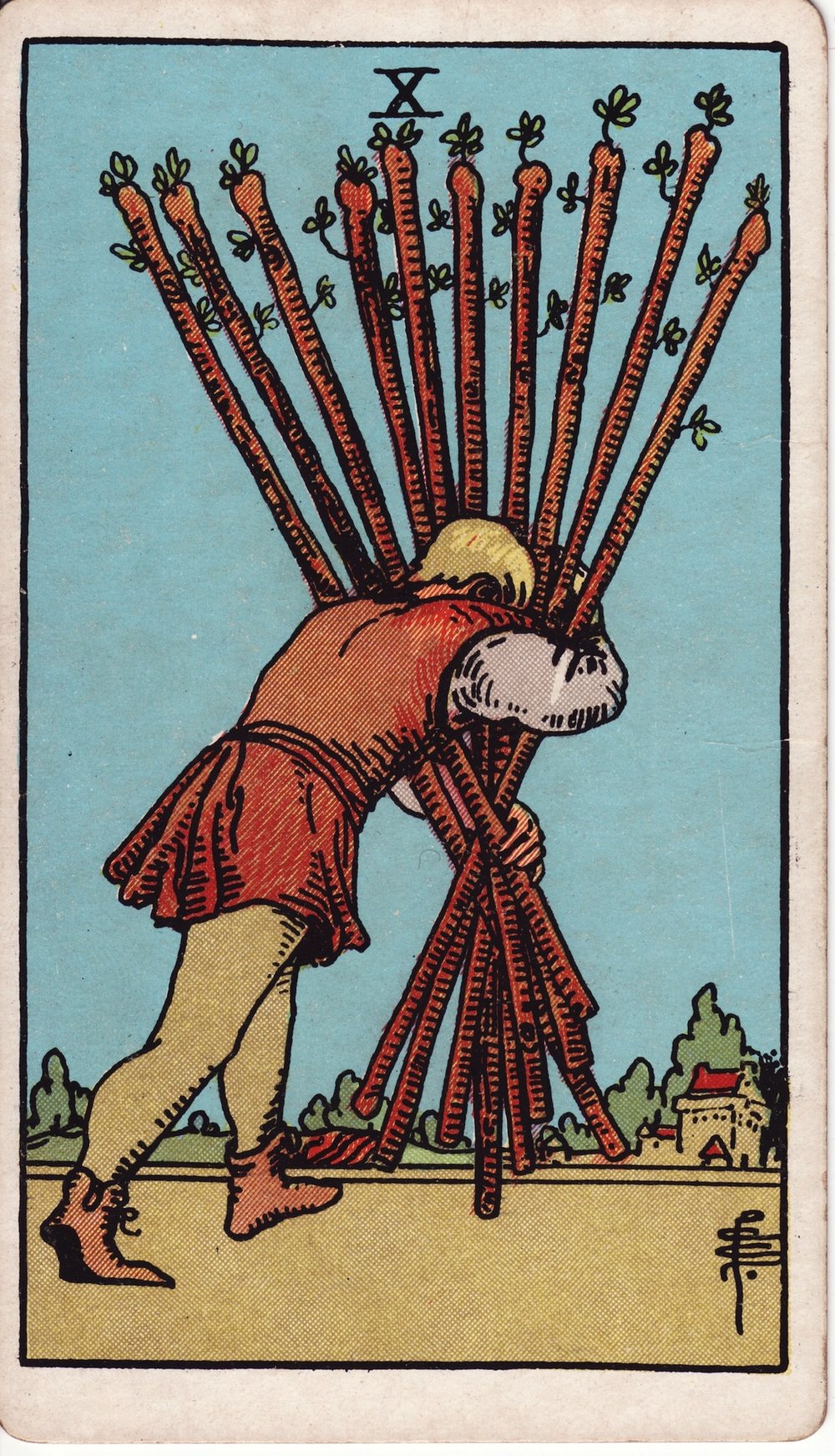
The Rider-Waite image is plain and almost comic in its honesty. A man walks bent nearly double, both arms wrapped around ten heavy staffs gathered against his chest. He has bundled the whole suit into one armload, and he is hauling it forward by sheer stubbornness. His face is hidden behind the wood. A small village sits in the distance on the right, green fields between him and the door, so he is close to home and almost there, yet the load is so tall it blocks his view of the very place he is heading.
This is the card of the person who finished what they started and is now crushed under what finishing required. The wands are not enemies. There is no fight here, no rival, no storm. They are his own ventures, his promises, his responsibilities, every yes he ever said gathered into a single weight he refuses to set down even for a moment. He could put some down. He does not. Something in him has decided that carrying all of it alone is the price of being the one who carries.
There is success buried in this card, which is what makes it ache. The harvest came in. The work paid off. But nobody warned him that the reward for doing the work would be more work, and that the strong back everyone relied on would never again be allowed to rest. In this guide to the Ten of Wands we look at the many shapes that weight can take, and at the quiet question the card keeps asking: which of these staffs is actually yours?
What does the Ten of Wands Tarot card mean?
Upright, the Ten of Wands is the card of overload. You have taken on a great deal, more than one set of arms was built to hold, and you are pushing toward the end of it through stubbornness rather than ease. The work is often good work. This is rarely failure. It is the strain that comes after success, when one accomplishment quietly turns into ten obligations and you find yourself responsible for all of them at once.
The card describes the feeling of being the load-bearing wall. Everyone leans on you because you have proven you can take the weight, and so the weight keeps arriving. You say yes because saying yes is who you are, and because the alternative feels like letting people down. Meanwhile your own view of the road ahead is blocked by the very pile you are carrying.
There is dignity in it. The Ten of Wands is no quitter, and the village is close. Whatever you are hauling, you will almost certainly get it home. But the card pauses you long enough to notice the cost, the bent back, the hidden face, the joy that drained out of the task somewhere along the way. It asks whether endurance has quietly become martyrdom, and whether some of these burdens could be shared, delegated, or simply set down in the grass.
Ten of Wands Keywords:
- Burden
- Overload
- Responsibility
- Hard work
- Strain
- Obligation
- Carrying too much
- Near the finish
- Duty
- Exhaustion
- Overcommitment
- Stubborn endurance
What does the Ten of Wands Tarot Card Mean when Reversed?
Reversed, the burden meets its breaking point, and that can go two ways. In the better reading, the man finally drops the extra staffs. You delegate, you say no, you hand back the work that was never yours, and the relief of a lighter load floods in. The reversal can be the moment of release, when you admit you cannot do it all and discover that the sky does not fall when you stop trying.
In the harder reading, the reversal is collapse. The weight that was merely heavy upright becomes crushing, and something gives. Burnout, resentment, a body that quits, a project abandoned mid-haul because there was never any plan for who would help. Where the upright card strains, the reversed card breaks or refuses.
It can also describe the person who finally throws the whole bundle down in anger and walks away from responsibilities that genuinely needed tending. So read the surrounding cards. The Ten of Wands reversed is either the wisdom to share the load or the cost of having carried it too long, and the same image holds both.
Ten of Wands Reversed Keywords:
- Release
- Delegation
- Burnout
- Letting go
- Collapse
- Refusing the load
- Overwhelm
- Avoidance
- Breaking point
- Unloading
- Resentment
- Relief
The Ten of Wands as How Someone (He/She) Sees You
When this card describes how someone sees you, they see a workhorse. To them you are the dependable one, the person who shoulders things without complaint and gets them done, and there is real respect in that view. They know that if they hand you something it will be carried.
But look closer at the picture. They may also see you as overloaded and a little inaccessible, your face hidden behind everything you are managing. They sense you are stretched thin and may hesitate to add to your pile, or worse, they have stopped offering to help because you always wave them off. Some admire your strength. A few quietly take advantage of it, content to let you haul what should have been shared.
The Ten of Wands Reversed as How Someone (He/She) Sees You
Reversed, they see someone at the end of their rope. The strain that was admirable upright now reads as someone who took on too much and is starting to crack, snapping at small things, dropping balls they used to catch. They may see you as overwhelmed, or as someone who finally and rightly set a boundary and stopped carrying everyone else.
In the harder version, they see a person who abandoned a responsibility, who put the load down and walked off, leaving others to pick up what fell. The kinder version is that they see you reclaiming yourself, refusing a burden that was crushing you, and they respect the honesty even if it inconveniences them.
What does the Ten of Wands Tarot Card mean in Love?
In love, the Ten of Wands warns that the relationship has become heavy. What should feel like partnership has started to feel like a chore, a list of duties and logistics and obligations that one or both of you are hauling without much joy left in it. The romance has not died, but it is buried under the weight of everything you are managing together or, more painfully, everything one of you is managing alone.
This card often shows up when one partner carries far more than their share, the emotional labor, the planning, the keeping of the peace, and has stopped expecting help. If that is you, the card is naming an imbalance that resentment will eventually find. If you are single, the Ten of Wands can describe someone so loaded down with other responsibilities that there is simply no room in their arms for a new person. Love asks to be a wand you share, not another one you carry alone. A relationship spread can help map which partner is carrying what and where the balancing needs to happen.
What does the Ten of Wands Reversed mean in Love?
Reversed, the weight in the relationship comes to a head. At best, this is the honest conversation where the load finally gets redistributed, where one partner admits they have been carrying too much and the other steps up, and the relief reopens a door that strain had closed. Setting the burden down together can save a tired partnership.
At worst, it is the breaking point, the relationship abandoned because it became too much to bear, or one partner walking away from duties they no longer want. For singles, the reversal can mean releasing the emotional baggage you have been dragging from old relationships into new ones, finally setting down a weight that was keeping your arms too full to hold anyone new.
What does the Ten of Wands Tarot Card mean in Friendship?
Among friends, the Ten of Wands often points to the one who always organizes, hosts, drives, remembers, and holds the group together, and who is quietly worn out by it. If that is you, notice how much of the friendship has become a job. If it is a friend, notice that they may need you to carry something for once rather than lean on them again.
The card can also describe a friendship that has turned into obligation, where you keep showing up out of duty rather than gladness, hauling the relationship forward because putting it down feels wrong. Friendship is not supposed to be one more staff on the pile. The Ten of Wands asks who in your circle does the carrying, and whether the load has ever once been passed around.
What does the Ten of Wands Reversed mean in Friendship?
Reversed, you either share the load or drop it. The healthy version is the friend group finally distributing the work, or you admitting you cannot be everyone’s fixer and stepping back from a role that drained you. There is relief in no longer being the one who holds it all.
The unhealthy version is burnout cutting a friendship loose, ghosting people because keeping up felt like too much, or resentment finally boiling over after years of uneven effort. The reversed card can also mark the moment you forgive yourself for not being able to be there for everyone, and quietly let some of the lighter obligations fall away.
What does the Ten of Wands Tarot Card mean in Career?
This is one of the Ten of Wands’ home turfs, and the message is blunt. You are overworked. You have taken on too many projects, said yes to too many people, and become the person every task gets dumped on because you reliably deliver. Success has bred more responsibility, not more freedom, and you are hauling the whole department’s worth of wands toward a deadline with your view of the horizon completely blocked.
The card respects your work ethic and usually promises you will get it done. But it flags burnout on the near edge of the field. The strong performer who never delegates becomes the bottleneck and the martyr at once. If the Four of Swords appears nearby in a career spread, the deck is prescribing the deliberate rest before the forced one. Ask which of these tasks genuinely require you, which could be handed off, and which you took on only because no one else volunteered. Being indispensable is not the same as being well, and the village is closer than the pile lets you see.
What does the Ten of Wands Reversed mean in Career?
Reversed at work, the overload resolves or detonates. In the good version, you finally delegate, drop the projects that were never yours, restructure your plate, and breathe. The card can mark a deliberate offloading, handing back work, declining the next ask, and reclaiming hours you had given away by default.
In the hard version, it is burnout made real, the breakdown, the sick leave, the quit-on-the-spot, the project that collapses because one exhausted person was holding it up. It can also describe walking away from a job that demanded everything and gave too little back. Either way the reversed card says the current load cannot continue, and something is about to change so that it does not have to.
The Ten of Wands as How Someone Thinks of You
When the Ten of Wands describes someone’s thoughts about you, they think of you as the one who carries things. In their mind you are capable, responsible, and strong, the person they trust to handle what they cannot. That is a compliment with a hook in it, because part of why they think of you this way is that they have grown used to handing you the weight.
They may also worry about you, sensing you are stretched thin and not knowing how to lighten the load without insulting your competence. Or, less kindly, they may simply think of you as the reliable mule and rarely consider what it costs you. The card asks whether the people who admire your strength ever picture you resting.
The Ten of Wands Reversed as How Someone Thinks of You
Reversed, they think you have hit your limit. The capable image is fraying in their mind, and they wonder if you bit off more than you can chew, or they admire that you finally drew a line and stopped carrying everyone. The thought is colored by your recent unloading.
If you set a boundary, the generous among them respect it and the dependent among them resent it. If you collapsed under the weight, they think of you with concern, maybe with a touch of told-you-so. Underneath it all, the reversed card suggests they are recalibrating who you are, no longer the bottomless workhorse but a person with a limit they had forgotten you possessed.
What does the Ten of Wands mean in Conflict?
In conflict, the Ten of Wands describes a fight you are too tired to fight well. You are carrying so much already that this dispute is one more weight, and you may be tempted to simply concede just to lighten the load. The card warns against absorbing yet another problem that is not yours to solve, taking on responsibility for a quarrel only because you cannot stand the friction of leaving it open.
It can also mark a conflict that has accumulated, many small grievances bundled into one heavy armful that you are hauling into the room. The danger is that you crash through the confrontation just to be done with it, your real point hidden behind the pile of everything else you are managing. Set some of it down before you engage, or you will fight blind.
What does the Ten of Wands Reversed mean in Conflict?
Reversed, the accumulated tension breaks. This is the moment you drop the whole bundle, every swallowed grievance coming out at once, which clears the air or floods it depending on how it lands. The reversal can be the overdue release of a resentment carried far too long, finally spoken.
It can also mean refusing the fight entirely, declining to pick up a conflict that someone is trying to hand you, walking away from a battle that was only going to add to your load. At its best the reversed card lets you put down a grudge you have been hauling for years. At its worst it is the blowup of someone who carried in silence until silence was no longer possible.
The Ten of Wands as Feelings
As feelings, the Ten of Wands is heavy. The person feels weighed down, obligated, responsible to the point of exhaustion. They may care deeply, but the caring has turned into duty, and the joy has been crowded out by the sheer logistics of everything they are holding. It is the emotion of doing too much for too long and not knowing how to stop.
There can be pride mixed in, the satisfaction of being needed and capable, but it sits under a layer of tiredness. If the question was about how someone feels toward you, the Ten of Wands suggests they experience the relationship as one more responsibility, something they are committed to but also a little burdened by. The feeling is not cold. It is just very, very full.
The Ten of Wands Reversed as Feelings
Reversed, the feeling reaches its limit. Either relief, the lightness of having finally set something down, or burnout, the numb collapse of having carried it too far. The reversed card can describe someone emotionally done, with nothing left to give, who has stopped pretending they can hold any more.
It can also be the freedom of letting go, the unexpected ease that comes when a long-carried feeling is finally released. In a relationship reading it may mean someone has emotionally checked out under the weight, or that they are unloading old baggage and clearing space inside. The thread that runs through every version is the same: the weight became too much, and feeling shifted in response.
The Ten of Wands as a Situation
As a situation, the Ten of Wands describes circumstances that have piled up. Responsibilities have accumulated faster than you could clear them, and now you are managing a great deal at once, close to the goal but staggering under the load. The situation is usually one you built through your own effort and ambition. The harvest came in, and it turned out to be heavier than expected.
The card frames a moment that calls for triage. You are near the finish, the village is in sight, but you will not enjoy arriving if you arrive crushed. The situation asks what can be put down, shared, or postponed so that the final stretch does not break you. It rarely describes a crisis from outside. It describes the slow accumulation of yeses that became a mountain.
The Ten of Wands Reversed as a Situation
Reversed, the overloaded situation resolves through release or rupture. Things get handed off, simplified, or abandoned, and the load lightens, sometimes by good planning and sometimes because something finally gave way. The reversal often marks the turning point where the unsustainable stops being sustained.
It can mean a situation you walk away from, a project, a role, a commitment set down because carrying it was costing too much. It can also mean a collapse that forces the redistribution you should have chosen earlier. The circumstances are changing so that one set of arms no longer has to hold everything, whether by your decision or by necessity making the decision for you.
The Ten of Wands as Intentions / What Someone Wants
As intentions, the Ten of Wands suggests someone who wants to finish, to push the whole thing across the line through sheer determination. They intend to follow through on their commitments, and they will not abandon the load even when abandoning some of it would be wiser. There is honor in the intention and a touch of stubbornness too.
It can also reveal someone who has taken on responsibility for you or for the situation, who intends to carry it whether or not they were asked. In a relationship reading, the card can show a person whose intentions are loyal but burdened, who wants to make it work but experiences the wanting as one more duty. They mean well and they are tired, and both things are true at once.
The Ten of Wands Reversed as Intentions / What Someone Wants
Reversed, the intention is to put it down. Someone wants out from under the weight, to delegate, to quit, to hand back what they have been carrying, or simply to stop. The desire for relief outweighs the pull of obligation, and they are looking for a way to set the load in the grass.
In the harder version, they intend to walk away from a responsibility, possibly one that genuinely needs them, because they have decided the cost is too high. In the gentler version, they want to share the load and are finally willing to ask. Either way the reversed card points to a wish for a lighter armful, by release if they can manage it gracefully and by collapse if they cannot.
Is the Ten of Wands a Yes or a No?
The Ten of Wands leans toward a qualified no, or more precisely a “yes, but at great cost.” The card is not about failure, the work usually does get done, but it warns that achieving the thing will exhaust you, and that the price may not be worth the prize. If your question is whether you should take on one more commitment, the answer is a clear no.
For questions about whether something will succeed, the card grudgingly allows yes while flagging the burden of getting there. For questions about whether you can keep going as you are, it is a firm no, you cannot, not without putting something down. Reversed, the card tips further toward no in the burnout reading, or toward a relieving yes if the question was whether you should let go of a burden. As a rule, treat the Ten of Wands as a warning not to add to your load.
The Ten of Wands as a Place
As a place, the Ten of Wands points to somewhere demanding, a workplace under deadline, an overstuffed office, a household running on one person’s labor, anywhere the air is thick with obligation. It is the busy kitchen at the dinner rush, the warehouse before a holiday, the home where one person quietly does everything. These are places of effort, not ease.
It can also describe the long road home with the destination in sight but the journey heavy, the last stretch of any demanding place. If you are looking for where you feel like the Ten of Wands, it is wherever the to-do list never empties and the weight never quite lifts. The card asks you to notice how such a place sits in your shoulders.
The Ten of Wands Reversed as a Place
Reversed, the place is one you are leaving or lightening. It can be a workplace you finally walk out of, a home where the load is being redistributed, somewhere the pressure is releasing after a long buildup. The exhausting environment is changing, by your exit or by relief arriving.
It can also describe a place of collapse, where something overloaded finally broke, or a place of rest reached after setting a heavy burden down. The reversed card moves you out from under the weight of a demanding location, toward somewhere your arms are allowed to be empty for a while.
The Ten of Wands as an Obstacle / Challenge
As an obstacle, the Ten of Wands is the load itself. What blocks you is everything you are already carrying, the sheer volume of commitments crowding out any room to maneuver. You cannot take the next step because your arms are full of the last ten, and your view of the path is hidden behind your own pile of responsibilities.
The challenge is rarely a single enemy. It is the accumulated weight of overcommitment, the inability or refusal to delegate, the habit of saying yes that has boxed you in. The card asks you to recognize that the thing in your way is not out there. It is in your arms, and unlike most obstacles, this one you can choose to set down.
The Ten of Wands Reversed as an Obstacle / Challenge
Reversed, the obstacle is either lifting or crushing. The lighter reading is that you are clearing the blockage by unloading, finally moving the pile out of your path so you can see and step forward. The challenge of overload is being solved by the courage to delegate or decline.
The heavier reading is burnout as the obstacle, the wall you hit when the load finally exceeds what you can bear, stopping you cold. The reversed card can mark the breakdown that forces change, or the resentment and avoidance that pile up when you have carried too much for too long. Read it as the moment the weight becomes the deciding factor, for relief or for rupture.
The Ten of Wands as Action
As advice for action, the Ten of Wands gives a double message. Upright, it can mean push through, finish the job, carry it the last stretch because the village really is close and quitting now would waste all the effort already spent. Sometimes the action is simply endurance, getting it done because it needs doing.
But the wiser action the card usually points to is the opposite: put something down. Delegate, prioritize, decline the next request, and refuse to add one more staff to an already impossible armful. The most useful thing you can do is often to stop doing so much. Lighten the load before it breaks you, and let the relief of fewer commitments restore the strength you have been spending too freely.
The Ten of Wands Reversed as Action
Reversed, the action is to release. Hand off the work, ask for help, quit what is crushing you, and stop trying to carry everything alone. The card practically insists on it now, where upright it merely suggested. The time for stubborn hauling is over, and the move is to set the bundle down before it sets you down.
The caution in the reversed action is to release on purpose rather than by collapse. Choose what to drop, hand things off responsibly, and do not simply abandon everything in a heap and walk away leaving others to clean up. Deliberate unloading heals. Reckless dumping just moves the weight onto someone else. Aim for the former.
The Ten of Wands as Advice
As advice, the Ten of Wands says you are carrying too much, and you need to stop pretending you are not. Look at your armload honestly and separate what is truly yours from what you took on out of habit, guilt, or the need to be needed. Then set down everything in the second pile. The card counsels delegation, boundaries, and the radical idea that you do not have to do it all.
It also advises you to look up. The village is close, the goal is reachable, but you will not enjoy arriving if the burden has hollowed you out. Being strong enough to carry everything does not obligate you to. The wisest move is to share the weight, accept help, and let other people hold their own staffs. You were never meant to be the only one carrying. If you are unsure where to start, a guidance spread can show you which threads to hand off first. For the resilience of holding your ground without crushing yourself, the Nine of Wands tarot card is the lesson that comes right before this one.
The Ten of Wands Reversed as Advice
Reversed, the advice sharpens to a single word: release. Put it down, now, before the choice is taken from you. Whatever you have been hauling past the point of reason, this is the moment to delegate it, decline it, or let it go. The card promises that the relief on the other side of release is worth more than the pride of having carried it.
Be deliberate about what you set down. Unload with care so that letting go is freeing rather than destructive, and so you are not simply abandoning what genuinely needed tending. The reversed Ten of Wands trusts you to know the difference between a burden that was never yours and a duty you are tempted to flee. Drop the first. Tend the second with help.
The Ten of Wands as an Outcome
As an outcome, the Ten of Wands describes arriving at the goal, but arriving tired. You will likely get what you worked for, and you will reach it carrying the full weight of what it took. The success is real, yet it comes wrapped in responsibility, and the reward for finishing often turns out to be more to manage. It is the harvest brought in by a back that aches.
The card asks you to brace for a victory that does not feel like rest. Whatever you achieve here will need maintaining, and the role you have earned may keep the load on your shoulders rather than lifting it. If you want the outcome to be sustainable, plan now for how the weight gets shared once you arrive, or you will spend the win the same way you spent the effort, alone and overloaded.
The Ten of Wands Reversed as an Outcome
Reversed, the outcome is the load coming off, for better or worse. In the good reading, you finish by releasing what you no longer need to carry, ending lighter than you began, the burden set down and the relief earned. The situation resolves into freedom rather than more obligation.
In the harder reading, the outcome is collapse or abandonment, the project dropped, the role quit, the weight refused at the last moment. Something gives because something had to. Read the surrounding cards to know which it is, but in both versions the defining feature of the outcome is that the burden does not continue. One way or another, the carrying ends.
The Ten of Wands in the Future
In the future position, the Ten of Wands warns that a period of heavy responsibility is ahead. The commitments you are taking on now will accumulate, and you will find yourself carrying a great deal at once, close to your goals but strained by the effort of reaching them. It is a forecast of success that arrives with a price tag of obligation.
This is not a warning to stop pursuing what you want. It is a warning to build in help before you need it, to set up the structures and the shared loads now so that the future does not bury you. If you keep saying yes to everything, the future the card shows is a bent back and a blocked view. Plan for delegation early, and the same achievements can arrive without the crushing weight.
The Ten of Wands Reversed in the Future
Reversed, the future holds release or breakdown. The hopeful reading is that a current burden lifts, that you learn to delegate and the load you are dreading never fully materializes because you handle it wisely. The future lightens because you choose to share what you cannot carry alone.
The cautionary reading is that an overload ahead reaches a breaking point, burnout or collapse forcing the change you did not make willingly. The reversed card in the future is the universe’s way of saying the weight will not be carried indefinitely, so decide now whether you put it down by choice or wait until it puts you down. The lighter path is available if you take it.
The Ten of Wands as a Person
As a person, the Ten of Wands describes the dependable workhorse, the one who carries everything for everyone and rarely asks for help. They are responsible, hardworking, and quietly exhausted (the friend or colleague who somehow ends up holding every task, every worry, every loose end). People rely on them precisely because they never seem to put anything down.
There is strength in this person and a stubbornness that shades into self-neglect. They take pride in being capable, and they struggle to delegate because part of them believes the load is theirs alone to bear. They may be a caretaker, a fixer, a provider, or simply the one who said yes too many times. What they need, and rarely accept, is permission to share the weight. The free-spirited fire of the suit lives in them still, but Saturn has loaded it down with duty. Compare them to the bold, generous warmth of the Queen of Wands to see what this fire looks like before the weight arrived.
The Ten of Wands Reversed as a Person
Reversed, this is the person at their limit. Either someone learning to set boundaries, finally handing back the loads that were not theirs and reclaiming their strength, or someone burning out, snapping under pressure, dropping responsibilities they can no longer hold. The reversed person is in the middle of a reckoning with how much they took on.
At their best, they are growing wiser, discovering they do not have to carry everything and feeling lighter for it. At their worst, they are collapsing, resentful, or fleeing duties in a way that leaves others scrambling. They might also be the person who abandoned something important because the weight overwhelmed them. Meet them with compassion. The reversed Ten of Wands is usually someone who carried too much for too long before anyone noticed.
What Zodiac Sign / Element is the Ten of Wands?
The Ten of Wands belongs to the element of fire, the territory of will, drive, and action, and among the fire signs Aries, Leo, and Sagittarius it carries the specific stamp of Sagittarius. In the Golden Dawn system the card is Saturn in Sagittarius, the planet of weight and limitation placed in the sign of the far-aiming archer.
That combination is the heart of the card. Sagittarius is expansive, optimistic, always reaching for the next horizon and taking on more than it can comfortably hold because the vision is so big. Saturn is the corrective, the gravity that pulls the arrow back to earth and presents the bill for all that ambition. Put them together and you get the fire that overcommitted, the dreamer who said yes to everything and now must carry it. The Ten of Wands is Sagittarian reach meeting Saturnian consequence, the joyful spark of the suit weighed down by the structure and duty that ambition eventually demands.
Final Thoughts
The Ten of Wands is the card of the strong back that was never allowed to rest, the harvest that turned out heavier than the planting. Its real lesson is not how to carry more, but how to put down what was never yours and let other hands hold their share. Strength is not measured by how much you can haul alone. If this card spoke to you, trace the journey backward through the wary endurance of the Nine of Wands and the original spark of ambition in the Ace of Wands, and when you are ready to lay a fuller question on the table, a structured layout like the Celtic Cross spread can show you exactly which staffs to set down. Wherever the Ten of Wands appears, it asks the same gentle question: how much of this weight is truly yours, and what would it feel like to finally set the rest in the grass?