Eight of Pentacles Tarot Card Meaning
After the tired stocktaking of the Seven of Pentacles, the farmer puts the doubt down and picks the tools back up. The Eight of Pentacles is the card of the workbench, of a person who has decided to get good at something and is willing to do the unglamorous repetition that getting good actually requires. It belongs to the suit of Earth, the world of money, labor, the body, and material craft, and in the old astrological scheme it carries the Sun in Virgo, the bright steady warmth of the Sun poured into the most careful and detail-loving sign of the zodiac. The Golden Dawn titled this card Lord of Prudence, and the Thoth deck named it Prudence outright, the quiet virtue of doing a thing properly because it deserves to be done properly.
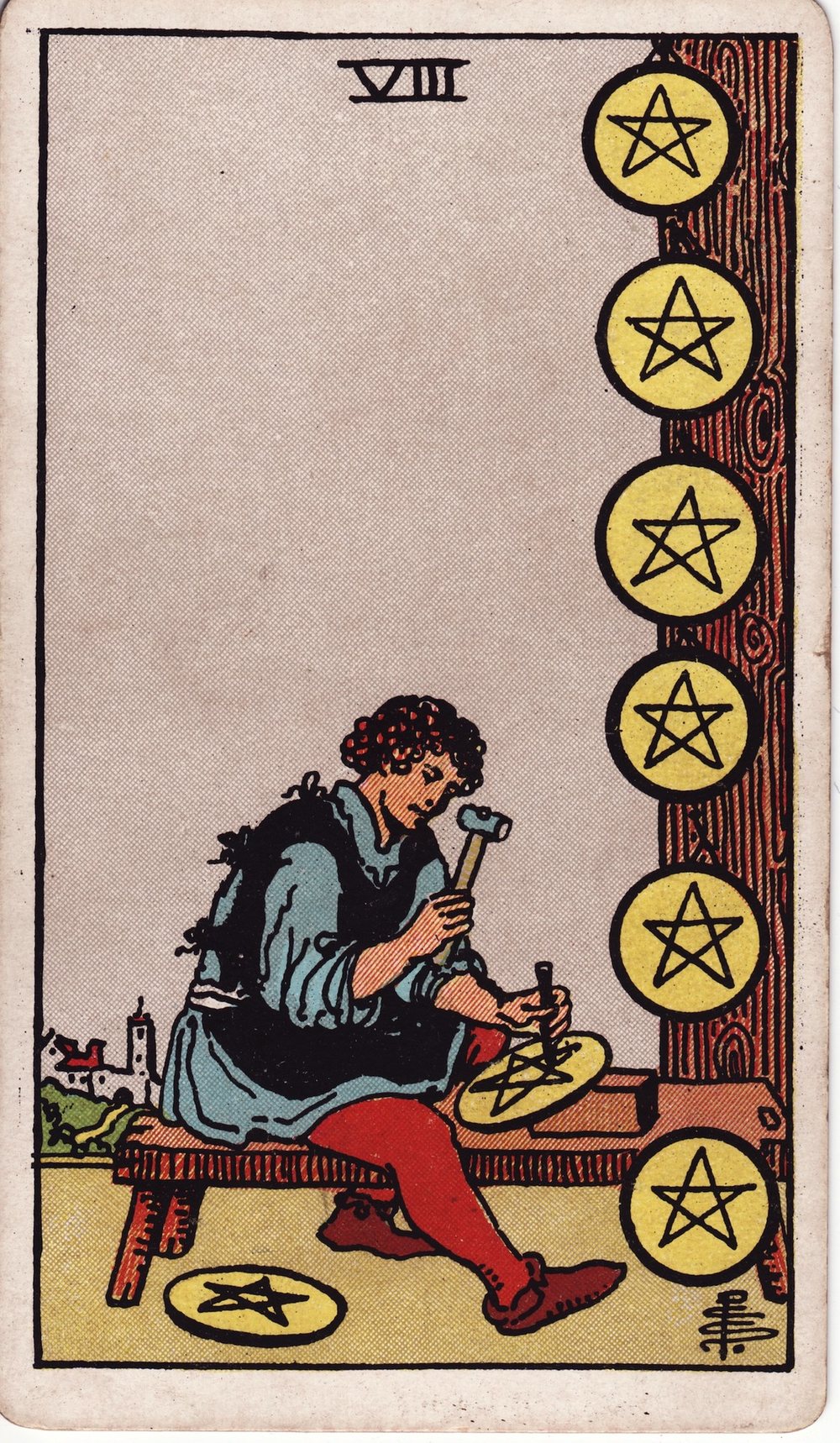
In the Rider-Waite image, a young craftsman sits alone on a wooden bench, hunched over his work. He holds a hammer in one hand and a chisel in the other, and he is carving an eight-pointed star into a golden pentacle. He is concentrating so hard that the rest of the world has gone quiet around him. Six finished pentacles already hang on the wooden post beside him, mounted like a row of completed proofs, and an eighth lies at his feet, waiting its turn.
Behind him, set off in the distance along a pale road, sits a small town. He has turned his back on it. The festivals and the gossip and the company of other people are all over there, and he is over here, on his bench, because the work is what he wants right now. That single detail tells you most of what the card is about. Mastery costs solitude. You cannot be at the party and at the workbench at the same time.
This is a card of diligence and slow improvement, of the difference between a person who talks about a skill and a person who sits down every day and grinds it into their hands. Each pentacle he finishes is a little better than the last. He is not a master yet, but he is becoming one, coin by coin, hour by hour. What follows traces the apprentice, the chisel, and the row of ripening coins through every corner of a reading.
What does the Eight of Pentacles mean?
The Eight of Pentacles is the card of dedicated work, skill-building, and the patient repetition that turns an amateur into a craftsman. It marks the stretch of any journey where the excitement of starting has worn off and what is left is the actual labor, the daily reps, the corrections, the slow accumulation of competence. Nothing flashy happens here. Something better than flashy happens. You get good.
At its heart this is a card about commitment to a craft. You have chosen a direction, a trade, a study, an art, a relationship you intend to tend well, and now you are doing the diligent, unromantic work of mastering it. The card rewards focus over flash, quality over speed, and the humility to keep improving rather than declaring yourself finished. The apprentice on the bench is not trying to impress anyone in the town behind him. He is trying to carve a cleaner star than he carved yesterday.
When this card appears, it usually points to a period of applied effort that is paying off in skill even before it pays off in money. You may be learning, training, building, or refining, and the message is to stay at the bench. Progress here is real but incremental. It shows up not as a single triumphant moment but as the quiet realization, months in, that the thing you once found hard has become second nature.
There is a deep dignity to this card. It honors the worker, the student, the maker, anyone who believes a job is worth doing carefully. The pentacles on the post are not luck. They are evidence.
Eight of Pentacles Keywords:
- Apprenticeship and learning
- Skill and craftsmanship
- Diligence and dedication
- Repetition and practice
- Attention to detail
- Quality of work
- Focus and concentration
- Slow, steady improvement
- Mastery in progress
- Pride in a job well done
What does the Eight of Pentacles mean when Reversed?
Reversed, the Eight of Pentacles is the card of work that has lost its meaning. The honest focus of the upright card curdles into one of two extremes: either tedious, joyless grinding at something you no longer care about, or sloppy, half-hearted effort that cuts corners and calls it good enough. The chisel either digs in too hard or barely touches the coin at all.
In its first sense, this is the dead-end grind. You are still at the bench, but the love has gone out of it. The work has become repetition without growth, a job you do on autopilot for a paycheck while your real attention lives somewhere else. Burnout hovers here, and so does the quiet despair of pouring your days into something that no longer rewards your care.
In its second sense, the reversed card is the opposite failure: laziness, shortcuts, and the refusal to put in the hours mastery actually demands. The pentacles come out rushed and flawed because the maker did not respect the craft enough to slow down. Perfectionism can also show up in this position, the paralyzed kind that polishes one corner forever and never finishes anything, which is just another way of avoiding the real work.
The skill of this card, upright or reversed, is keeping the labor and the meaning attached to each other. Reversed, they have come apart. Either you are working hard at something that no longer feeds you, or you are coasting through something that deserves your full hands.
Eight of Pentacles Reversed Keywords:
- Tedium and monotony
- Cutting corners
- Lack of focus or ambition
- Uninspired, joyless work
- Perfectionism and paralysis
- A dead-end job
- Rushed, sloppy effort
- Going through the motions
- Wasted talent
- Burnout
The Eight of Pentacles as How Someone (He/She) Sees You
When the Eight of Pentacles describes how another person sees you, they see someone serious about their craft. You come across as competent, hardworking, and quietly self-improving. Someone who would rather be good at something than merely talk about it. There is respect in this view, and often a touch of admiration for your discipline.
They notice that you put the hours in. Where others chase quick wins, you are visibly building something, refining a skill, learning a trade, getting steadily better in a way they can watch happen. To them you are reliable in the deepest sense, dependable and genuinely excellent at what you do, or fast becoming so.
There may be a faint note of distance in their perception, though. The same focus that makes you impressive can read as unavailable. They might see a person so absorbed in their work that the town is always at your back, and wonder whether there is room in your days for them as well as your bench.
Mostly, though, this is a flattering card to draw here. They see a maker, a student, a professional in the truest sense. Someone whose results speak for themselves.
The Eight of Pentacles Reversed as How Someone Sees You
Reversed, this card says the person sees effort that has gone stale, or skill that is being wasted. They may perceive you as stuck in a grind you have outgrown, going through the motions of work that no longer suits you, your talent visibly idling.
Alternatively, they see someone cutting corners. The care has slipped, the standards have dropped, and they have noticed. To them your recent work feels rushed or half-finished, as though your heart left the room and only your hands stayed. That is a hard impression to carry, because the Eight upright earns so much respect, and reversed it spends that respect down.
There can also be the perception of a perfectionist who never ships, someone so afraid of an imperfect result that nothing ever gets declared done. They may find this frustrating, especially if they are waiting on you.
The remedy this card points to is simple, if not easy. Reconnect your effort to something you actually care about, or raise your standards back to where they belong. People can tell the difference between work done with attention and work done with a sigh.
What does the Eight of Pentacles mean in Love?
In love, the Eight of Pentacles is the card of a relationship you are willing to work on, patiently and without drama. This is not the lightning of new infatuation. It is the steadier, more grown-up love of two people committing to build something well, learning each other’s needs the way a craftsman learns a material, and putting in the daily effort that lasting partnership quietly requires.
For those in a relationship, the card is a good omen for anyone willing to tend their bond like a craft. It speaks of effort that compounds, the small repeated acts of care, attention, and showing up that turn a connection into something solid. Love here is built, not found. The card honors the partner who keeps trying to be better, who works on their own faults, who treats the relationship as something worth getting right.
There is one caution folded into it, the apprentice’s turned back. If you pour all your focus into work and only the leftovers into your partner, the card warns that love is also a craft, and it withers from neglect just as a skill does. The same diligence you give the bench is needed at home.
For those seeking love, the Eight suggests that connection may grow through shared effort or a shared pursuit rather than across a crowded room. You may meet someone through your work, your training, your craft, or build something with a person you already know through patient, attentive interest. This is love as apprenticeship, learned slowly and held with care.
What does the Eight of Pentacles Reversed mean in Love?
Reversed in love, the Eight points to a relationship running on autopilot, or to effort spent in the wrong place. The work has become routine in the dull sense, the same gestures repeated without warmth behind them, two people going through the motions of a partnership that no longer gets their real attention.
It can also mean one person is putting in all the labor while the other coasts. The diligent partner keeps tending and refining, and the bond keeps not improving, because care from one side alone cannot carve a relationship into shape. Resentment grows quietly in that imbalance.
Sometimes the card reveals the workaholic’s cost directly. Someone has chosen the bench over the bond so completely that the relationship has been starved, the town at the back has become the whole world, and the person waiting at home has stopped waiting. The work was never the enemy. The neglect was.
For singles, the reversed Eight can mean trying too hard in a forced, joyless way, or chasing the wrong person with effort that will not be repaid. It asks you to stop grinding at a connection that does not grow and to put your care where it actually takes root. A spread built for relationships can help show whether the effort is landing in the right place or has simply been pointed in the wrong direction.
What does the Eight of Pentacles mean in Friendship?
Among friends, the Eight of Pentacles speaks to bonds built on shared work, shared learning, or simply mutual respect for what each person is becoming. These are the friends from the workshop, the gym, the studio, the late study sessions (people you grew alongside while you were both getting good at something).
This card values the friend who supports your growth, who takes your ambitions seriously and holds you to your own standards. It also honors the kind of friendship that does not need constant entertainment to survive. You can sit in companionable focus, each doing your own thing, and still feel the bond.
There is a reminder here too. The apprentice’s solitude is productive but it has a cost, and if your dedication to a craft has pulled you away from the people who care about you, the card gently notes the empty chairs. Friendship, like skill, needs maintenance. A bond you never tend will quietly rust, no matter how good it once was.
At its best, the Eight in friendship describes the steady, low-drama loyalty of people who help each other build their lives, one ordinary day at a time.
What does the Eight of Pentacles Reversed mean in Friendship?
Reversed, this card can show a friendship that has gone stale or one-sided. You keep making the effort, the texts, the plans, the check-ins, and it keeps not being returned, until the upkeep starts to feel like a chore rather than a pleasure.
It can also point to neglect on your own part. The work, the grind, the tunnel-vision focus has quietly crowded your friends out, and you have let bonds lapse that mattered to you. The town is still back there. The people in it have noticed you never visit.
Sometimes the reversed Eight in friendship warns of a connection that exists only out of habit, two people who keep meeting because they always have, with no real growth or warmth left in it. Going through the motions is as hollow in friendship as it is in work. The card asks whether this bond is still being built, or merely maintained out of inertia.
The repair is the same as always with this card. Reattach the effort to genuine care, or be honest that the care has gone.
What does the Eight of Pentacles mean in Career?
This is one of the Eight of Pentacles’ home turfs, and here it is strongly positive. In a career reading it points to skill development, dedicated effort, and the steady building of expertise that turns a job into a craft and a worker into a professional. You are learning, training, apprenticing, or honing, and the work is making you better.
The card favors anyone willing to master their trade through patient repetition. It is excellent for students, apprentices, tradespeople, artists, and anyone partway through the long process of becoming genuinely good at what they do. It promises that the effort is not wasted, even when the rewards lag behind the work. Competence is accruing. The pentacles are going up on the post whether or not anyone has applauded yet.
It can also signal a fresh commitment to quality, a decision to stop coasting and start doing the work properly, or the early, unglamorous stage of a new skill or business where you are simply putting in the hours. The message is to stay at the bench. Money and recognition tend to follow mastery, but mastery comes first, and mastery is built one careful coin at a time.
If you have been wondering whether all this practice is leading anywhere, the Eight answers plainly. Yes. Keep going. The skill you are building now is the foundation everything later will stand on.
What does the Eight of Pentacles Reversed mean in Career?
Reversed, the career meaning flips into the grind without growth, or the work done badly. In its first form it is the dead-end job, the role you have outgrown, the daily repetition that no longer teaches you anything and no longer pays you in satisfaction. You are still clocking in, but the bench has become a treadmill.
In its second form it is the warning against cutting corners. Standards have slipped, deadlines are met with rushed and sloppy output, and the quality that once defined your work has frayed. This catches up with people. Reputation in any trade is built on the careful coin, and it is lost on the rushed one.
The reversed Eight can also describe a stalled apprenticeship: training that has stagnated, a skill you started learning and abandoned before it took, ambition that fizzled into going through the motions. Perfectionism may be the culprit too, the kind that endlessly polishes and never finishes, so that talent stays locked up inside an unshippable project.
The advice is to diagnose which trap you are in. If the job no longer grows you, it may be time to find a bench that does. If your standards have slipped, it is time to raise them. If you are stalled by fear of imperfection, it is time to finish something flawed and learn from it.
The Eight of Pentacles as How Someone Thinks of You
When this card describes how someone thinks of you, they think of you as skilled and dedicated, the person they would trust to do a job right. You hold a kind of quiet authority in their mind, the authority of competence. They believe you know your craft and take it seriously.
They likely admire your work ethic and your patience. Where they might cut a corner or quit a hard thing, they see you stay with it, refining and improving, and that steadiness earns their respect. To a colleague you are the reliable expert. To a mentor you are the promising student. To a partner you are someone with depth and self-discipline. Someone building a real life rather than drifting through one.
If there is a shadow in their thoughts, it is the worry that your devotion to your work leaves little room for them. They may think of you fondly and also wish you would look up from the bench more often. But the core of their impression is admiration. They see someone who is good at what they do and getting better, and that is a rare and attractive thing.
The Eight of Pentacles Reversed as How Someone Thinks of You
Reversed, the person may think of you as stuck, or as someone whose effort has gone slack. They might see you grinding away at something beneath your ability, your talent visibly underused, and feel a mix of sympathy and frustration on your behalf.
Or they think you have gotten careless. Where they once trusted your work, they have noticed corners being cut, and the trust has dimmed. This is the harder reading, because the Eight upright commands so much respect that to lose it stings. They are not condemning you, but they are reserving judgment, waiting to see whether the old care comes back.
There can also be the impression of a workaholic who has disappeared into the job, someone they think of with a little worry, sensing burnout or imbalance. Or they may see a perfectionist whose standards have tipped into paralysis, and wonder why you never let anything you make actually be finished.
None of these are permanent verdicts. They are observations of a slump, and slumps end the moment you sit back down and do the work with care again.
What does the Eight of Pentacles mean in Conflict?
In conflict, the Eight of Pentacles counsels patience, attention to detail, and the slow, methodical resolution of a problem rather than a single dramatic confrontation. It is not a card of fireworks. It is a card of careful work, and it treats a disagreement as something to be worked through with the same diligence you would give a difficult repair.
The card suggests that the way out is through steady, deliberate effort, not heat. Examine the details. Understand exactly where the breakdown is. Address it piece by piece, the way a craftsman finds the one flawed joint and reworks it, rather than tearing the whole thing apart. Resolution here rewards the person willing to do the unglamorous work of actually fixing what is wrong.
It also asks whether the conflict itself is worth your skilled attention, or whether your energy belongs back at the bench. Some disputes are worth the careful labor of repair. Others are a distraction from the work that actually matters, and the dignified move is to disengage and return to building.
Above all the Eight rejects the quick, sloppy patch. If you are going to resolve this, resolve it properly, so it stays resolved. Anything rushed here will only have to be done again.
What does the Eight of Pentacles Reversed mean in Conflict?
Reversed, the Eight in conflict warns of corners cut and problems patched badly. There is a temptation to slap a quick fix over the disagreement, to say what is needed to make it stop rather than do the real work of resolving it. That patch will not hold. The flaw is still in the joint.
It can also describe a conflict that has become a draining, repetitive grind, the same argument circling endlessly with no growth and no resolution, each round more tedious than the last. You are putting effort in and getting nowhere, going through the motions of resolving something that never actually resolves.
Sometimes the card points to carelessness as the cause of the conflict itself. Sloppy work, a dropped standard, or inattention to detail created the problem, and pretending otherwise will keep it alive. Honesty about what went wrong is the first careful cut.
The reversed Eight asks you to either commit to the real, patient work of fixing this, or to stop wasting your hands on a repair you have no intention of finishing properly.
The Eight of Pentacles as Feelings
As a feeling, the Eight of Pentacles describes absorption, the deep and quiet satisfaction of being fully engaged in meaningful work. It is the contentment of the maker at the bench, hours dissolving into focus, the world narrowing to the coin and the chisel. There is peace in this state, the peace of doing something well for its own sake.
When the card describes how someone feels about you, it suggests a love or interest that is being built carefully and seriously rather than declared all at once. They are investing in you, learning you, putting in patient effort, the way you tend something you intend to keep. Their feelings may not be loud, but they are sincere and they are growing through deliberate attention rather than impulse.
For your own feelings, the Eight can mean you are happiest when you are useful and improving, when your hands are busy with something that matters. It is the emotional signature of flow, of pride in slow progress, of the calm that comes from knowing you are getting better. There can be a faint loneliness folded in, the apprentice’s solitude, but for most people who draw this card the focus is a comfort, not a cost. They would rather be at the bench than anywhere else.
The Eight of Pentacles Reversed as Feelings
Reversed, the feeling sours into tedium, frustration, or emotional disengagement. The absorption is gone. What is left is the dull, joyless sense of grinding through something that no longer feeds you, the heart absent while the hands keep moving.
When it describes someone’s feelings toward you, the reversed Eight can mean they are going through the motions, present in form but not in warmth, their real attention elsewhere. Or it can mean they care but are putting their effort in clumsily, in ways that miss you. Either way the connection feels like work in the bad sense, effortful and unrewarding.
For your own emotional state, this card can flag burnout, the depletion that comes from too much grind and too little meaning. It can also point to the restless dissatisfaction of underused talent, the itch of knowing you are capable of more than the rut you are in. You feel stalled, bored, or stretched thin.
The way back is to reconnect with what made the work worth doing, or to admit the work is no longer yours to do. Feeling nothing at the bench is the soul’s way of saying it is time to change something.
The Eight of Pentacles as a Situation
As a situation, the Eight of Pentacles describes a stretch of focused effort, a period where the main thing happening in your life is the patient building of a skill, a project, or a body of work. This is a heads-down chapter. Not much spectacle, a great deal of progress.
The situation rewards diligence and routine. You are in the middle of a process that asks for consistency more than brilliance, the daily reps that quietly add up. It is the kind of season that looks unremarkable from the outside and turns out, in hindsight, to have been the foundation of everything that came after. The pentacles go up on the post one at a time, and you may not notice how many until you count.
The card often marks the apprenticeship phase of any larger endeavor, the unglamorous early labor before the rewards arrive. If you are wondering whether to keep at it, the situation says yes. This is the part where you become capable. The harvest comes later, and it comes because of what you are doing now.
It can also describe a situation that requires your full, careful attention, where detail matters and rushing would ruin things. Slow down. Do it properly. This is not a moment for shortcuts.
The Eight of Pentacles Reversed as a Situation
Reversed, the situation is a rut. You are in a stretch of repetitive effort that has stopped producing growth, the daily grind continuing out of habit while the meaning has drained away. The bench has become a cage.
It can also describe a situation marred by carelessness, where corners are being cut, quality is slipping, and the consequences are starting to show. A project done in haste, a job done with half a heart, a foundation laid badly that will not hold the weight you mean to put on it.
Sometimes the reversed Eight marks a situation of stalled progress, an apprenticeship abandoned partway, a skill left half-learned, ambition that fizzled into going through the motions. The momentum has gone, and what remains is inertia.
This is a moment to either recommit fully or change direction honestly. A situation like this does not improve on its own. It improves when you decide to put real care back into the work, or when you accept that the work is no longer worth your care and walk to a different bench.
The Eight of Pentacles as Intentions / What Someone Wants
As intentions, the Eight of Pentacles means someone wants to do this properly. Their aim is to build something of quality, to put in the genuine effort, to earn a result through skill rather than shortcut. Whatever they are pursuing, with you or with their own goals, they intend to work for it.
In a relationship question, this is a reassuring card. It suggests the person wants to invest, to tend the connection carefully, to build something lasting rather than chase a quick thrill. Their intentions are serious and patient. They are willing to learn you and to put in the daily care a real bond requires.
In a work or project question, the intention is mastery. They want to get good, to develop their skill, to be respected for genuine competence. There is ambition here, but it is the grounded, hardworking kind that is willing to start at the bench and climb through effort.
The one caution is the apprentice’s focus. Someone with this intention may pour so much into their craft or goal that other things, including people, get less of them than those people would like. The want is admirable. Its intensity can be lonely for those nearby.
The Eight of Pentacles Reversed as Intentions / What Someone Wants
Reversed, the intention is compromised. Someone may want the result without the work, the reward without the patient effort, and so they are inclined to cut corners and hope no one notices. The chisel barely touches the coin.
Alternatively, the reversed Eight reveals someone whose ambition has gone slack. They no longer want to put in the hours, the drive has faded, and they are content to coast on the minimum. Whatever they are doing, they are doing it half-heartedly, and the lack of real intention shows in the quality.
In a relationship question, this can mean the person is going through the motions without genuine investment, present but not committed, doing just enough to keep things from ending without ever truly building. Or it can mean their focus is so locked onto work that the relationship is an afterthought, not out of malice but out of neglect.
The reversed Eight asks, of yourself or of another, whether the intention behind the effort is real. Work without genuine want behind it produces flawed coins, and people can tell.
Is the Eight of Pentacles a Yes or a No?
The Eight of Pentacles is a qualified yes, a yes that comes with conditions attached. The answer is favorable, but it depends on your willingness to do the work. This is not a card of luck or instant arrival. It is a card of earned results.
So if you are asking whether your effort will pay off, whether your skill will develop, whether the thing you are building will come good, the Eight says yes, provided you stay at the bench. The reward is real but it is not free, and it is not immediate. You get there by putting in the hours.
If your question is about something you hope will fall into your lap without effort, the answer is softer. The Eight does not deliver overnight success. It delivers mastery to those who earn it, one careful coin at a time.
Reversed, the answer tilts toward no, or toward not yet. Reversed, the card warns that effort is being wasted, corners are being cut, or the work has lost its meaning, and under those conditions the outcome you want will not arrive. The reversed Eight is the universe telling you to fix your approach before you expect a yes. Either recommit to doing it properly, or accept that this particular bench is not the one that will reward you.
The Eight of Pentacles as a Place
As a place, the Eight of Pentacles is the workshop, the studio, the classroom, the bench, anywhere people go to learn and to make. It is the quiet, focused environment built for concentration, set a little apart from the noise of social life, like the apprentice’s town kept at a distance.
Think of a craftsman’s garage smelling of sawdust, a potter’s studio, a library carrel, a training room, a kitchen at the hour before service. These are places of productive solitude, where the world narrows to the task and the hands and the slow accumulation of skill. The card favors any setting that lets you do careful work without distraction.
It can also point literally to a place of employment or apprenticeship, the site where your trade is practiced and your competence is built. Or to a school, a workshop, a course, anywhere that exists to turn beginners into practitioners.
To connect with the Eight as a place, find the bench that is yours. The desk, the corner, the room where you do your real work. Somewhere you can shut the door on the town and let the focus take you.
The Eight of Pentacles Reversed as a Place
Reversed, the place becomes the dreary one. It is the soulless workplace, the cubicle where the clock crawls, the environment where work is done without joy or meaning, the room you cannot wait to leave. The bench is still there, but the life has gone out of it.
It can also suggest a place that has fallen into disorder or neglect, a workshop gone messy and unproductive, a studio where nothing gets finished, a setting where standards have slipped and the careful atmosphere has decayed into clutter and half-done jobs.
Sometimes the reversed Eight as a place describes somewhere you feel stuck, a location tied to a rut you have outgrown, a job site or routine setting that drains rather than builds you. The walls have started to feel like a trap.
The card asks whether your environment is helping you do good work or quietly killing your care for it. Sometimes the fastest way to fix the work is to change the room you do it in.
The Eight of Pentacles as an Obstacle / Challenge
As an obstacle, the Eight of Pentacles usually means the challenge is the work itself, the sheer grind of what mastery demands. There is no shortcut available. The only way through is the patient, repetitive effort you may be tempted to avoid, and the obstacle is your own willingness to sit down and do it.
The card can also flag the challenge of a steep learning curve. You are trying to acquire a skill that does not come quickly, and the difficulty is staying with the slow, frustrating early stage before competence kicks in. Many people quit here, at the part where they are bad at the thing and improvement is invisible. The obstacle is that valley.
Sometimes the Eight as an obstacle warns of tunnel vision, of being so absorbed in detailed work that you lose the wider picture, or so committed to one craft that you neglect everything else. The focus that is usually your strength has narrowed into a blind spot.
Whatever its form, the challenge here yields to diligence, not cleverness. You do not outsmart this obstacle. You outwork it, one careful coin at a time.
The Eight of Pentacles Reversed as an Obstacle / Challenge
Reversed, the obstacle is your own slackened effort. Laziness, distraction, or a refusal to put in the hours is the thing standing between you and what you want. The work is there to be done, and the challenge is that you keep not doing it properly.
It can also be the obstacle of perfectionism, the paralyzing kind that polishes one corner endlessly and never finishes anything. Here the barrier is not too little effort but effort misdirected, poured into pointless refinement while the actual goal stays unreached. Done is better than perfect, and the reversed Eight is often a nudge to finally finish.
Another form of this obstacle is the dead-end grind, work that genuinely is not leading anywhere, so that your diligence is being spent on a path with no future. The challenge becomes recognizing that this particular labor is the trap, and having the courage to redirect your effort somewhere it will actually compound.
The reversed Eight asks you to honestly name which version you are facing: too little care, care misapplied, or care wasted on the wrong thing. Each has a different cure, but all require you to stop coasting and look squarely at the work.
The Eight of Pentacles as Action
As an action, the Eight of Pentacles says: get to work, and do it well. Sit down at the bench, focus, and put in the patient, detailed effort the task deserves. This is a card of doing, specifically of doing carefully, with attention and pride rather than haste.
The action it calls for is committed practice. If you want to get good at something, the card’s instruction is plain: do the reps, study the craft, refine the technique, and keep at it past the point where it stops being exciting. Mastery is built in the unglamorous hours, and the Eight tells you to go log them.
It also counsels quality over speed. Whatever you are making or doing, take the time to do it right. Cut no corners. The careful coin is worth ten rushed ones, and the action that honors this card is the slow, deliberate kind that you will not have to redo.
There is a quieter instruction too, about focus. The apprentice turns his back on the town to concentrate, and sometimes the action this card asks for is exactly that: protect your attention, reduce the distractions, and give your real work the undivided hands it needs.
The Eight of Pentacles Reversed as Action
Reversed, the action card warns against the way you are currently working, or failing to. If you have been cutting corners, the instruction is to slow down and raise your standards before the sloppiness costs you. If you have been coasting, it is to recommit and actually put the effort in.
It can also counsel the opposite for the perfectionist: stop polishing and ship. The reversed Eight sometimes tells the over-careful worker to release the death grip on a project, accept that it is good enough, and move on. Endless refinement is just procrastination in a nicer outfit.
For someone trapped in a meaningless grind, the reversed Eight as action can mean it is time to stop the autopilot labor and make a real change, to step back from a routine that is consuming you without rewarding you and choose a different use of your hands.
The throughline is honesty about your effort. Reversed, this card catches you either doing the work badly or doing the wrong work, and the action it asks for is to fix whichever it is.
The Eight of Pentacles as Advice
As advice, the Eight of Pentacles tells you to put your head down and do the work, carefully and without shortcuts. Whatever you are building, it deserves your real attention and your patient effort. Trust that competence compounds, that the hours you invest now become the foundation you stand on later.
It advises you to treat your craft seriously, to keep learning, to keep refining, and to take pride in doing things well for their own sake rather than only for reward. The maker who loves the work tends to outlast the one who only loves the paycheck, because the love is what carries you through the dull stretches.
The card also advises focus. Pick the thing that matters and give it your concentrated hands. The apprentice does not split himself across the town and the bench. He chooses the bench, for now, because some things can only be mastered with undivided attention.
And it advises patience with your own progress. You will not be excellent overnight. You will be a little better than yesterday, and that is exactly how mastery is built, in increments so small you can only see them by looking back. Keep going. The pentacles are going up on the post.
The Eight of Pentacles Reversed as Advice
Reversed, the advice is corrective. If your work has gone sloppy, the card says raise your standards, slow down, and do it right, because the corners you cut now will come back to find you. Reputation and skill are both built on care, and both leak away through carelessness.
If you are stuck in a joyless grind, the advice flips: stop pouring yourself into work that no longer feeds you. Reconnect your effort to meaning, or change the work entirely. Diligence is a virtue only when it serves something worth serving, and the reversed Eight warns against the noble-looking waste of grinding faithfully at the wrong thing.
If perfectionism is the trouble, the advice is to finish. Let the imperfect thing be done. You learn more from a flawed piece released into the world than from a perfect one that never leaves the bench.
And if your ambition has gone slack, the reversed Eight says it plainly: the talent is real, but talent without applied effort stays a rumor. Sit back down. Do the work. The only thing standing between you and competence is the hours you have not yet put in.
The Eight of Pentacles as an Outcome
As an outcome, the Eight of Pentacles promises a result earned through skill and diligent effort. You will become genuinely good at what you have been working on, and that competence will open doors. The harvest here is not luck. It is the natural payoff of patient, careful labor, and it is solid because you built it yourself.
This card as a final result suggests mastery achieved, or well within reach, the apprentice grown into a craftsman whose finished pentacles speak for themselves. The work pays off in both senses: in the skill you now own and in the recognition and reward that skill earns. It is a quietly triumphant outcome, the satisfaction of a job done well and a capability that no one can take from you.
It often marks the successful completion of a learning phase, the point where effort crystallizes into real ability. Whatever you were apprenticing toward, the Eight says you reach it, not by accident but by the steady accumulation of careful days.
The outcome rewards everyone who stayed at the bench. If you have been doubting whether the grind was worth it, this card answers: it was, and it will be. Keep carving. The result you want is taking shape in your hands.
The Eight of Pentacles Reversed as an Outcome
Reversed, the outcome is compromised by how the work was done. If corners were cut, the result comes out flawed, and the haste shows in the finished thing. A job rushed is a job that disappoints, and the reversed Eight as an outcome often means the quality simply was not there.
It can also mean an outcome of stalled progress, effort that did not quite pay off because it was abandoned partway, or skill that never fully developed because the hours were not put in. The harvest is thin not from bad luck but from incomplete labor.
Sometimes the reversed Eight as a result describes a hollow success, a goal reached through a joyless grind that left you burned out and wondering whether it was worth it. You got the thing, and the getting cost you more than the thing is worth.
The card’s message about the future is corrective rather than doomed. A flawed outcome can be reworked. The skill can still be finished. The reversed Eight points at what went wrong precisely so you can put the care back in and produce a better result next time.
The Eight of Pentacles in the Future
In the future position, the Eight of Pentacles is an encouraging sign, especially for anyone on a path of learning or building. It says that a period of dedicated work lies ahead, and that this work will make you genuinely skilled. The road in front of you is one of patient effort that steadily pays off.
This card in the future suggests you are moving toward mastery, toward a competence you do not yet fully have but will earn through the coming months of diligent labor. It promises that the effort you are about to invest is well placed, that the apprenticeship ahead leads somewhere real. The town stays at your back a while longer, but the pentacles keep going up on the post.
It can also foretell a new craft, course, job, or project that will absorb and reward your focus, a chapter where the main work is getting good at something. If the Ace of Pentacles appeared earlier in your spread, it may have been the first seed of exactly this kind of beginning. If you have been wanting to develop a skill or commit to a trade, the future Eight says the conditions are coming together for exactly that.
The future it describes is not handed to you. It is built by you, carefully, day by day. And that is precisely why it will be solid when it arrives.
The Eight of Pentacles Reversed in the Future
Reversed, the future Eight warns of a stretch ahead that risks turning into a meaningless grind, or of effort about to be wasted through carelessness. It asks you to be deliberate now so the coming months do not dissolve into joyless repetition or sloppy, regrettable work.
It can signal a future where you feel stuck, doing the same labor without growth, the bench becoming a treadmill. The card raises this not as a fixed fate but as a path to avoid, a nudge to keep your work connected to meaning so the future does not flatten into tedium.
Alternatively, the reversed Eight in the future cautions against quitting too soon, abandoning a skill or pursuit before it matures, so that the mastery you could have reached stays just out of grasp. If you walk away from the bench now, the warning runs, you may look back and wish you had stayed a little longer.
The future here is still yours to shape. The reversed Eight is less a prophecy than a fork: do the coming work with care and meaning, or risk a stretch of effort that exhausts you without building anything that lasts.
The Eight of Pentacles as a Person
As a person, the Eight of Pentacles describes the dedicated craftsman, the diligent student, the skilled worker who takes quiet pride in doing things well. This is someone defined by their competence and their work ethic. You trust them to do a job properly because they always have.
They tend to be focused, patient, and humble about their skill, more interested in getting good than in being seen. They value mastery, attention to detail, and the slow satisfaction of a craft well practiced. You will often find them a little apart from the social whirl, happiest at their bench, in their workshop, or absorbed in whatever they are building. They are not antisocial so much as devoted, and the devotion takes time.
This person can be an apprentice or a master, a tradesperson, an artist, a maker of any kind, anyone whose identity is bound up with their work and the quality of it. They are reliable, industrious, and deeply respect-worthy. In astrological terms they often carry the careful, service-minded, detail-loving spirit of Virgo, the sign the card belongs to.
The one thing they may need reminding of is to look up sometimes. The bench will still be there after dinner. The people who love them would like a turn.
The Eight of Pentacles Reversed as a Person
Reversed, the person is one of two figures. The first is the burned-out grinder, someone trapped in joyless work, their talent dulled by a rut they cannot seem to leave. They go through the motions, competent but hollow, their love for the craft long since faded into duty.
The second is the corner-cutter, the one who does shoddy work and hopes no one checks, whose laziness or lack of pride shows in everything they touch. This person has the ability but not the will, and their unfinished or careless output frustrates everyone who relies on them.
The reversed Eight can also describe the paralyzed perfectionist, so afraid of imperfect work that they never finish anything, their potential locked behind impossibly high standards. Or the person of wasted talent, gifted but unwilling to do the patient labor that talent needs to become real skill.
Approached with understanding, this person can find their way back. Often they have simply lost the connection between their effort and its meaning, and reattaching the two, through a change of work, a renewed standard, or a finished imperfect thing, brings the careful craftsman back to the bench.
What Zodiac Sign / Element is the Eight of Pentacles?
The Eight of Pentacles belongs to the element of Earth, the suit’s grounding in the material world of money, labor, the body, and craft. Earth is the element of patience, substance, and slow reliable growth, and the Earth signs are Taurus, Virgo, and Capricorn, each of them builders and tenders in their own way.
Within that earthy family, the Eight of Pentacles is tied specifically to Virgo, and more precisely to the Sun in Virgo, the first decan of the sign. The fit is almost too neat. Virgo is the zodiac’s craftsman and servant, ruling skill, diligence, attention to detail, and the quiet dignity of work done well. The apprentice at his bench, refining each coin with patient care, is Virgo made into an image.
The Sun’s presence here adds vitality and pride to Virgo’s carefulness. This is not anxious, fussy precision but warm, devoted competence, the joy of mastering a craft and taking honest pleasure in a job well done. The Sun lights up the workbench and makes the labor a source of identity rather than mere drudgery.
Together, Sun and Virgo give the Eight of Pentacles its whole character: earthy, skilled, patient, and proud of good work. If you were born under Virgo, or with strong Virgo placements, you may recognize this card’s spirit as your own, the deep satisfaction of doing something properly and getting a little better every time.
Final Thoughts
The Eight of Pentacles is a quiet promise that careful, patient work becomes mastery, and that the unglamorous hours at the bench are exactly where real skill is built. Its lesson is to stay with the craft, do it well, and trust that competence compounds. If this card drew you in, follow the suit forward through the patient assessment of the Seven of Pentacles tarot card and the collaborative craftsmanship of the Three of Pentacles tarot card meaning, and if you want to read these number cards with more confidence, our guide on how to read the Minor Arcana ties the whole suit together. If you find yourself wanting more structure around where this card lands, the best tarot spreads for guidance are a natural next step. Wherever the Eight appears, it asks the same honest thing of you: sit down, focus, and carve the next coin a little cleaner than the last.